Feeds:
Posts
Comments

As a follow-up to yesterday’s post about the news of Orson Welles’s The Other Side of the Wind, it is worth posting news of a contemporary movie that shows the fragile state of film and the highly volatile and transitory condition of motion picture media that has continued to build over the past two decades.  David Riker, the director (The Girl) and writer (Dirty Wars) who is the featured Close-Up interviewee of Chapter 5 of Moving Images, has recently initiated a Kickstarter campaign to bring his universally praised first film La Ciudad back into circulation.
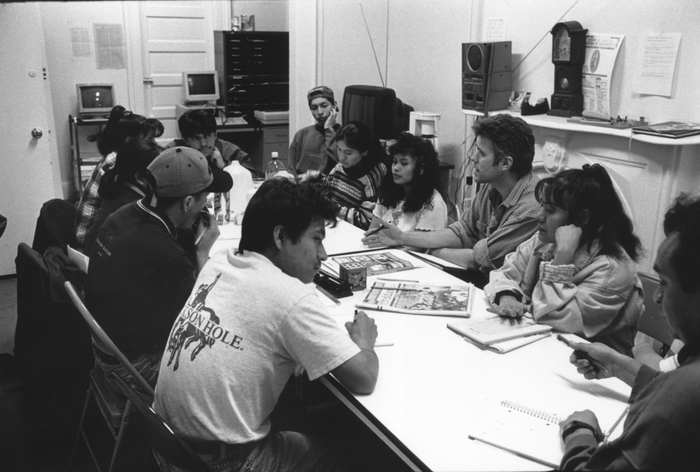
Director David Riker, third from right, working with garment workers to develop La Ciudad

Director David Riker, third from right, working with garment workers to develop La Ciudad

In only 15 years, this important movie that features a series of stories about undocumented immigrants in the United States – “a treasure,” according to Roger Ebert, “simply a great film,” from the Washington Post, and compared with neo-realist classics by Variety – became virtually unseeable, with a few worn prints in circulation and the DVD release out of print, its company having folded.  This particular story is a highly valuable one for media educators and students to explore, because it touches on many issues of great importance to 21st century mediamakers: newly developing funding resources and methods, direct pitches to audiences, film preservation, and social issues addressed in movies. Another important corollary to this story is that it ties in with one issue that media teachers have to deal with constantly: reminding students of the necessity to carefully preserve and archive their own work.  Are you making copies and keeping track of them?  Do you control the formats and have access to them?  I find that often enough, the answer is no.  Students often do not pay enough attention to this, and from time to time, former students contact me asking if I have copies of their work.  “Well, I’ll be happy to check,” I say, wanting to add, “and do you remember the first things I went over when we started class?  And telling you that there’s a decent chance you will be creating treasures that will be priceless to you in years to come…”
More Lost Treasures

Empty Reels

Discovering Lost Reels (photo Carl Casinghino)

An important theme in the study of motion pictures, from the long gestation that led to the first projected movies to today’s dazzling array of effects and sensory enveloping platforms, is the preservation and restoration of lost classics of the cinema.  In earlier posts, such as Treasure Troves from a few months ago, new discoveries by film preservationists and scholars were highlighted in these pages.  Now it appears that, in addition to Too Much Johnson, another of Orson Welles’s lost or unreleased works may see the light of day: The Other Side of the Wind.  The complex tale of its fate is discussed in a new article in the New York Timesinvolving family members of the shah of Iran, 1083 hidden reels of film in storage, an artist drawing on decades of life for inspiration, a director stealing movie prints and escaping in an unmarked van, and much more.  Producer Frank Marshall (a cofounder of Amblin Entertainment with Steven Spielberg) and director Peter Bogdanovich (The Last Picture Show, Paper Moon, What’s Up Doc and a great supporting role on The Sopranos) are working on completing the unfinished edit of the movie.  Among the movies highlighted for study with Moving Images are Touch of Evil and Citizen Kane; whether The Other Side of the Wind will be or not, in whole or part, remains to be seen, while the full cut of The Magnificent Ambersons can remain the lost treasure that will always be lost…

Matrix-fullA year ago, I wrote a post addressing new research and developments in ongoing analyses of the effects of media violence – from motion pictures to games and more – on young people (and everyone else too!).  Since then, an important new study has emerged that provides a new snapshot of attitudes from a variety of groups regarding the effects of media violence in its many forms.  Check out this article describing the Ohio State University study published in Psychology of Popular Media Culture that indicates “there is a broad consensus that violent media increases child aggression.”

shortoftheweekLooking for some short films for new material in a variety of genres?  Check out Short of the Week, where there are many great selections here and the articles accompanying the movies are a real plus.  For starters, you might want to check out The Nobodies, by Greg Bratman and Dusty Brown, who are definitely not nobodies.  Navigate to “Playlists” for their award winners for the last few years as well as Sundance winners and such categories as sports and new media.

Bond…James Bond?

Bond…James Bond?

One of the primary uses of ADR – discussed in Chapter 3 (Sound and Image) of Moving Images – is for dubbing the original voices of a movie into the language of the country in which that motion picture is being distributed, whether for cinemas, television, video games, or whatever platform for which it has been made.  For most Americans, the term “The Fine Art of Dubbing” might seem like a joke since it is not so prevalently used (except for animation) and a great deal of the dubbing that is done is not particularly effective (such as the longstanding tradition of ridiculously bad dubbing in certain Asian martial arts movies).  However, in much of the world dubbing is taken very seriously and the quality can be exceptional.  Here is a very interesting and eye-opening portrait of the work of a dubbing specialist, German actor Dietmar Wunder (the previous link is to the New York Times article and accompanying video; here is just the video).  He is most famous as the German voice of Daniel Craig’s James Bond.  Like with my previous blog posts about the work of the foley artist or sound designer, these resources can provide compelling explorations into the worlds of sound in moviemaking.