 If you are looking to review media literacy analytical resources that might be useful for the upcoming school year, this hour-long Frontline piece from this past semester can provide useful perspectives on the generation in our classrooms today, christened “Generation Like” in the title to this PBS documentary. Hosted by author and mediamaker Douglas Rushkoff who writes, “Generation Like explores how the perennial teen quest for identity and connection has migrated to social media — and exposes the game of cat-and-mouse that corporations are playing with these young consumers.” Also take a look at my earlier post which includes a lesson plan created for the Frontline exposés Merchants of Cool and Digital Nation and may provide guidance or ideas for similar lessons with Generation Like.
Archive for the ‘Resources’ Category
Screenwriting Resources
Posted in Chapter 3, Chapter 7, Resources, tagged Adobe Story, Celtx, Final Draft, Paris When It Sizzles, Screenplay format, Screenplay Template Microsoft Word on June 29, 2014| 2 Comments »
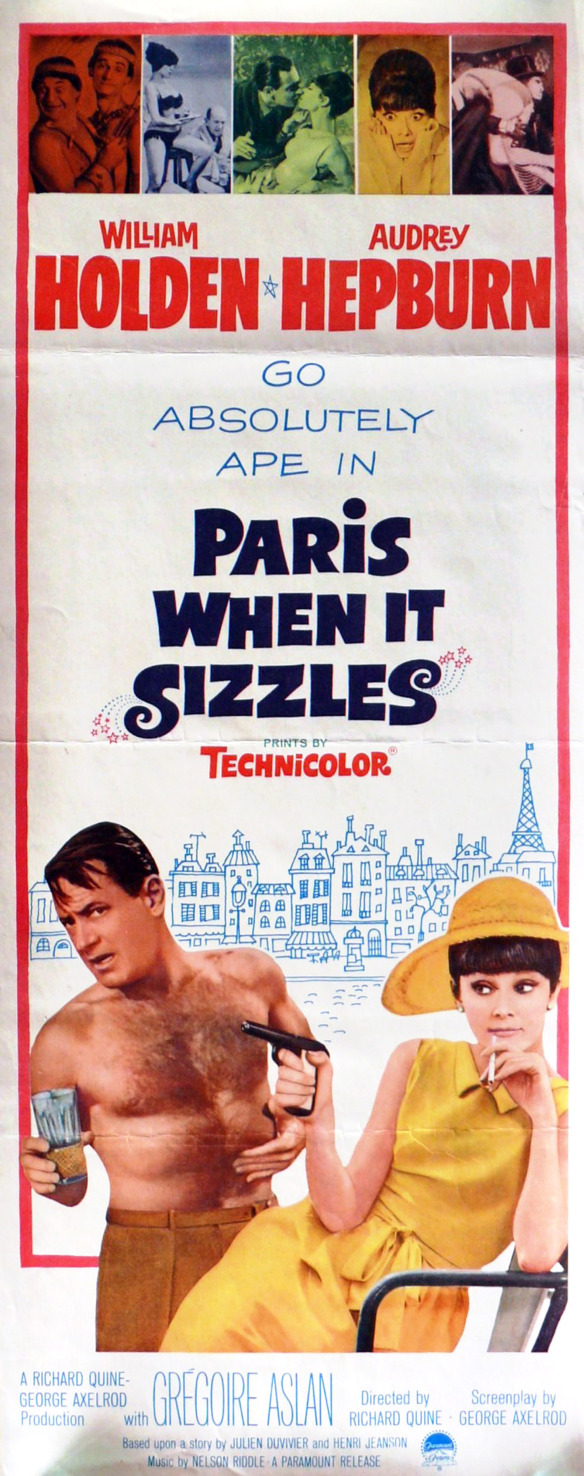
Summer Movie about Screenwriting: Sizzle in Paris with Hepburn and Holden as they work to get the creative juices flowing
Chapters 3 and 7 (Sound and Image and From Page to Screen) are the sections of Moving Images that deal most explicitly and directly with screenwriting. One of the topics introduced in Chapter 3 and pursued further in Chapter 7 is that of screenplay format. Currently, there are many programs available to set up writing for proper screenplay format, such as Celtx (which offers a freeware version), Final Draft, Adobe Story, and many others. Educators or students may wish to invest in any of these or access freeware versions, but here is another easily accessible option. Microsoft Word can be programmed so that through the style settings the basic components of a script are ready to go.
Would you like a copy that is prepared for you? Here it is: Screenplay template. The titles for screenplay components in this document are those that I have used in Moving Images and are described in the definitions and descriptions in Chapter 3 (p. 101-106) and Chapter 7 (268-271). This Word doc template has been set for Courier; you may have to change the font settings to Courier New depending on your version of Word. Please review the style settings, because they can be problematic between software versions and they might need review or updating. In addition, here is a template for a two-column script.
National Core Arts Standards
Posted in Resources, tagged Americans for the Arts, media literacy, National Coalition for Core Arts Standards, National Core Arts Standards on June 4, 2014| Leave a Comment »
 Today, the The National Coalition for Core Arts Standards, in partnership with Americans for the Arts, released a set of national standards for the arts, including Media Arts. Here is a link to pages that provides documents and resources for these standards. In reviewing these standards, it is clear that they are well aligned with national media literacy standards highlighted in the pages of this blog and that formulate the core principles of Moving Images and the coursework provided with this textbook.
Short News
Posted in Resources, tagged Alice Herz Sommer, Anders Walter, Film Shortage, Helium, Kim Magnusson, Malcolm Clarke, Mr. Hublot, The Lady in Number 6 on April 24, 2014| Leave a Comment »
 This year’s Academy Award winning shorts are featured on this page from the Film Shortage site, which is based out of Montreal (and to share with French teachers, Film Shortage has a Films de Chez Nous section featuring some Québecois shorts). There are interviews with Kim Magnusson and Anders Walter, who won for the live action short Helium, and I also recommend checking out the other winners, the animated French movie Mr. Hublot and the documentary short The Lady in Number 6 (directed by Malcolm Clarke about 109-year old Alice Herz Sommer, who was the oldest living Holocaust survivor and pianist). Many shorts are featured on the Film Shortage site and filmmakers can submit movies as well.
The Winter Olympics and Media Literacy
Posted in Chapter 5, Resources, tagged Andrei Tarkovsky, Hedgehog in the Fog, Mark McMorris, media literacy, Monty Python's The Meaning of Life, New York Times Video, Olympic Games, Sochi, Winter Olympics 2014 on February 7, 2014| 1 Comment »

Where Winter Olympics meet young filmmakers: snowboarding videos
Sochi 2014 is here! There are so many topics to discuss, whether concerning cultural perspectives, world languages, geography, human rights and equality, world history and international relations, and, of course, sports, among many other angles. For media literacy perspectives on the Games, I am posting right here a new lesson activity that works with Chapter 5 of Moving Images: Critical Notebook 5b. This exercise encourages students to apply principles of media literacy to the images that they see as they watch the Olympics – from the personal interest pieces to direct sports coverage to commercials to power outages.
 As we discuss or write about how we “experience” these Winter Olympics (or any similar event) from afar, it is particularly useful to raise questions about concepts that are at the core of the Olympics themselves: how does one interpret these events differently in another country or through contrasting media sources and visual traditions? Students should be encouraged to seek out media from across the globe in relation to coverage of specific sporting events or ceremonies, sports figures, and commercial interests. It can be highly enlightening to discover new perspectives on familiar institutions, events, or phenomena. Including commercials.
I also recommend the continuously evolving video resources of the New York Times, which include a piece on snowboarder Mark McMorris that might be a big hit with high schoolers.
 P.S.: I have to add that, on a personal note, whenever I watch an Olympics opening ceremony in the USA (and I have seen them from the vantage point of other countries, where the coverage is so very different), I am reminded of the lines from the Grim Reaper in Monty Python’s The Meaning of Life: “Shut up… You always talk, you Americans. You talk and you talk and say ‘let me tell you something’ and ‘I just wanna say this’.” Couldn’t we ever just watch the actual ceremony in America with its actual soundtrack? Do the commentators really need to be blabbing on about whatever comes into their heads while these amazing images from out of Tarkovsky and Hedgehog in the Fog are gorgeously floating by on the screen? It’s really maddening at times.
 mediateacherdotnet