Matthew Myers has served as a producer on such notable independent movies as Then She Found Me (directed by Helen Hunt), Griffin & Phoenix, and Speak (starring Kristen Stewart), as well as the upcoming Ned Rifle, by noted indie director Hal Hartley and featuring Aubrey Plaza. Myers began his career as a Unit Production Manager, including supervising production and post-production on Hartley’s award winning feature Henry Fool. He also produced the film adaptation of author Katherine Paterson’s novel The Great Gilly Hopkins, directed by Stephen Herek and slated for release in 2015.
Did you have any particular inspirations relative to moviemaking early in life or during your years in school? What was your initial path on the way to becoming a filmmaker?

Matt Myers (at right) demonstrates the finer points of producing to David Wintersteen on the set of The Great Gilly Hopkins
I get asked this question a lot. I have to say that The Wizard of Oz and the original King Kong were two of the first pictures I remember inspiring me to take a closer look at the mechanical creativity of film production. As a kid I was obsessed with deconstructing those movies—how they worked narratively, emotionally…and physically. Those two pictures made such an impression on me and really captured my imagination. I remember watching them on television every year with my grandfather, who was a big movie fan. He had first seen these old classic pictures in the cinema during their first runs and read about them extensively. He ruined the illusion of the Wicked Witch of the West melting in front of my eyes by informing me that they just tacked down her dress and lowered her through the stage floor. That blew my mind and I became extremely eager to learn more about ‘the man behind the curtain’ so to speak—the physical production.
In what ways did you first become involved in making movies?
I was in Pittsburgh, freshman year of college. I was 18 years old and I was strolling along downtown, and I just wandered into a low budget MOW (Movie Of the Week for TV) called Alone in the Neon Jungle starring Suzanne Pleshette and Danny Aiello. The director was Georg Stanford Brown. I saw all these trucks, lights, tons of people on the street and I kind of just crashed the set. I worked for free for a couple of weeks in the wardrobe department whenever I could make it or skip class (nobody turns away free labor!), and then, eventually, they gave me a little money to dress the cop extras for big crowd scenes. I was hooked immediately.

Produced by Matt Myers
How did you move on from those initial steps? What were some useful lessons you learned through your first experiences with motion pictures?
I had never been on a movie set before as someone who was actually doing the work—actively participating in what goes up on screen. I had only casually observed movies being filmed, but being part of a crew, even in the lowest possible echelon, flipped a switch for me. I learned that this was a business. A real business that operated only by the physical labor of a lot of people whose livelihood depended on it. And by and large, even though it was a job it didn’t feel like a normal job, and that’s what really appealed to me. Even today, I still can’t believe they pay us the kind of money we get to work in the movies. And it’s hard work. Very hard work. But when it’s all done, there is a real satisfaction to it, a genuine sense of accomplishment. And you can’t wait to do it again.
Initially, you worked as a Unit Production Manager. How was the transition to Producer?
It was a gradual process. As a UPM, you bring a specific set of craft and management skills to the table (and everyone has their own style about this); but basically, you have to be the adult in the room who knows the machine, how it works, how much it costs, etc. And typically you are reporting to a Line Producer or other supervisors who are the architect of the production plan. The job of the UPM is to manage, plan and execute at the most detailed level—the smallest of details to make the picture. The Line Producer (and often the two jobs are intertwined at lower budgets) is (hopefully) linking those small details to the larger and more complicated goals and creative ambitions of the picture, as they are collaborated upon between director and crew.
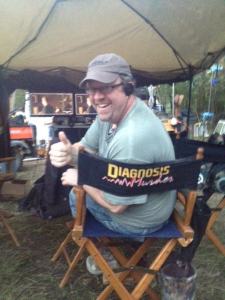 And how did you like working as UPM?
Being a UPM can be a fun job. And, like anything else, it can be hell. It depends on the movie, and who your collaborators are. Generally, it’s a great job to have—particularly if you are a member of the DGA which I happen to be, still—because the pay is excellent and the benefits are solid. Being a UPM is like being the manager of the rock band, so it’s a great place to get to really know the business in all its permutations, and to really understand the complexity of filmmaking as an enterprise.
Speaking of this enterprise, do you have any particular examples of problem solving to illustrate your work?
Problem solving: so many to solve! Everyday is a problem solving exercise where you don’t have enough time or money to accomplish what’s written in the script or how the director wants to shoot it. Our job in the production realm is to collaborate and compromise, while remaining faithful to the narrative objectives set out in the shooting script. Example: The script says “And the villain dangles our heroine over a fish tank full of snapping piranhas”. Well, it turns out 1.) we can’t actually do that practically on camera because obtaining piranhas is difficult in many places due to various laws, 2.) it is impossible to predict with any degree of certainty that we can get actual piranhas to “snap” on command to articulate the specific jeopardy suggested in the script and 3.) we can’t afford to do a full blown CGI-Post VFX gag, which is really the only good option to solve the problem. So, then we start having the conversation: “What is the point of the piranhas in this scene? Why is this here in the script? What’s the storytelling goal here?” Which then delves into all the juicy fundamental aspects of screenwriting, storytelling, plot points, character, etc.—all the stuff we love to sit around and talk about in film school! So, this is the creative challenge: how to articulate a sense of what the script is asking for in the scene (in this case a sense of outlandish jeopardy for the heroine) but somehow still make it work within the context of the dramatic narrative—and do it all on budget and on schedule! Ultimately, after considering many other options—snakes, bugs, alligators, etc.—we settled on….knife throwing! An inexpensive stunt gag with monofilament wires, reversing the shots and removing the wires in post. Still outlandish, but do-able and affordable! Problem solved!
As a producer, what are the most important skills you need in order to succeed?

The feed that helps to oversee the process
Dogged perseverance! A solid sense of storytelling. The ability to multi-task while keeping your eye on the prize. You need to be good with people, know how to communicate effectively and delegate responsibilities and you must be able to spot talent and know it when you see it. Producers have to also be consummate sales people—knowing the marketplace, its industrial trends and models and how to convince others of the potential of a movie within that context. And, most importantly, you have to be a good audience. And be able to take boatloads of rejection—because you are Sisyphus pushing that boulder up the hill, only to have it constantly roll down on you. For every 100 tries, you finally manage to get it over the hill and it’s a movie.
For many people, when they hear the word “producer” in a person’s title, they think that it involves having, raising, or managing money. In what ways is that accurate or inaccurate?
David Mamet famously said in State and Main that an ‘Associate Producer’ credit is what you give your secretary instead of a raise. During the Golden Age, there was a single producer, usually assigned by the studio, to oversee a particular production on the lot. That producer understood all aspects of filmmaking—script development, budgeting, scheduling, casting, marketing, distribution, etc. Nowadays, you see 20+ producing credits. Most of these folks have very little direct involvement in the actual making of the film while some make a tremendous contribution on a daily basis. What’s happened is that there has been a lot of fragmented specialization in the producing realm and thus a proliferation of various types of producing credits—now there are creative producers, dealmaking producers, line producers, hedge fund producers, talent manager/producers, etc. – all prefixed with ‘Executive’ or ‘Associate’ or ‘Co-Executive’ or ‘Supervising’. Anyone who has access to money, resources or talent, labor, tax credits or physical production management is essentially—by default—a producer. And so a lot of the meaning behind the titles gets diluted—executive, associate, co-whatever. They’re all involved in some way, whether they found the money, spent the money or developed the script. But it’s very hard to discern who is ‘THE Producer’. Because they are ALL producers and nobody can produce a movie all by themselves any more.
In our study of media arts, a great portion of our work deals with the collaborative process. In what ways does a producer facilitate this process and how can producers encounter difficulties in moviemaking?

Matt Myers on the set of The Great Gilly Hopkins with author Katherine Paterson
Ideally, a producer is intelligently assembling the artistically and commercially appropriate constellation of stars and talent to make the picture. It’s like throwing a good dinner party. You want to bring together the very best combination of elements, people, resources and creative energy to make the movie the very best it can possibly be, and hopefully, the most critically and commercially successful it can be. As with any creative enterprise, it’s all about the people you bring to the table. The right actor can breathe life into your protagonist, just as the wrong actor can kill it. The right director will have the best vision to helm your script, the wrong director can sink the ship. And so on with every single person involved in the collaboration down the line—from the DP, the Editor, the Production Designer, the Gaffer, the Sound Mixer, the Composer, the production support team—EVERYONE. The difficult thing is: being able to discern talent, yes; but also who is right and who is wrong for the job. There are so many talented individuals out there, but that doesn’t mean they can all play Moses or beautifully shoot your script in 30 days, right?
Can you illustrate any distinct challenges you have faced in your career?
The biggest challenge I always face is keeping focused on the goal. It’s very easy to become distracted with all the politics that govern a movie production, especially when there are millions of dollars involved. The more money, the more politics. Ultimately, the audience doesn’t care about how hard it was—they only care about an excellent picture. Sometimes, there is a lot of disagreement about very specific details in the film—and these details can be very important some of the time, and they can also be minor. But, the challenge is really to keep everyone rowing in the same direction to achieve the best possible end result. That’s the challenge of leadership and management, at all levels of production. You want the crew to support the director creatively, you want the crew to support the budget economically and you want the distributor of the picture to support the marketing and distribution in an intelligent way. All three of those things are tough to do. The challenge we always face is trying to work within limitations—you never have enough money to do what you want to do. So how do we persevere to tell the story? How do we turn liabilities into assets? How do we be creative within very specific, very rigorous constraints?
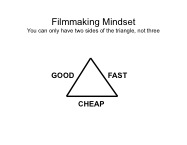 I think the best way to illustrate the challenges of filmmaking is to show this popular image that tells us “Filmmaking Mindset: You can only have two sides of the triangle, not three.”
When you approach a production, what are key steps in the process that you can highlight to us?
The first step is to outline where you want to be with the movie a year from now. Once you get the greenlight, the clock starts ticking right away. We begin with the end: when is the soonest we can bow the movie at a key, major A-list film festival? What does the circuit look like for us based on our start date? What is the target launch date? Sundance? Cannes? Berlin? Venice? Toronto? We work backwards from there because the festival circuit is like a river that keeps on going without regards to the undulating calendars of film production. Once we have that in hand, we can start outlining the most important dates on our calendar: start of pre-production, the dates of our tech scout, first day of principal, last day of principal, picture lock date, final mix date, color correct date, etc. All the way through to the end. You have to impose deadlines—time is money. It’s easy to get myopia—so you have to force everyone to look at the movie from the 30,000 foot view from soup to nuts. Because—as I’ve said—it’s a business. An enterprise. And if the movie is the “product” we have to have an end date in mind. The next step is then to organize all the elements: hiring crew, location scouting, set construction plans, casting supporting roles, closing actor deals, managing cash flow, legal and financial issues, guild and union contracts, tax credits, etc. etc. This is a lengthy pre-pre-production process that typically starts months before actual pre-production begins. And the less money you have in your budget, the more time you need to prepare because you can’t just throw money at the problems.
From pre-production to production to post-production, are there any other facets of the creative and collaborative process that you would like to stress in terms of their importance.
 My god, they are ALL important! Every little gear moves every bigger gear until the whole watch moves to keep perfect time (hopefully). The most important thing to remember at each phase is: what movie are we making? Never lose sight of that. It’s easy to get lost because the process is so slow to get moving, and then suddenly a year goes by at the speed of light and you’re stunned that it’s suddenly coming to an end. We work for years sometimes to obtain a very narrow window of access to the professional production apparatus, and then it all has to be accomplished in a very short period of time. Filmmaking is an expensive paintbox to play with, just in terms of professional labor, so the most crucial aspect is to never forget the goals of the picture when you get bogged down in the granular details. Sometimes it feels like the machine is more important than what the machine can make, that the paint brush is more important than the painting…and that’s when everybody needs to take a big step back and remind each other what exactly we’re trying to accomplish. It’s like a mosaic and everyday we are working on one tile at a time—but over and over we have to periodically try to see the full picture.
What have been some of the most fulfilling experiences of your career? Are there any particular moments that stand out to you?
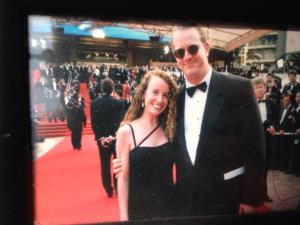
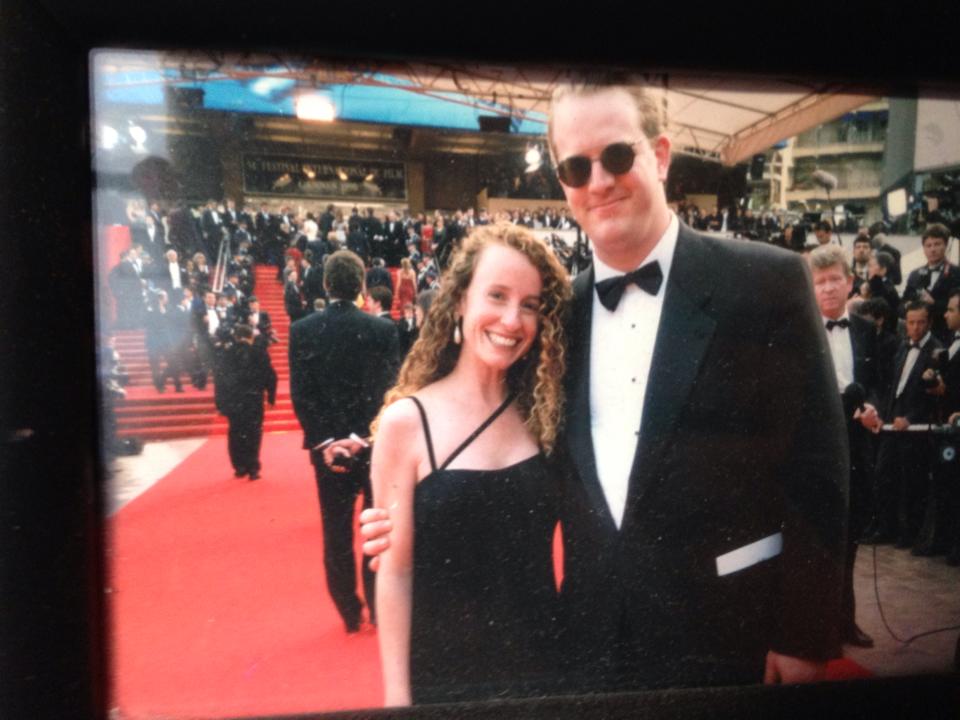
On the red carpet at Cannes
Standing on the red carpet at Cannes with my wife for Henry Fool which would go on to win awards—feeling utterly stunned that all the hard work translated into this moment. We felt like Cinderella. A strange, but exciting feeling. I felt so proud that I got to be involved in that movie. Then the standing ovations and the realization that the movie no longer belonged to us—it belonged to the public and, fortunately, they loved it. Speak at Sundance when victims of date rape came up to us and thanked us for making the movie—that they no longer felt alone in the world. In that moment, I genuinely felt that movies can really change lives, and that the movie really profoundly touched people. Yeah. Those two moments stand out.
Read Full Post »
 In recent months, the importance of safety for all media creators has been at the forefront of discussions of industry standards and production practices and the legal implications of our work as moviemakers in the tragic death of assistant cameraperson Sarah Jones. Director Randall Miller was sentenced to a two-year prison term for involuntary manslaughter for the death of Ms. Jones during a night shoot on the feature film Midnight Rider. As reporter Richard Verrier explains, “The crew was filming a scene – a dream sequence for a movie about the life of Greg Allman of The Allman Brothers. And actor William Hurt was lying on a bed that had been placed on a railway track … the crew had been assured that no trains would be coming down the track, that they had permission to film there from the landowner. And what happened was a CSX freight train came barreling down the tracks and hit the bed and shards from the bed struck and killed the camera assistant Sarah Jones… and injured several other workers.” This piece for the podcast The Frame provides further information and discussion of this tragic incident and its current implications for the industry. However, it should be pointed out that these are not new concerns: Among the most famous cases of loss of life during film production are the deaths of Vic Morrow and two child actors during the making of John Landis’s segment of Twilight Zone, the death of actor Brandon Lee on The Crow, and the death of a stunt crew member for the creation of chase sequences in Christopher Nolan’s The Dark Knight.
  Related to all of this, I am reminded of the classic recurring line from Sgt. Esterhaus of Hill Street Blues: “Let’s be careful out there.” For ourselves, as well as for those with whom we are working and for whom we are responsible.





 mediateacherdotnet