Feeds:
Posts
Comments

Archive for the ‘Chapter 3’ Category

IMG_1704In a post from this past spring, I provided information to support a presentation I made at the 11th Annual Northeast Media Literacy Conference, in which one of the topics I discussed was the development of collaborative skills in the classroom, both as a means and as a goal of learning.  This has prompted me to share a few further thoughts about collaborative processes.

A story from this past school year offers an illustration of the importance of developing a flexible yet rigorous process when completing cooperative tasks in the classroom.

DSC_0959One of my media literacy classes was producing PSAs on the theme of safe driving for teens and the students were placed into groups that I selected.  Often I designate groups for projects, and at other times I allow students to choose their collaborators.  I feel that allowing for both arrangements is beneficial because it forces students to work with a variety of peers while also giving them outlets for independent choice.  These arrangements mirror either work situations when people are inserted into groups or those creative or business opportunities when we can choose our teammates.

IMG_1699IMG_1700Each member of the class had to write a proposal for the 30-second PSA, which could be in the form of a script or a storyboard with shot list and description of the content.  The members had to pitch their ideas to their designated group and then they had to come to a decision on which PSA would be made.  In fact, these clips are so short that it is quite possible for a group to produce two of the proposals, and one group finished their first one quickly and did just that.  As was often the case during this year, a number of the students could not produce a viable complete script for the PSA; this was a class that struggled greatly throughout the year with generating narratives and expressing written concepts or ideas, and this assignment was no exception.

For some of the groups, the students swiftly came to a decision because there was only one viable proposal on the table.  For other groups, there were no concepts that anyone was confident with, so they decided to initiate brainstorming sessions to come up with ideas and then see if they could flesh them out.  In the end, this is how almost half of the groups settled on a story or idea for their PSAs.
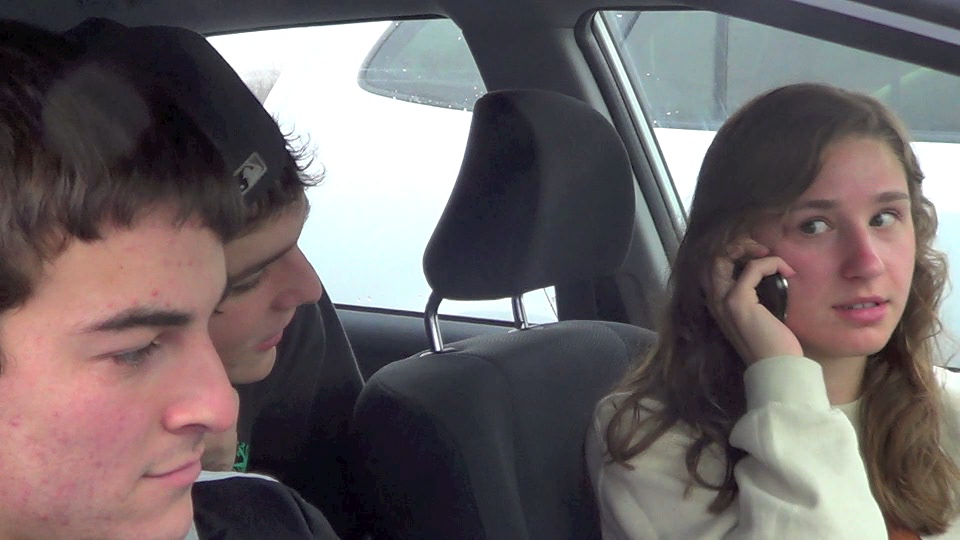
I'm in are you in 2  1For one of the groups with a student who had written a detailed script that she felt confident about, they decided right away to produce her idea.  It centered on a student driver who agrees to give a ride to a friend (which is illegal for beginning drivers), then answers a call when she begins to drive.  It is ended with a third person peeking forward from the back seat to deliver the message of “Are you in?” in relation to good decision-making on the part of teen drivers.   The narrative was a single uncomplicated scene in one location, so they rapidly proceeded to production.  They shot the scene and edited it within a brief time.  From their point of view, they were done.

DSC_0965I watched the “completed” movie and talked about it with them.  Like many projects I have seen in introductory media literacy courses, the concept of “finished” for some students actually amounts to a rough cut.  Occasionally, an entire class will screen their projects on the due date and every single one will be in rough cut form.  That is why for major projects I always have a buffer for “extra time” so that students can learn what it means to tighten or refine a movie into one that resembles a true final cut.

I'm in are you in 1  1In this case, the weaknesses of the initial script combined with lack of focus in the directing resulted in a piece that was nearly incomprehensible.  It was hard to follow the dialogue, and the poor writing choice of having another character suddenly appear made for even more confusion (while this had also been pointed out at the script stage).  We talked about the editing, and, after some evaluation, it was agreed that they did not have the footage to make it much better.  What to do?  In this case, they were fortunate that they had shot so quickly, because they had the time for a complete reshoot.  This allowed us more time to talk about how they could  more effectively communicate their idea.  They replicated the initial shots with some improvements on composition, timing,  and performance, and they also added ideas such as a last shot with a character pointing to the viewer saying “Are You In?” punctuated by a snazzy graphic of the message on the screen.  They reshot, edited, and completed a far more successful PSA.

There are many daunting challenges when facing collaborative learning situations: fairness in assessment, delineation of tasks, group dynamics, power struggles, among many factors.  However, one of the most significant tests for project-based learning in the media literacy classroom is the ability to get to the finish line.  Often, students do not know exactly where the finish line is, and it generally takes organization, determination, and tenacity to develop the skills and strength to be able to see projects completely through to fruition.  It is one of the most challenging tasks for an educator to provide the contexts and support to enable students to strengthen their abilities in creative problem solving and cooperative ventures.  These skills can be enormously beneficial to them in fostering critical thinking, strong writing proficiency, and the ability to meet the diverse professional and personal challenges they will meet in their lives.

Many of these messages are reflected in the interview with copywriter Kevin Goff in Chapter 3 of Moving Images and through the projects for commercials and PSAs with that chapter and in other lessons of the textbook.

Read Full Post »

image-homepage

Admongo: Deconstructing Commercial Messages

As mentioned earlier in this blog, at the 11th Annual Northeast Media Literacy Conference at UConn I am presenting a talk titled “CCSS and Media Literacy in the Classroom: Communications and Critical Thinking through Promotional and Public Service Messages.”  As a service to those attending the conference and to followers of this blog and the Moving Images textbook, here are notes and links included in my presentation.

First, it is important to review principles of media literacy: here are the essentials at the NAMLE website.

Then, on to what educators face as principal challenges in curriculum development today: the Common Core State Standards.  For media literacy professionals, the following descriptions are the essentials.  For Reading Literature:  Analyze the representation of a subject or key scene in two different artistic mediums (RL/9-10:7); Analyze multiple interpretations of a story, drama, or poem (RL/11-12:7).  For Reading Informational Texts:  Analyze various accounts of a subject told in different mediums (incl. multimedia).. (RI/9-10:7); also, integrate and evaluate multiple sources of information presented in different media or formats (e.g. visually, quantitatively) as well as in words in order to address a question or solve a problem (RI/11-12:7).  For Speaking and Listening, students must make strategic use of digital media (incl. audio, visual, and interactive elements) in presentations to enhance understanding of findings, reasoning, and evidence and to add interest.  (SL/9-12:5)  Finally, in History/Social Studies and Science/Technical Subjects, learners have to make strategic use of digital media (incl. audio, visual, and interactive elements) in presentations to enhance understanding of findings, reasoning, and evidence and to add interest.  (SL/9-12:5)

MerchantsCoverFor resources specific to the investigation of commercials, one of the best places to begin is at Frank Baker’s Media Literacy Clearinghouse, where there is a homepage for materials on critical thinking about advertising.  For educators of elementary and middle grades, there is the Federal Trade Commission resource Admongo, which features many exercises and lessons.  From my own materials related to Moving Images, there is an extended interview on this blog with advertising copywriter Kevin Goff, and links to commercials can be found.  These can be evaluated using such models as those of the Instructor’s Resources with Moving Images or this lesson from the MLC pages: Deconstructing a TV ad.  Recent ads have come under quite a bit of scrutiny, such as the commercials during this year’s Super Bowl.

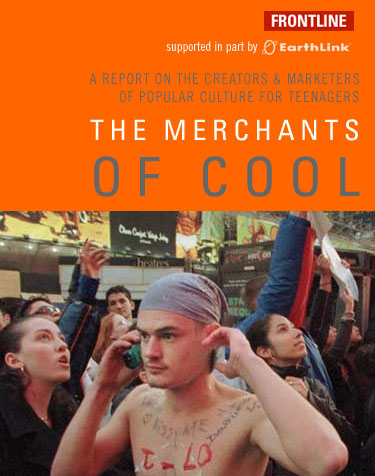
Other examples used during the presentation are for investigative work done by students using such exposes as PBS’s Merchants of Cool and Digital Nation and Media Education Foundation’s Killing Us Softly and The Bro Code .   Using selected parts of these media reports as a basis, students must research topics offered by their teachers and create presentations based on the media questions that are most appropriate.  The attached Unit Activity GuideCritical Analysis 5b Lesson Plan – was drafted for work with Merchants of Cool and Digital Nation in conjunction with Chapter 5 of Moving Images.

As for examples from my classes that are shared during the presentation, those are for attendees – so I look forward to seeing some of you media literacy educators there!

Read Full Post »

The Conversation: Sound Design Walter Murch

The Conversation: Sound Design Walter Murch

Do you want to know more about the basics of sound in contemporary moviemaking?  Here is an excellent talk titled 40 Years of Sound for Film given by Chris Newman (production sound mixer on such movies as The Godfather and The Silence of the Lambs) and Tom Fleischman (re-recording mixer who received the Academy Award for his work on Martin Scorsese’s Hugo).  In the piece, they discuss classics such as The Godfather and McCabe and Mrs. Miller and explain their perspectives on what digital technology has brought to the world of sound.  It is an excellent introduction to the current state of sound and can serve as video accompaniment to Moving Images Chapter 3: Sound and Image.  

Among the movies suggested for analytical work in the Moving Images Instructor’s Resourcesa trio by the Coen Brothers is worth highlighting for investigation in the context of sound: Raising Arizona, O Brother Where Art Thou?, and True Grit.  

Sound Designer Skip Lievsay working with Avid MC Mix for True Grit

Sound Designer Skip Lievsay working with Avid MC Mix for True Grit

All three feature the work of renowned sound designer Skip Lievsay and are also rich examples of the distinctive brand of “American Tales” that are at the core of much of the Coen brothers work, in which they have continued to explore and develop deep traditions of regional storytelling featuring distinctive narrative voices and exploring complex themes at the heart of the frontier experience and American culture.  They also offer strong links with cross-curricular connections: the short stories of Mark Twain, Bret Harte, Ring Lardner and other darkly comic narrative masters compared and contrasted with Raising Arizona; Homer’s The Odyssey for O Brother, Where Art Thou? (or Preston Sturges’s Sullivan’s Travelsthe cinematic source of its title); and the original Portis novel for True Grit; meanwhile, social studies connections also abound in these movies, particularly for O Brother.  Depending on classroom context and objectives, other movies from the Coen Brothers’ filmography can be quite worthy of investigation, such as No Country for Old Men and Fargo, but these first three are more appropriate for use in a high school classroom (all are PG-13).  Here is an extra for teachers – a worksheet for use with Raising Arizona: Critical Notebook 3c Raising Arizona.    

Director Christopher Nolan with Leonardo DiCaprio and Ellen Page on Inception

Director Christopher Nolan with Leonardo DiCaprio and Ellen Page on Inception

Another recent award-winner with rich classroom applications is Christopher Nolan’s Inceptionwhose sound teams won the 2010 Oscars for Sound Mixing and Sound Editing.  For the first award, three people were there to receive Oscars: Lora Hirschberg, Gary Rizzo and Ed Novick.  Why three?  Lora Hirschberg is re-recording sound mixer for effects and music, Gary Rizzo is mixer for dialogue and foley effects, and Ed Novick is the production sound mixer.  For Inception’s second sound statuette, sound designer Richard King won for editing.   Here are interviews with Lora Hirschberg and Ed Novick, and this is a page with many articles for Gary Rizzo on the site Designing Sound; in addition, here are a print interview and a short video about sound design with Richard King.

Ben Burtt and director Andrew Stanton at the French premiere of Wall-E

Ben Burtt and director Andrew Stanton at the French premiere of Wall-E

Excellent resources for interviews, technical information (such as SFX libraries), and more are available at filmsound.org and designing sound.org.  Among pages about such respected sound designers like Gary Rydstrom and Randy Thom, there are useful articles for a movie that was featured in an earlier blog post on this site: Wall-E.

The sound design on that Pixar movie was overseen by one of the legends of Hollywood sound artistry, Ben Burtt.   Speaking of groundbreaking sound designers, there are also excellent posts by or about pioneer Walter Murch, including these on the Orson Welles classic Touch of Evil  and the importance of sound design for the overall tasks of movie editing.  Of course, sound design is vital to the widest possible range of media platforms, and here is an article on one of the specialists for video game sound design, Jeff Seamster.

Read Full Post »

One of the innumerable lists of best Super Bowl Commercials

Next week is the arrival of one of the key American media events of the year: the Super Bowl.  Talking with people today in the halls of virtually any school or workplace across the nation, there typically seems to be as much excitement about the commercials as the game itself among the millions of people who will be watching the event (clearly, while they are also eating: the Super Bowl has become the second-largest day of food consumption in the U.S. after Thanksgiving and ahead of all the other holidays – so the advertisers are clearly doing something right!… or wrong, depending on your perspective from a health standpoint).

So, I will be updating my extended Close-Up Interview with Kevin Goff, which is featured in Chapter 3 of Moving Images: “Sound and Image.”  Check it out along with the links to some of his finest material.

Also, in celebration of the art of creative advertising, here is a link to an article from Paste magazine that features ads from some of the most celebrated filmmakers of the past few decades (Michel Gondry, Spikes Jonze and Lee, Sofia Coppola, Wes Anderson, and others).  Soon, the juries will be out on a new slate of “Super Bowl Commercials,” which sometimes seem to be more passionate debates than about the merits of the game itself!

Read Full Post »

In Chapter 3 of Moving Images, sound is the primary topic of the unit, and the concluding sections deal with the introduction of advertising and a promotional project for students.   For the interview at the end of this chapter, I contacted a former student of mine who has gone on to a highly successful career in advertising.  Besides being an extremely talented advertising copywriter  and associate creative director at DBB in Chicago,* Kevin Goff provides another inspiring example: a very nice guy who makes it big.  Moreover, there are a couple of classroom moments from when he was in high school that I will never forget.  First, when we were doing an initial brief in-class project that is designed so that students can get their hands on the cameras and start getting used to filming, Kevin was in a group working at the back corner of the room, essentially a little closet that was about three feet wide.  In this cluttered, tiny spot, Kevin — who hadn’t really done much in video until then — directed this amazing little piece (and he was behind the camera) that immediately grabbed the viewer’s attention because he had a jaw-dropping sense of where to place and how to move the camera.  Later, his final project for this introductory course was exceptional: he created a take-off from the Lara Croft: Tomb Raider video game that was dynamic, funny, strikingly shot, and clearly the work of a budding ad man: the twist at the end was that it was a “Got Milk?” commercial.  And this was made well before the Lara Croft movies starring Angelina Jolie!

Here is the full interview with Kevin Goff, whose credits include internationally recognized projects for clients such as McDonald’s, Capital One, Budweiser, and State Farm (and another).

McDonald’s “No Fry Left Behind” ad won many international awards

What drew you to working in motion picture communications?

I’ve always enjoyed the art of storytelling- be it written, or on film. Advertising provides me with the opportunity to craft stories around a variety of products and human truths. Every day is different, with a different challenge and a different story to tell. As a creative, that’s a fun playground to be in.

What were some useful lessons you learned through your first experiences writing and producing motion pictures?

There’s no right answer. But there are countless wrong answers. And you’ll eventually find countless examples where that’s true. For example, a joke on a script that we’ve been laughing about for weeks, even through auditions, comes out flat when the camera starts rolling. The belly laughs are suddenly replaced by crickets. There’s no explanation for it, but it doesn’t really matter why it’s happening. Because it’s not happening. And you better start writing. Fast. I highly recommend going into a shoot with a good list of prepared alternatives. (They’re easier to write when you don’t have the client, director, producers, and entire film crew waiting on you to be funny.) You never know – an alt may be better than what was originally scripted. But you won’t know until the shoot, or even until you start editing.

What are the standard key positions and the basic work flow for a 30- or 60- second spot?

As a copywriter, a project begins with us getting briefed. We’re told what the assignment is for, the message we’re supposed to communicate, and how much time we have to communicate it – 15, 30, or 60 seconds. It’s then up to us to conceptualize and write an effective, memorable, and entertaining commercial that can be completed on time and within budget. Many scripts will be written, and should one sell, we begin the production process.

Working with a producer, we’ll look at directors and find three or four who we feel are a good fit for the job. We’ll talk to each director about the script, discussing what we envision. After the call, the director writes a treatment for the spot. It’s the director’s chance to present what he envisions the spot to be, and how he wants to tell the story. The agency will take each treatment, and each director’s reel and recommend one director to the client. Once the client buys off on the director, a casting agency the director works with begins casting. We’ll eventually go through casting tapes of actors acting out parts in the script, selecting who we’d like to see called back for another casting session.  Once at callbacks, the director has a chance to work with the actors and we all get a better feel for their abilities and can better judge if they’re the best actor for the role or not.  At the end of the day, or days, the director and agency selects a cast, sometimes with back-up choices should the client have an issue with someone.  We’ll also go over the director’s shooting board and shooting locations, as well as props and wardrobe.  Soon, it’s time for the pre-production meeting.  While the agency and the director are all on the same page at this point, the pre-pro is designed to get client approvals on everything.  Once the client signs off on everything, it’s time to shoot.

Come shoot day, the director runs the shoot.  But the agency makes sure they’re getting the performances and shots they need.  While a spot often evolves for the better, the client bought a script, and the agency needs to cover what was boarded and sold.  That said, I’m still writing new lines on set as the camera is rolling.  You have to cover what you sold, but options are good, and those options often turn up in the final cut.

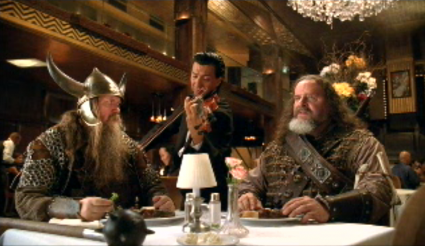
Capital One Triple Rewards sold by “Barbarians”

After the shoot, the film is sent to an editing house for an editor to cut.  The editor will cut several versions of the spot to show the agency, and from there, the agency chooses a cut and starts tweaking- trying different shots, adding frames to shots, etc.  This is also when music becomes an issue.  We’ll use scratch tracks as fillers, and eventually either hire a music house to score a piece of music, or find a piece of stock music to drop in.  On occasion, we’ll license an artist’s music track.  With a spot assembled, we’ll bring it to the client to sell the cut.  With the client’s approval, we move on to recording company to record voice-overs, and mix the spot.  The sound engineer begins sound design, adding ambient sounds, music tracks, voiceovers, and adjust levels of all sound, while the agency tweaks and approves it.  With the spot mixed, it’s on to another post-house for the telecine.  Here, the agency works with a colorist to color correct the film, and then finish it, cleaning up the film by applying minor special effects, and adding any necessary legal copy.  With the client’s final approval, the spot ships, and it’s onto the next spot.

Can you cite an instance when you were able to find a visual solution to a storytelling issue?  

I was working on an assignment involving a movie promotion for a major restaurant chain. I needed to find a way to tell a story that linked together the restaurant chain with the motion picture, and do it in a way that would get people excited to go buy the food and go buy a movie ticket. Additionally, the spot would be running globally so I had to find a solution that didn’t rely on dialogue.  Not surprisingly, months went by where no one was able to sell a script. If one side liked a script, the other side didn’t. It’s how these promotions usually go. Eventually I sold a script that satisfied everyone. It was a purely visual comparison of the similar sensory experiences people would enjoy while watching the film and while eating the food. For example, I compared how someone watching an intense action scene in a theater might grip the arm rest of the seat their sitting in, the same way someone might grip their bag of food if they were worried someone was going to steal it.

How do you balance visual storytelling in your pieces with the importance of sound in establishing tone and style and in communicating key information?

There’s more than one way to tell a story. You can do it purely through visuals, without any sound. But you can also tell the same story purely through sound, without any visuals. The balance of visual and sound ultimately comes down to the story you’re trying to tell and how you want to tell it. Any stimuli you choose to include, or choose to omit, communicates something to your audience. It’s up to you to determine just the right combination of stimuli to communicate your story in the most impactful way.

Sound is important in every project I’m involved with. From the music and sound effects, to the dialogue and voice talent, sound is vital to the communication. Music can evoke a variety emotions, add energy- or remove it, and even set a pacing for the film. Sound effects simply help explain what you’re seeing on film, adding a texture to the visual. Voice talent can be a challenge. Male or female. Old or young. And all the different voice qualities you can think of- the slightest variation of which can mean the difference between feeling authentic or fake, and getting laugh or getting crickets. It’s common to audition as many as 400 or so voices just to get the right one. Because without the right voice, the spot might simply not work. Sound is a sensitive thing. It usually works or it doesn’t. And you don’t usually know if it works until you see it put to picture.

What have been some of your observations of the filmmaking process?

Have an opinion. And have a reason for it. Because everyone has an opinion- some good and some bad. Listen with an open mind. Then listen to your gut.

Once you start shooting, anything can happen. Actors you thought could act- can’t. Lines you thought were funny- aren’t. You go from being ahead of schedule, to 4 shots behind. And weather that’s sunny and 80, is suddenly a flash flood washing your set away. Filmmaking is a fluid process. You have to roll with the punches and find solutions- fast.

What have been among your most fulfilling experiences in promotional moviemaking?

Creating television commercials that make people think about something in a way they’ve never thought about it before. And in a way that doesn’t make them want to change the channel.

* Currently (2014), Kevin Goff is a Senior Copywriter at Arnold Boston, where he has produced work for Produced Work For: New Balance, Volvo, Carnival Cruise Lines, and ADT Security.  

Read Full Post »

« Newer Posts - Older Posts »