
Rachel McAdams in production still from Brian De Palma’s “Passion” shot in 35mm, victim of a digital mishap at 2012 NYFF
Catastrophe at the 50th New York Film Festival: for a gala opening of Brian De Palma’s Passion, just as the screening was about to begin, the digitally based copy … wouldn’t play. The projectionists frantically tried to get the Digital Cinema Package (DCP) to work – it had functioned earlier in the day – but it just would not run. They did not solve the problem, and the movie was not seen, which was disastrous for the festival and a major letdown for those in attendance, notably director Brian De Palma.

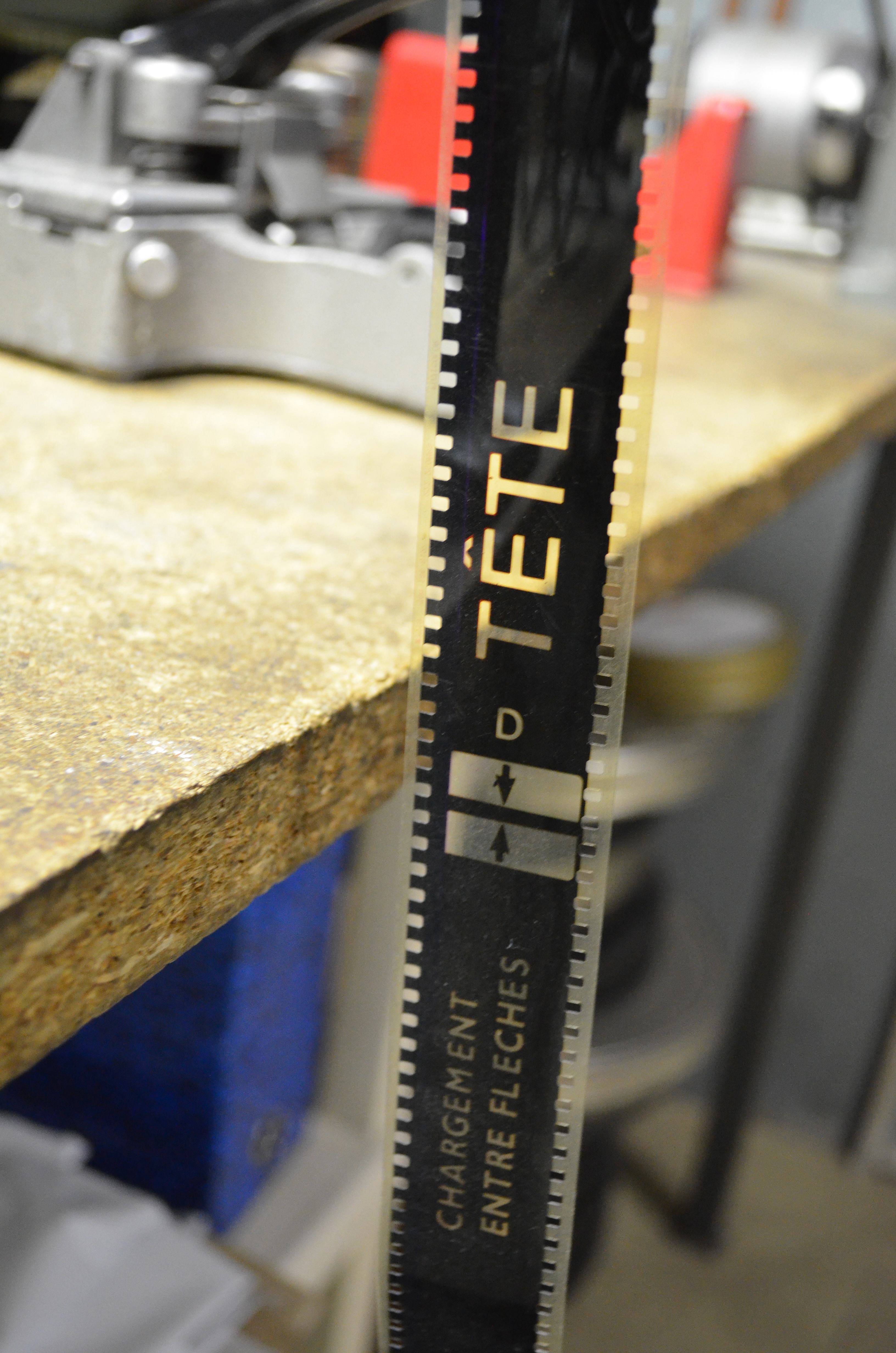
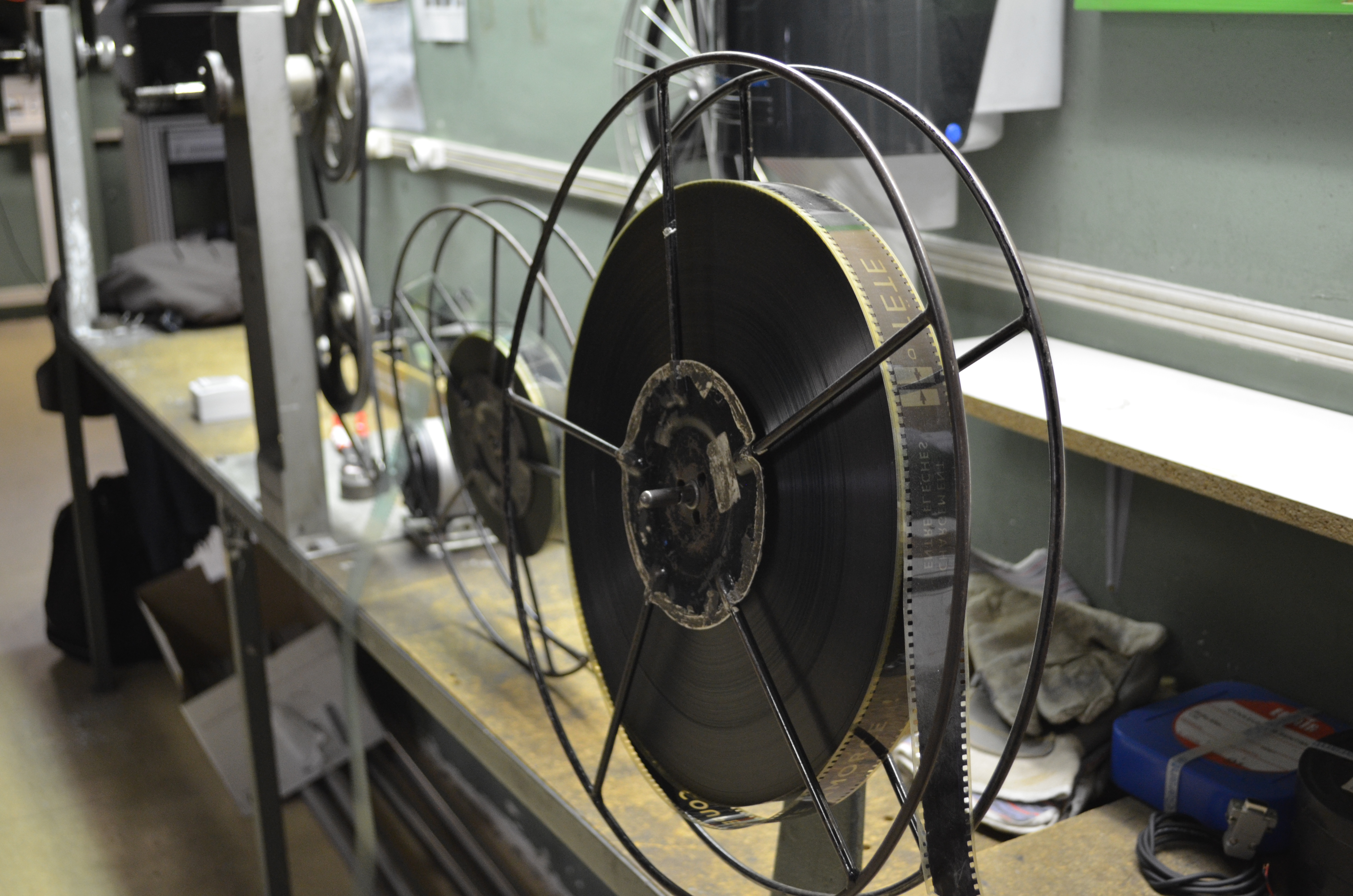
Stills from Studio Cinemas in Tours, France (photos Carl Casinghino)
In earlier posts, I have discussed the recent flurry of articles, movies, and general discussion about the enormous changes in media creation through the shift to digital moviemaking and projection; in particular, declarations of “film is dead.” (I recommend this discussion between Manohla Dargis and A.O. Scott from the New York Times.) In fact, when I looked up information on the Passion premiere debacle, I ended up on message boards of digital projectionists and obsessives who were all dismissive of the failure at the NYFF and saying, essentially, “oh, so what” and in any case…”film” pretty much doesn’t exist any more.
 One point I have not seen raised anywhere is the fact that the key to this entire discussion is linguistic. At the time of Edison’s Kinetoscope and the Lumière Brothers’ Cinematograph, the word in English used for a transparent, supple, thin strip of celluloid (later polyester) coated with a light-sensitive emulsion was “film.” When moviemakers took that material and recorded moving images on these bands of “film,” and then began cutting up these strips of celluloid and repasting them together, they were producing something new.
 What to call it? Well, in English, one of the words was “film.” They simply used the same word to describe a motion picture generally intended as an attraction for theatrical distribution, whether a short or feature. They did not make up a new word, although others have been used such as the phrases “motion pictures” and “moving pictures,” shortened to “movies.” But the foremost word that stuck was “film” for these two things.
 So, now since in English we settled on the same word for these two distinctly different concepts, there is a debate about the end of seeing “a film” because you are not watching it “on film.” But what if the words were not the same? Well, they are not in some other languages. In French, the actual roll of film is called “la pellicule” while the thing you watch is “un film”; it is essentially the same in Italian and Spanish. Let us remember what we are debating. The specifics of this argument hinge completely on a linguistic distinction; if there had been another word for this different thing, we would not be having this particular debate, at least not in these terms.

I did face this issue when I wrote Moving Images. I decided generally to call what we are watching “moving images” or “movies” or “motion pictures.” But whatever the case I’ll still sometimes say I’m going to watch a film when I’m going to the cinema; even if it has been shot digitally and is being projected digitally, what I am going to see is at its core the same thing as what people have described as “a film” for over a century.

Digital technicians repair and update equipment at an independent cinema
I would also like to add thanks to Studio Cinémas in Tours, France (soon celebrating their 50th anniversary) for their hospitality and generosity to me during a visit last summer in which I met with Tarik Roukba and Jérémie Monmarché to discuss the role of independent cinemas in France regarding media education and public schools. It was also enjoyable to discuss many topics concerning issues facing independent cinemas in France and throughout the world, including the conversion to digital projection and the archiving of films in the 21st century. I chuckled when I read about the issues experienced at this year’s New York Film Festival, particularly with respect to “disappearing subtitles” for the Mexican film Here and There, which is a problem Studio Cinémas has encountered along with other digital mishaps that plague projections today. Previously, their projectionist could repair equipment and deal with nearly all the technical problems they would face; now they must have technicians come to the cinema to deal with the glitches and breakdowns occurring in the bytes that form our moving images.
Read Full Post »




 mediateacherdotnet