Feeds:
Posts
Comments

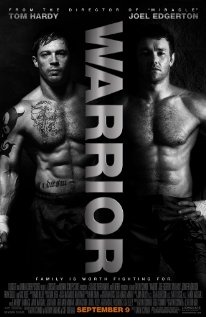
Marketing and visual communication discussion for the classroom: Is this poster effective in communicating the story of “Warrior?” Is this poster going to help to attract the full potential audience for this movie?

From my perspective, one of the most useful movies from 2011 to study in a media literacy class would have to be Warrior, directed by Gavin O’Connor.  In the American press, much of the commentary that I have seen is about the film’s relationship to the traditions of Rocky and similar sports movies (smartly acknowledged by the filmmakers in an offhand dig at character Tommy Conlon/Riordan when he first goes into a gym).  However, a very interesting contrast with that 1976 movie can be studied through the roles of various media in Warrior: the style and omnipresence of television’s high-octane, aggressively promotional nature in contemporary society; the use of social media as a go-to connection between people (in fact, that it is through the Internet that you will be tracked down!); and the importance of audience in the relationships between subjects, media, and events.

The central setting of the movie is one of the most important issues to consider: the mixed martial arts ring.  Its violence is not for every viewer, and that should be the first consideration of the use of this movie, although in current television standards, there is a strong push to normalize mixed martial arts in popular culture.  At its release in the summer of 2011, critics virtually across the board seemed quite surprised that this movie combines the rousing excitement of a sports showdown movie with complex thematic material, from abuse, alcoholism, and family dissolution to military service and the drive to live through violence.  For many viewers, this is a deeply moving motion picture.  I must add that the casting and direction of actors are particularly distinctive: the performances in this movie are simply pitch-perfect.  Tom Hardy has received many justified accolades for his performance and Nick Nolte should be nominated for a Best Supporting Actor Oscar in one of the best performances of his career, but the rest of the ensemble I found to be just as good, including Joel Edgerton in a particularly challenging role, playing a high school physics teacher beset by financial troubles that bring him back into the brutal ring of MMA.  I should add that Joel Edgerton’s brother Nash is the filmmaker who is featured in the interview for Chapter 8 of Moving Images, and their production company Blue-Tongue provides another fine angle for the study of the moviemaking process in conjunction with this chapter, The Production Process.  

Tom Hardy and Joel Edgerton in Warrior: two performances that are more about subtlety and character depth than brawn.

In addition, the movie raises a number of other fruitful topics for classroom work.  First, to investigate the moviemaking process, the bonus materials available on Warrior’s discs provide for an in-depth examination of pre-production and production, including one of the best “making of” docs I have seen (primarily because of excellent filmmaker interviews that avoid most of the fluff typically seen in these pieces).  The development process is described in vivid detail and the perspective of the writers is well explored, including the story’s original setting of Long Beach, California!  There are many other issues providing for fruitful discussion, including the contributions of cinematographer Masanobu Takayanagi (in an astonishing major feature production debut), the rehearsal process, and analysis of footage from the production.  There is also the inclusion of a deleted scene, that, to me, is one of the most painful I have ever had to watch: this sequence belonged so powerfully in the movie!  I can understand the desire of the filmmakers to keep up the pace of the movie early on, but this is a tour de force scene that helps to give more substance to the shared background in the military of Tommy and his father Paddy.  Classroom debate: is the movie already too long?  Do you need the scene?  Can you put it in?  Where?

Second is the role of violence considered from a number of angles: in the mediamaking process, in the values held by contemporary cultures, and in the themes and meanings of this particular story.  One important angle is this: what is the responsibility of media professionals regarding the safety of those working on its products?  There is a great deal of footage in the extras of this movie that show the lengths to which the moviemakers worked to choreograph the convincingly realistic fight scenes.  Recently, I have noticed a trend in celebrating “real violence” as necessary to the realism of media products.  Just this week, I read two articles about movies opening this month in which filmmakers were using the pain inflicted on their performers as selling points to the movie.  For Soderbergh’s movie Haywire, scripted by Lem Dobbs (the writer of Kafka and The Limey, which is one of my favorite Soderbergh films along with King of the Hill, The Underneath, and Out of Sight), when the director talks about his new movie he stresses the effects of actually inflicting the pain.  Talking about actor Michael Fassbender, he says, “He took a beating.” 

In an interview about the release of Contraband, directed by Baltasar Kormákur, actor Mark Wahlberg talks at length about the degree to which they wanted to “just go crazy… like when I get to smash Giovanni Ribisi’s head and pull him through the window of the truck, that was really fun…[and for a scene in the upcoming movie] Broken City… I honestly think it’s going to be one of the best fight scenes ever in a film, because it’s real.”

The first chapter of Moving Images is about motion picture language, which involves learning about the power of editing and basic techniques of moviemaking.  In the classroom, students will sometimes write scenes in which there are physical altercations, punches, or fights.  For some students, it takes a bit of learning to discover that the actors do not need to hit each other in order to create the scene.  In fact, the students are required not to inflict harm or break any school rule when creating media, just as our drama students learn how to stage fights for theatrical productions.  These recent trends in movie culture could provide for potent classroom discussion.
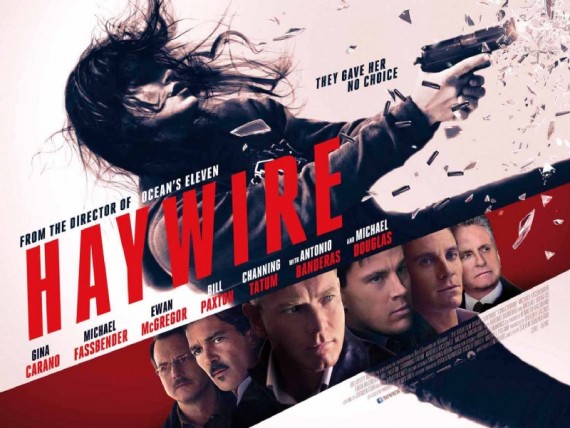
Steven Soderbergh’s “Haywire” with script by Lem Dobbs

Raising the point of editing is one of the major other topics addressed in this debate: in their interviews both Soderbergh and Wahlberg talk negatively about intentionally jarring editing and jittery hand-held shooting, and each one cites the more recent Bourne movies as an example.  In fact, I use The Bourne Supremacy as an example of jump cuts in Chapter 1 of Moving Images.  Now, the tables are turning and filmmakers are vaunting the fact that in their movies the viewer can actually understand the geography and sequence of action scenes.  (Although in the interview with Soderbergh, the reporter uses Doug Liman’s Bourne Identity as the reference, but this is incorrect; it was in the later Bourne movies directed by Paul Greengrass that this highly jarring, non-continuity style was adopted full force.)  Soderbergh says about Haywire, “I don’t think there’s a single hand-held shot in the movie.  We were really consciously going against the grain there, because my feeling is that lately, there has been a way of disguising the fact that the people can’t really do what’s required, and knowing that I had Gina, and knowing that we had cast people around her who could actually do this stuff, we took the conscious position of letting you really see it, not cutting as fast, keeping the shots looser, and having you feel, ‘Wow, that’s really happening in front of us.'”  And when Soderbergh cites a James Bond movie as an influence for this movie, it is Terence Young’s From Russia With Lovewhich sounds good to me, as it’s one of my favorites too!

How styles cycle back and forth!

And as a final note, thanks to my student Dylan Taravella for recommending Warrior and for not giving up reminding me until I saw it.
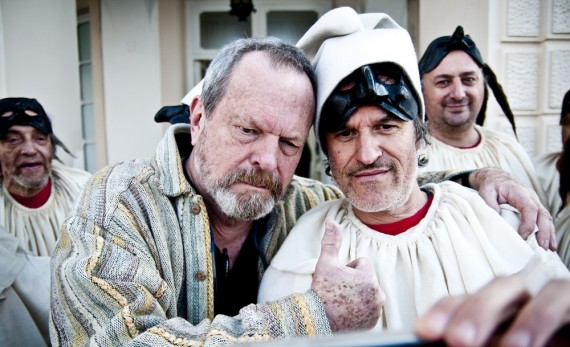
Terry Gilliam making The Wholly Family in Italy

Who funds independently produced movies?  What makes them truly “independent?”  Outside of feature films and television shows, how do filmmakers reach audiences besides posting their streaming videos for free online?  For his recent short The Wholly Family, filmmaker Terry Gilliam – renowned for his work with Monty Python, such classics as Time Bandits and The Fisher King, and my two favorites, Brazil and The Adventures of Baron Munchausenwas entirely funded by Italian pasta maker Garofolo Pasta, and the twenty-minute movie is going to be available streaming by the British newspaper The Guardian.  And here is another good interview with Gilliam about making The Wholly Family; included are comments about shooting digitally and working in short forms.  And these days he is even talking about making The Defective Detective again…

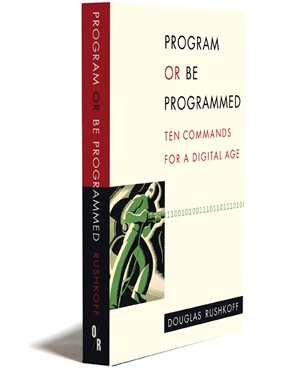
Program or Be Programmed by Douglas Rushkoff

Douglas Rushkoff, primarily known as the media theorist who has written some of the most important books on digital media and the Internet, and who coined phrases such as “viral media,” “digital native,” and “social currency,” has created some of the most interesting and thought-provoking materials for classroom lessons about contemporary media, including the documentaries The Merchants of Cool (which I have used many times in conjunction with my teaching with Moving Images) and Digital Nation: Life on the Virtual Frontier, and his most recent book Program or Be Programmed (this Laughing Squid blog page features videos and an excellent intro to the book).  Last summer, Rushkoff was a keynote speaker at the 2011 NAMLE conference in Philadelphia at which I presented a workshop on integrating media literacy and digital production in the classroom.  Rushkoff’s speech was engrossing and quite funny; moreover, I was impressed by his participation in the conference – he paid close attention to the people and events over the course of the weekend and was clearly connected to what others had to say and do.

A.D.D.: by Rushkoff and illustrator Goran Sudzuka

At the end of this month, a graphic novel he has written with illustrator Goran Sudzuka, A.D.D.: Adolescent Demo Division, is being released by Vertigo.  What a perfect concept for Rushkoff – a cyber-driven story composed of text and visuals about adolescent gamers who are being manipulated by a future society and must uncover the secret agendas and codes of their world!  Graphic novels continue to be one of the most dynamic media around – one of the nice surprises that as the world goes digital, drawing continues to make a comeback in innovation and inspiration – and the relationship between comics and moving images offers boundless potential for visual storytellers and learning scenarios.  There is an excellent interview with Rushkoff  about the book on his website.

Poster created from iconic images by artist Saul Bass

Just recently a definitive, in-depth book on the design work of artist Saul Bass has been released: Saul Bass: A Life in Film & Design (by Jennifer Bass and Pat Kirkham).  Bass was a true media innovator and through his work one can observe the synergy between text, composition, color, movement, and other visual elements at the core of effective communication.

Bass’s work has provided inspiration for generations of design professionals, advertisers, and filmmakers.  The dynamism of his designs were key as filmmakers invigorated the function and importance of title sequences in movies, and his work helped to usher in the mid-century modern style that has seen a renaissance in recent years, from advertising to graphic novels to animation.

Bass’s storyboard for the infamous and extremely influential shower murder scene from Psycho is highlighted in Chapter 1 of Moving Images (see Figure 1-36).  The half-hour movie Bass on Titles provides a good overview of his work and viewpoints on the craft of movie titles, such as his groundbreaking work for a number of Alfred Hitchcock films (such as Psycho, Vertigo, and North by Northwest), Scorsese movies (including Goodfellas, Cape Fearand The Age of Innocence), and many others including The Man with the Golden Arm and Cowboy.  His work can provide examples for many aspects of the essential questions in Moving Images, including motion picture forms in Chapter 5 and the full production process in Chapter 8.

As a final point, Saul Bass: A Life in Film & Design features a superb foreword by Martin Scorsese – to add to the list of his exceptional work in this vein, including the moving piece he wrote for the DVD release of the Beatles’ movie Help, directed by Richard Lester.

In Chapter 3 of Moving Images, sound is the primary topic of the unit, and the concluding sections deal with the introduction of advertising and a promotional project for students.   For the interview at the end of this chapter, I contacted a former student of mine who has gone on to a highly successful career in advertising.  Besides being an extremely talented advertising copywriter  and associate creative director at DBB in Chicago,* Kevin Goff provides another inspiring example: a very nice guy who makes it big.  Moreover, there are a couple of classroom moments from when he was in high school that I will never forget.  First, when we were doing an initial brief in-class project that is designed so that students can get their hands on the cameras and start getting used to filming, Kevin was in a group working at the back corner of the room, essentially a little closet that was about three feet wide.  In this cluttered, tiny spot, Kevin — who hadn’t really done much in video until then — directed this amazing little piece (and he was behind the camera) that immediately grabbed the viewer’s attention because he had a jaw-dropping sense of where to place and how to move the camera.  Later, his final project for this introductory course was exceptional: he created a take-off from the Lara Croft: Tomb Raider video game that was dynamic, funny, strikingly shot, and clearly the work of a budding ad man: the twist at the end was that it was a “Got Milk?” commercial.  And this was made well before the Lara Croft movies starring Angelina Jolie!

Here is the full interview with Kevin Goff, whose credits include internationally recognized projects for clients such as McDonald’s, Capital One, Budweiser, and State Farm (and another).

McDonald’s “No Fry Left Behind” ad won many international awards

What drew you to working in motion picture communications?

I’ve always enjoyed the art of storytelling- be it written, or on film. Advertising provides me with the opportunity to craft stories around a variety of products and human truths. Every day is different, with a different challenge and a different story to tell. As a creative, that’s a fun playground to be in.

What were some useful lessons you learned through your first experiences writing and producing motion pictures?

There’s no right answer. But there are countless wrong answers. And you’ll eventually find countless examples where that’s true. For example, a joke on a script that we’ve been laughing about for weeks, even through auditions, comes out flat when the camera starts rolling. The belly laughs are suddenly replaced by crickets. There’s no explanation for it, but it doesn’t really matter why it’s happening. Because it’s not happening. And you better start writing. Fast. I highly recommend going into a shoot with a good list of prepared alternatives. (They’re easier to write when you don’t have the client, director, producers, and entire film crew waiting on you to be funny.) You never know – an alt may be better than what was originally scripted. But you won’t know until the shoot, or even until you start editing.

What are the standard key positions and the basic work flow for a 30- or 60- second spot?

As a copywriter, a project begins with us getting briefed. We’re told what the assignment is for, the message we’re supposed to communicate, and how much time we have to communicate it – 15, 30, or 60 seconds. It’s then up to us to conceptualize and write an effective, memorable, and entertaining commercial that can be completed on time and within budget. Many scripts will be written, and should one sell, we begin the production process.

Working with a producer, we’ll look at directors and find three or four who we feel are a good fit for the job. We’ll talk to each director about the script, discussing what we envision. After the call, the director writes a treatment for the spot. It’s the director’s chance to present what he envisions the spot to be, and how he wants to tell the story. The agency will take each treatment, and each director’s reel and recommend one director to the client. Once the client buys off on the director, a casting agency the director works with begins casting. We’ll eventually go through casting tapes of actors acting out parts in the script, selecting who we’d like to see called back for another casting session.  Once at callbacks, the director has a chance to work with the actors and we all get a better feel for their abilities and can better judge if they’re the best actor for the role or not.  At the end of the day, or days, the director and agency selects a cast, sometimes with back-up choices should the client have an issue with someone.  We’ll also go over the director’s shooting board and shooting locations, as well as props and wardrobe.  Soon, it’s time for the pre-production meeting.  While the agency and the director are all on the same page at this point, the pre-pro is designed to get client approvals on everything.  Once the client signs off on everything, it’s time to shoot.

Come shoot day, the director runs the shoot.  But the agency makes sure they’re getting the performances and shots they need.  While a spot often evolves for the better, the client bought a script, and the agency needs to cover what was boarded and sold.  That said, I’m still writing new lines on set as the camera is rolling.  You have to cover what you sold, but options are good, and those options often turn up in the final cut.

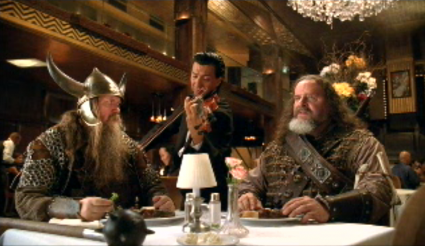
Capital One Triple Rewards sold by “Barbarians”

After the shoot, the film is sent to an editing house for an editor to cut.  The editor will cut several versions of the spot to show the agency, and from there, the agency chooses a cut and starts tweaking- trying different shots, adding frames to shots, etc.  This is also when music becomes an issue.  We’ll use scratch tracks as fillers, and eventually either hire a music house to score a piece of music, or find a piece of stock music to drop in.  On occasion, we’ll license an artist’s music track.  With a spot assembled, we’ll bring it to the client to sell the cut.  With the client’s approval, we move on to recording company to record voice-overs, and mix the spot.  The sound engineer begins sound design, adding ambient sounds, music tracks, voiceovers, and adjust levels of all sound, while the agency tweaks and approves it.  With the spot mixed, it’s on to another post-house for the telecine.  Here, the agency works with a colorist to color correct the film, and then finish it, cleaning up the film by applying minor special effects, and adding any necessary legal copy.  With the client’s final approval, the spot ships, and it’s onto the next spot.

Can you cite an instance when you were able to find a visual solution to a storytelling issue?  

I was working on an assignment involving a movie promotion for a major restaurant chain. I needed to find a way to tell a story that linked together the restaurant chain with the motion picture, and do it in a way that would get people excited to go buy the food and go buy a movie ticket. Additionally, the spot would be running globally so I had to find a solution that didn’t rely on dialogue.  Not surprisingly, months went by where no one was able to sell a script. If one side liked a script, the other side didn’t. It’s how these promotions usually go. Eventually I sold a script that satisfied everyone. It was a purely visual comparison of the similar sensory experiences people would enjoy while watching the film and while eating the food. For example, I compared how someone watching an intense action scene in a theater might grip the arm rest of the seat their sitting in, the same way someone might grip their bag of food if they were worried someone was going to steal it.

How do you balance visual storytelling in your pieces with the importance of sound in establishing tone and style and in communicating key information?

There’s more than one way to tell a story. You can do it purely through visuals, without any sound. But you can also tell the same story purely through sound, without any visuals. The balance of visual and sound ultimately comes down to the story you’re trying to tell and how you want to tell it. Any stimuli you choose to include, or choose to omit, communicates something to your audience. It’s up to you to determine just the right combination of stimuli to communicate your story in the most impactful way.

Sound is important in every project I’m involved with. From the music and sound effects, to the dialogue and voice talent, sound is vital to the communication. Music can evoke a variety emotions, add energy- or remove it, and even set a pacing for the film. Sound effects simply help explain what you’re seeing on film, adding a texture to the visual. Voice talent can be a challenge. Male or female. Old or young. And all the different voice qualities you can think of- the slightest variation of which can mean the difference between feeling authentic or fake, and getting laugh or getting crickets. It’s common to audition as many as 400 or so voices just to get the right one. Because without the right voice, the spot might simply not work. Sound is a sensitive thing. It usually works or it doesn’t. And you don’t usually know if it works until you see it put to picture.

What have been some of your observations of the filmmaking process?

Have an opinion. And have a reason for it. Because everyone has an opinion- some good and some bad. Listen with an open mind. Then listen to your gut.

Once you start shooting, anything can happen. Actors you thought could act- can’t. Lines you thought were funny- aren’t. You go from being ahead of schedule, to 4 shots behind. And weather that’s sunny and 80, is suddenly a flash flood washing your set away. Filmmaking is a fluid process. You have to roll with the punches and find solutions- fast.

What have been among your most fulfilling experiences in promotional moviemaking?

Creating television commercials that make people think about something in a way they’ve never thought about it before. And in a way that doesn’t make them want to change the channel.

* Currently (2014), Kevin Goff is a Senior Copywriter at Arnold Boston, where he has produced work for Produced Work For: New Balance, Volvo, Carnival Cruise Lines, and ADT Security.