
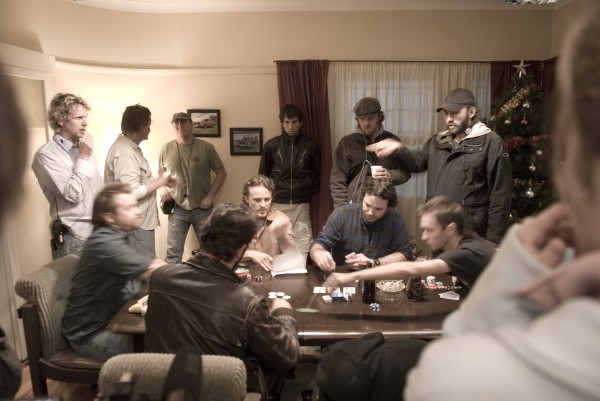
Nash Edgerton with camera operator Sebastian Dickens shooting “Lucky”
The interview for Chapter 8, The Production Process, is with a filmmaker who has been involved in an amazing range of capacities of media processes: as a writer, actor, director, editor, and in the role that originally started his career, stunt artist. Nash Edgerton has also played a key role in one of the most interesting stories in movie production of the past decade or so, which has been the emergence of the group of filmmakers who work through the partnership Blue-Tongue Films. This collective of young Australian filmmakers has sustained a very interesting working relationship to produce work that clearly revolves around the stories, styles, and objectives that interest and inspire them personally and as a group. Among the highlights of Nash Edgerton’s prolific career are the shorts Spider and Fuel, and his feature The Square; he has worked on the stunts of dozens of movies and served as stunt coordinator on the upcoming Wish You Were Here. In addition, his shorts Lucky and The Pitch are featured on the DVD with Moving Images. His next short, Bear – which is a follow-up to Spider – premiered in competition at the 64th Cannes International Film Festival. As a couple of final notes, one neat aspect of connecting with Nash as a contributor to this textbook is that I have used one of the original Blue-Tongue collaborations, Bloodlock, in my media studies and production classes for many years, and this short provides many enlightening lessons on the roots of Blue-Tongue films, their stylistic approaches, and the dynamics of their collaborative. Finally, it was such a pleasure to be able to work with Nash: he was very generous with his time, materials, and attention, and so keen on sharing his respect for his collaborators and his love for his craft.
Did you have any early inspirations to use moving images to communicate?
I watched a lot of films when I was a kid. Seeing something that totally affects you, like horror films – I think what surprises me now, working on films, knowing what goes into it, the make-believe, is that I still get affected by films when I see them and that’s what’s really powerful about them.
From the beginning of your career, you have worked as a stunt specialist. How did you develop expertise in that type of work?
I kind of got into it and learned it in an old-fashioned approach, learning from people that had done it before. I would get the concept by helping out, and then get training by working with different people. I think one of the most important aspects of it is being adaptable because there are things that are always changing and things don’t always go to plan or you’re working against time or weather or various other things. As you work, you can get better at finding solutions. Having learned to be adaptable, as director you can get better ideas on that day when you’re in actual situations. I think that’s what helped me most in preparing to be a director.

Nash Edgerton performing a stunt for “Lucky” featured as the short for Chapter 4 of Moving Images
Your background as a filmmaker is rather unique, having moved to the director’s chair from starting as a stunt specialist and actor. How did your work as a director unfold as your career evolved? Describe your initial experiences overseeing an entire production.
By the time I started directing I had been on a lot of film sets, so just by being on film sets I feel natural and comfortable being around a crew. It’s quite daunting running the show, so the fact that I was comfortable really helped. I think it’s always kind of scary trying to get your head around how to tell the story. You have to make sure you can do as much homework as you can so you have an idea of how you’re going to approach the day of filming with fresh ideas. Filmmaking is such a collaborative process. You try to hire the right people to be around you because they’re going to bring something to it. The combination of you all is going to help you get the best of your day. What I like about filmmaking in general is that it does take more than just one person to do it. It’s working as a team made of different people who all have different skills. It’s a combination of these contributions that creates what it becomes.
What were some useful lessons you learned through your first moviemaking experiences?
The best thing I learned is to be open to accidents, to things going wrong or not your way. Instead of resisting it, maybe it’s meant to be that way. If you’re open to things that change or don’t go your way, maybe you’ll find a better idea. Rather than just being disappointed because it’s raining or because you can’t have this tool or something is broken, there is always a solution. It’s good to have a plan, but ideas are always evolving and part of it is always out of your control. Embrace the chaos!
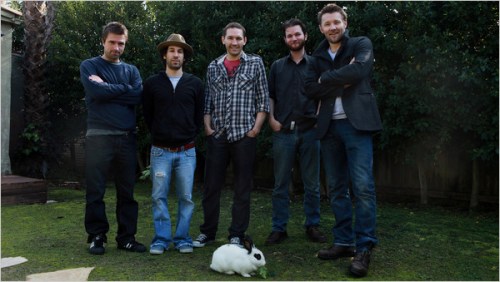
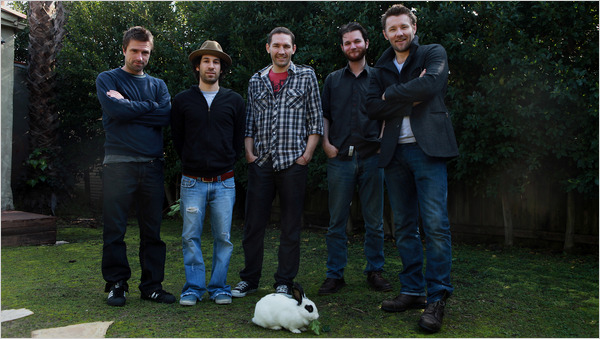
David Michôd, Spencer Susser, Nash Edgerton, Luke Doolan and Joel Edgerton of Blue-Tongue Films
You have worked with a team of filmmakers throughout your career, and you have helped to run Blue-Tongue Films, an independent production unit. How have your collaborative relationships been fruitful to you throughout your career?
Yes, there’s a bunch of guys that I work with, what’s great is that we all work on each other’s films, in different aspects. I’m not always directing, like at the moment I’m editing, or I do stunts on them. Luke (Doolan), who edits a lot with me, he sometimes shoots on my stuff, he’s also been directing. What’s great is you learn from each other, and we have a good shorthand with each other that makes it easier. They have a good way of challenging you and asking why you want to do something a certain way. It’s kind of like a healthy competition. It helps you to be the best that you can be and next time you want to do something even better than that. Then they make something better, and it makes you want to do something better. I like working with my friends.
On some of your films, you have served as writer as well as director. How have you experienced the process of seeing a project move from inception to release? What lessons have you learned from that process?
I find writing hard, to put it quite bluntly. Ultimately, making something you’ve written tends to be more satisfying. Going from what’s inside your head, sharing it with other people, going through the whole process, I like that a lot. For example, Spider was my idea. I’ll explain my ideas to one of my friends or my brother, because I know I will like their writing of it better. So Spider was my idea and it took David (Michôd) to actually write it out and flesh it out a bit. I like to see someone else’s take on the idea.
When you have directed from screenplays by writers other than yourself, what input or developmental contributions have you made to them? Have you found that scripts evolve significantly during production or post-production?
For example, for films I have made with my brother what will usually happen when I read it during the process and the different drafts is that I will be thinking about it as a director. If I can see it when I’m reading it, then I know how to make it. If I can’t see it, for a particular scene, if I can’t visualize it then I fear there’s something that’s not working for me in it so that’s how I talk about it with the writers. Rather than telling them how to do the scene I’ll say there’s something about the scene that doesn’t work. I know it’s not right because I can’t visualize it. By the same token, I’ll say what scenes I like – it’s as simple as that. If I can’t see it, there must be another way of doing it or it doesn’t need to be there. I’d rather say it at that point than try to shoot it without any idea on how to.

Nash Edgerton at right directing The Square
What have been some of the greatest challenges you have faced in filmmaking?
Usually on any kind of shoot day you get challenges, where you’re trying to get everything you need to shoot in that one day. A lot of the time, I find that the start of the day is rather slow and the second half of the day you’re chasing your tail to get things done. The challenge all the time is, if you have a plan like “the way I want to cover this scene is in five shots,” you have to be ready for complications. There was a day we were shooting The Square in a small apartment, and we had gotten really far behind. We were trying to get this scene, and my plan was to get five or six shots, and with the amount of time I had left, I was forced to try and cover the scene in one shot. I think sometimes the pressure can help, and the way we ended up shooting it was way better than anything I had come up with before. Because I was forced to do it in that shorter space of time, I got something better than I would have if I had all the time I wanted. It’s funny because the pressure or the challenges you may face make you step up to it, or I’ve shot stuff where you try and figure out the best way to do it, and then you get home after the shoot day and then you figure it out. Naturally, it can be pretty depressing because it’s too late, and you figured out how to solve it when what you should be doing is planning the next day. Filmmaking is always ups and downs, but I find that there’s always at least one good thing that happens in a day, and it’s enough to keep you going. Something good happened or something worked out how you planned it. You try to savor that when other things don’t work out.
What have been among your most fulfilling experiences in moviemaking?
The most fulfilling part for me is when you screen the film for the first time in front of an audience and it works. The actual process of shooting is always challenging and exhausting – and rewarding. When you’ve written something, you’re thinking about it, you’re planning it, you’re shooting it, you start to forget the freshness and enjoyment of when you first write or read something. When you’re making it, you start to lose sight of what it was, and it’s not until you see it with an audience for the first time that you’re reminded of how you felt when you first read something. You get to see it through other people’s eyes and through their reactions. A lot of times, the hardest thing is to complete something you start, and if you do go full circle that’s when you get the reward. If it doesn’t happen, you get to learn what works and what doesn’t.
With storytelling and filmmaking, I always try and make stuff that I want to make. I try not to make something just because I think other people are going to like it. I try to trust in the fact that if I like it, there are enough people in the world that someone else might like it too. Rather than trying to second-guess what you think, you try to create movies for yourself and put yourself in the audience. Hopefully you’re not that weird and someone else will like it too.
Read Full Post »



 mediateacherdotnet