
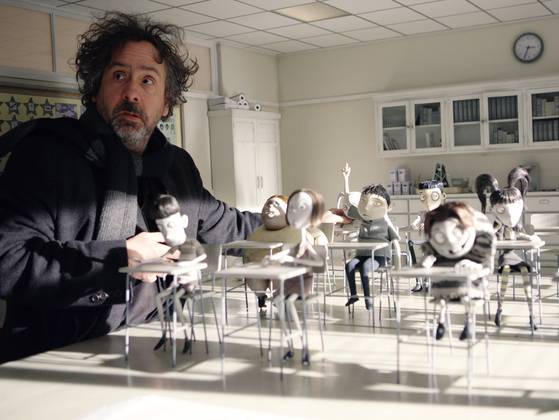
Tim Burton with stop-motion characters from Frankenweenie
If teens have opportunities to research moviemakers and deliver reports on their bodies of work, who would be the most popular choice? Steven Spielberg? Quentin Tarantino? Spike Lee? Well, in my experience, the decision is not even close: it’s Tim Burton. I have been teaching media literacy and digital production courses for a decade and a half, and during that time Burton has been the one consistent choice when students can explore personal interests in movies through an independently-researched presentation on the career and work of an individual moviemaker (this assignment is part of the Instructor’s Resources package of Moving Images).

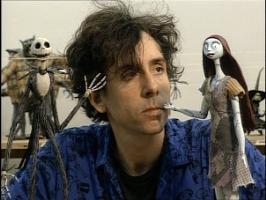
Burton with early creations Jack Skellington and Sally
Over the years, interest in different directors rises and falls intermittently – for example, Tarantino will be quite popular for a couple years (most notably during the Kill Bill period), then there will be no interest at all for a while; the same goes for M. Night Shyamalan, James Cameron, and many others – but Tim Burton is always selected. Clearly, his work connects with certain young people growing up in America. This recent New York Times interview with Tim Burton helps to highlight some of the reasons for this resonance with viewers.

Mr. Rzykruski voiced by Martin Landau
Burton’s stop-motion feature Frankenweenie came out last week, and at its best – particularly the opening fifteen minutes or so of the movie and the scenes with science teacher Mr. Rzykruski (voiced by Martin Landau, who won a well-deserved Best Supporting Actor Oscar as Bela Lugosi in Burton’s Ed Wood) – it has passages that resonate among Tim Burton’s most compelling and personal work (those two things tend to go hand in hand for him, such as in his early classics Edward Scissorhands, Ed Wood, The Nightmare Before Christmas directed by Henry Selick, and arguably Batman Returns).
I think that those first minutes of Frankenweenie should be quite useful and popular for media literacy teachers when they explore the history of moviemaking in class (and in Chapter 2 of Moving Images). In fact, I have used the original short live-action version of Frankenweenie a number of times in class over the years, whether for issues of black and white cinematography, storytelling, or reanimating dead pets.
 By the way, who would take the number two position? Again, in terms of my own classes, it’s definitely John Hughes. His movies have actually grown in status over the years, and of all of them The Breakfast Club is an undisputed classic. As opposed to most movies from that time, it continues to connect with kids today.
Read Full Post »
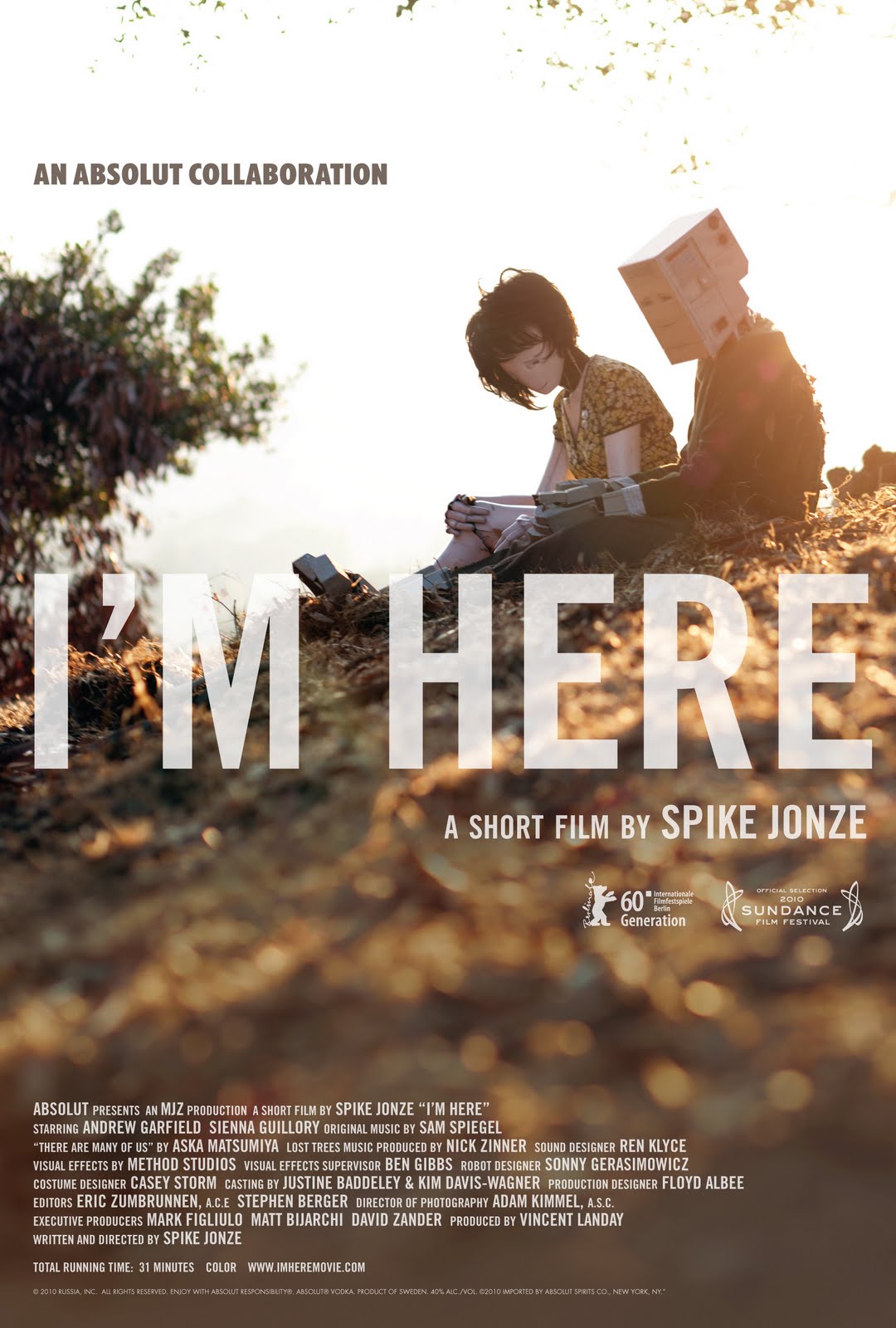 After directing scripts by Charlie Kaufman for Being John Malkovich and Adaptation and then collaborating with Dave Eggers to write Where the Wild Things Are, Spike Jonze went solo to pen the script for his most recent feature Her and promptly won numerous awards for his effort, including the Oscar for original screenplay. Aside from studying the script for Her, I also recommend checking out this far less known short that Jonze made in 2010, I’m Here, which is a bit of a thematic and stylistic warmup for issues explored in Her. Also, you can check out the links with each movie above for screenwriting perspectives and discussions with Kaufman, Eggers, and Jonze.



 mediateacherdotnet