Feeds:
Posts
Comments

Archive for the ‘Chapter 5’ Category

In a blog post from two months ago, I featured a google doodle that highlighted cinema pioneer Eadweard Muybridge, and today they have another excellent animated doodle (yes, it’s a real winner, check out the entire animation!).  This time it is for the anniversary of the opening of the first drive-in theater in the United States 79 years ago, when Richard Hollingshead Jr. opened the first drive-in theater on Crescent Boulevard in Camden, New Jersey.

Many questions can be raised when thinking and talking about drive-ins: why did drive-ins begin, when and why did they flourish, and why did they dwindle away?  Why are drive-ins a particularly American phenomenon?  How have people experienced moving images over the years?  How do you experience them today?  How have the economics of movie distribution and of independent theaters (such as drive-in cinemas) evolved over the past century?  What percentage of a movie theater’s profits derive from its concession stand (which in turn brings up one of the most iconic aspects of drive-ins: the history of advertising linked to concession stands)?

Northfield Drive-In in Massachusetts and New Hampshire

Fascinating investigations can be made on how motion picture marketing, distribution, and screening occur, particularly from the vantage point of a local perspective.  What are the theaters in close proximity to one’s community?  Are they only chain theaters?  Are there other public venues for watching motion pictures?  What options exist for television and cable viewing?  What is the percentage of viewing that you do through streaming sources?  How often are you paying any motion picture creators when you watch moving images?

In the projection booth

In my own region, a favorite theater of my family has been the Northfield Drive-In in Northfield, Massachusetts.  Like many of the drive-ins still in operation, it has a rich history of entrepeneurship and family ownerships.  It is also entertaining to consider the full social, aesthetic, and gastronomic aspects of moviegoing, of which drive-ins offer many provocative angles!

Read Full Post »

Abbie Cornish in David Riker’s “The Girl”

An earlier post in this blog featured the full interview with David Riker, our featured Close-Up Interview from Chapter 5 of Moving Images.  

Here is an excellent article from the Tribeca website that discusses the Q&A with Riker and producer Tania Zarak after the last festival screening of The Girl, starring Abbie Cornish.

Read Full Post »

Images from PES's "Western Spaghetti."

A bunch of very fun and visually striking shorts are available on the aptly named website The Twisted Films of PES.  In particular, I would recommend Western Spaghetti, Game Over, The Deep (produced for Showtime), and the commercial Human Skateboard.

Innovative animator Norman McLaren

Here is a recent interview with PES.

In this interview, he discusses his use of pixilation; as he explains, this is a method that has been used by filmmakers since the earliest years of cinema.  One of the most important examples of its use is the classic short Neighbours, made for the National Film Board of Canada by visionary filmmaker Norman McLaren and featuring fellow animator (and performer) Grant Munro.

The works of PES and Norman McLaren can offer many interesting examples for educators as they explore questions of film forms that are raised in Chapter 5 of Moving Images Other examples will be discussed in upcoming blogs: stay tuned!

Read Full Post »

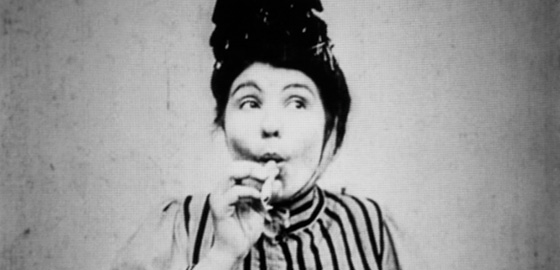
A still from Alice Guy Blaché’s groundbreaking short “Madame Has Her Cravings”

In the late 1980’s, I studied at the Sorbonne Nouvelle in Paris while completing research on French director Marcel Carné for my senior thesis at Princeton University.  There, in a course taught by French film scholar Michel Marie, I was particularly interested by a story that I had never heard of in any of the film histories I had read until then: the cinematic legacy and amazing life of director Alice Guy Blaché.  Since then, major biographies (most significantly, Alison McMahan‘s Alice Guy Blaché: Lost Visionary of the Cinema) and articles have been published on this inspiring pioneer, and evidence of her work has been unearthed in film archives and dusty attics from around the world, allowing for more thorough investigation of her achievements.  At the last Directors Guild of America Awards ceremony in New York City, the DGA offered a posthumous award to Alice Guy Blaché presented by Martin Scorsese.  Currently, her feature The Ocean Waif is available on DVD in partial form along with another feature directed by a woman, Ruth Ann Baldwin‘s 49-17.  For Guy Blaché’s short films, there is a Gaumont Treasures DVD set that features a number of her French movies from 1897-1907.  Online, many of her shorts are available streaming such as Falling Leaves, a 1912 movie produced by her own Solax Studios in New Jersey.

Director and actress Julie Delpy’s followup to 2 Days in Paris

Study of Alice Guy Blaché in the classroom can involve many interesting topics for students.  These include the development of visual storytelling (see Chapter 7 of Moving Images for the “alcoholic mattress” example from the work of Guy Blaché), the prominence of independent studios in film history such as Guy Blaché’s Solax Studios in New Jersey, and the changing roles of women in movie production, particularly the entrenchment of a “males only” world of film production in Hollywood studios after the first decades of the cinema.  Today, France has many active female directors, including Julie Delpy, Agnès Jaoui, Claire Denis, Noémie Lvovsky, Tonie Marshall, Danièle Thompson, and pioneer Agnès Varda who is among the featured directors of Chapter 5 of Moving Images.  

Read Full Post »

One of many major websites protesting SOPA

At virtually every corner these days, teachers are exhorted to use technology – and media-driven technology in particular – to engage students; sometimes we educators might feel that unless we’re interfacing with students primarily with a screen or two between us, we’re not really “reaching them.”  Years from now, it will certainly be interesting to see how people look back at these transitional days for new media interfaces and the world of Internet culture.  To highlight the ongoing debate about SOPA and PIPA – which quite prevalently involve widespread trends in media use – I’ve found a sample page that presents common approaches by educators.  Here is a link to that article – “Free Social Media Tools for Teachers.”  It is notable that many of the uses of the Internet recommended in educational blogs and articles on current pedagogical trends (like the one above and countless others I have seen) involve, at least in part, what would fall under copyright infringement and thus would become fair game for shutdown under this legislation.  Of course, the variety of these platforms has increased since this posting but remains quite similar.

Some media outlets, such as the MPAA, see this legislation as a protection of their copyrights

On a personal note, I am very happy to report that one of the most prominent current voices in the national debate about legal issues dealing with digital news standards, social media, and related domains is a former student of mine (not in media studies or digital moviemaking but French class!), Trevor Timm, who is a lawyer currently writing for Electronic Frontier Foundation.

Read Full Post »

« Newer Posts - Older Posts »