Feeds:
Posts
Comments

Archive for the ‘Chapter 5’ Category

Oscars2015463790992This year’s Academy Awards nominees feature some movies that are so full of media literacy lessons – like Boyhood which was discussed in an earlier post, American Sniper which will be the subject of a new post on mediateacher.net that will appear this week, Birdman or (The Unexpected Virtue of Ignorance) which features truly groundbreaking collaboration between director Alejandro González Iñárritu, cinematographer Emmanuel Lubezki (featured in Moving Images and a number of mediateacher posts), its actors including Michael Keaton, and percussionist and composer Antonio Sánchez, among others – and it will be very interesting to see the ones chosen in various categories by the Academy voters.  The tricky relationship of history, truth, authenticity, and accuracy that has been seen in debates related to Selma and The Imitation Game as well as the multiply-controversial American Sniper is a key thematic core to lessons in Moving Images, and there will be upcoming posts that feature information and links within our already well-developed category of social studies-related media lessons.

Me-and-My-Moulton-post1Meanwhile, for most of the general public, the categories for the short films are the most unknown quantities on the Oscar ballot.  You might want to check out this piece by A.O. Scott for any last-minute info and for a short film that shows the nominees for animation.  One of the animated shorts, Me and My Moulton, is by Torill Kove, who directed past winner The Danish Poet, which is available with other past winners on an excellent BluRay by Shorts International.

Read Full Post »

Snapchat 101

SnapchatStoriesI get these questions all the time from fellow educators: “So how do I integrate Snapchat into my classes?” or “Can I write an entire curriculum based on Snapchat?” or “How do I fully integrate a digital learning environment into my teaching and stay up with the kids?” or “What is it that those youngsters are sending to each other all the time?”  Well, here is that initial tutorial you have been asking for.  And the little movie is pretty funny.  It’s by New York Times reporter Nick Bilton and Casey Neistat, who is a YouTube filmmaker.  Moreover, his videos Make It Count and Crazy German Water Park both fulfill the Chapter 5 portrait project, one as a self-portrait and the other as a portrait of place.

Read Full Post »

Photoshopped WomenSince it’s the end of the year, there are lists all over the place of the best, the worst, and all in between of the year’s movies, shows, games, news stories, vines, live feeds, and everything else from the worlds of moving images and sounds.  I will share one that I find particularly useful for media literacy educators, which is a short piece from BuzzFeed in the vein of the work done by the Media Education Foundation.  Titled Photoshopping Real Women Into Cover Modelsit’s succinct, well produced, and eye-opening for teens (and will be for quite a few older people as well).  For me, this is one of the most important visual literacy themes for our students today because kids have been so skillfully conditioned by our media environment to believe unconditionally in popular culture’s models of behavior, of consumption, of what is supposed to attract and repulse us.  As a result, many young people never even start to question these forces while they have been simultaneously led to believe that they are absolutely independent in their choices, tastes, and values.

For longer pieces on this and related topics, Media Education Foundation also offers many titles investigating these forces from numerous angles, including gender roles, violence in the media, ethnic stereotypes, and more.  For younger students, here is a page from Canada’s MediaSmarts with short videos and lesson plans establishing the basics of media literacy.  Finally, on mediateacher.net, check out these posts  Generation Like or Digital Nation/Merchants of Cool for materials, lesson plans, and further reading.

Read Full Post »

NinjaVideoAs noted in earlier blog posts on mediateacher.net, one of the the most popular veins of cross-curricular planning is between business and media literacy studies.  The effect of economics on movies, television, gaming, and other media-related activities (even visual effects, such as in this visit with VFX supervisor Greg Butler) is discussed in Chapter 5 and other areas of Moving Images.  An important area to explore with students is that of legal use of media and understanding and respect for copyrights, intellectual property, and fair use standards.  This article from the New York Times – The Unrepentant Bloggerconcerning both a specific case involving streaming pirated movies (“NinjaVideo”) and the pursuit of illegal activity by various American criminal investigation agencies can be an interesting starting point or reference for discussion.  Some might be surprised to learn that jail time has been seen by some bloggers and uploaders of pirated materials.

And meanwhile from another spot on the Business pages, to attract more young viewers some theaters find they need to move past even 3D to explore further dimensions in the moviegoing experience…

Read Full Post »

As a follow-up to yesterday’s post about the news of Orson Welles’s The Other Side of the Wind, it is worth posting news of a contemporary movie that shows the fragile state of film and the highly volatile and transitory condition of motion picture media that has continued to build over the past two decades.  David Riker, the director (The Girl) and writer (Dirty Wars) who is the featured Close-Up interviewee of Chapter 5 of Moving Images, has recently initiated a Kickstarter campaign to bring his universally praised first film La Ciudad back into circulation.

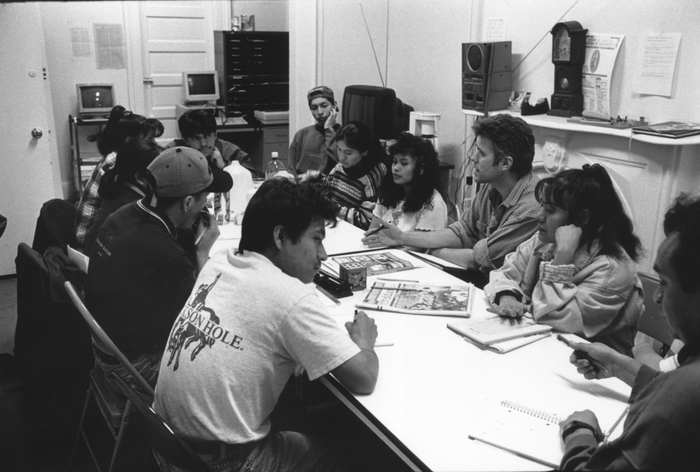
Director David Riker, third from right, working with garment workers to develop La Ciudad

Director David Riker, third from right, working with garment workers to develop La Ciudad

In only 15 years, this important movie that features a series of stories about undocumented immigrants in the United States – “a treasure,” according to Roger Ebert, “simply a great film,” from the Washington Post, and compared with neo-realist classics by Variety – became virtually unseeable, with a few worn prints in circulation and the DVD release out of print, its company having folded.  This particular story is a highly valuable one for media educators and students to explore, because it touches on many issues of great importance to 21st century mediamakers: newly developing funding resources and methods, direct pitches to audiences, film preservation, and social issues addressed in movies. Another important corollary to this story is that it ties in with one issue that media teachers have to deal with constantly: reminding students of the necessity to carefully preserve and archive their own work.  Are you making copies and keeping track of them?  Do you control the formats and have access to them?  I find that often enough, the answer is no.  Students often do not pay enough attention to this, and from time to time, former students contact me asking if I have copies of their work.  “Well, I’ll be happy to check,” I say, wanting to add, “and do you remember the first things I went over when we started class?  And telling you that there’s a decent chance you will be creating treasures that will be priceless to you in years to come…”

Read Full Post »

« Newer Posts - Older Posts »