Feeds:
Posts
Comments

Archive for the ‘Chapter 1’ Category

For any teacher of moviemaking, one of the most vital concerns should always be safety.  I know that it always has been for me — and for anyone working with adolescents it must take on the utmost importance.  In class guidelines, the significance of clear rules and principles for safety must be firmly articulated in any agreement to which students and parents must sign.  When developing the textbook Moving Images, I knew that I would need to discuss safety in my notes to instructors and in project guidelines, and I pointed out to the publisher that there must be a clear statement about safety in the front matter of the book.

sarah_jones_train_tracks_insetIn recent months, the importance of safety for all media creators has been at the forefront of discussions of industry standards and production practices and the legal implications of our work as moviemakers in the tragic death of assistant cameraperson Sarah Jones.  Director Randall Miller was sentenced to a two-year prison term for involuntary manslaughter for the death of Ms. Jones during a night shoot on the feature film Midnight Rider.  As reporter Richard Verrier explains, “The crew was filming a scene – a dream sequence for a movie about the life of Greg Allman of The Allman Brothers. And actor William Hurt was lying on a bed that had been placed on a railway track … the crew had been assured that no trains would be coming down the track, that they had permission to film there from the landowner. And what happened was a CSX freight train came barreling down the tracks and hit the bed and shards from the bed struck and killed the camera assistant Sarah Jones… and injured several other workers.”  This piece for the podcast The Frame provides further information and discussion of this tragic incident and its current implications for the industry.  However, it should be pointed out that these are not new concerns: Among the most famous cases of loss of life during film production are the deaths of Vic Morrow and two child actors during the making of John Landis’s segment of Twilight Zone,  the death of actor Brandon Lee on The Crow, and the death of a stunt crew member for the creation of chase sequences in Christopher Nolan’s The Dark Knight.  

hill-street-blues_wide-8f94a0b0d3d404e8d705d04b59a99434e38dba7b-s800-c85Related to all of this, I am reminded of the classic recurring line from Sgt. Esterhaus of Hill Street Blues: “Let’s be careful out there.”  For ourselves, as well as for those with whom we are working and for whom we are responsible.

Read Full Post »

Storyboard example from "The Hanging Tree" by writer/director/artist Delmer Daves

Storyboard example from “The Hanging Tree” by writer/director/artist Delmer Daves

One of the primary preparatory methods available to mediamakers working through pre-visualization techniques is storyboards.  This concept is presented in the initial chapter of Moving Images and has been discussed numerous times in mediateacher.net blog posts (such as through the work of Alex Toth or Saul Bass).  For filmmakers and educators wishing to explore further a wide range of methods and historical uses of storyboards, the following post (with the caveat of “please be forewarned!” some of their examples are gruesome, such as from John Carpenter’s The Thing) from the exceptional site cinephilia & beyond is a superb resource.  The cases from such classics as Hitchcock’s Strangers on a Train, Ridley Scott’s Alien and Blade Runner, among others, are extremely informative.

And this year’s deluxe boxed-set blu-ray release of Jerry Lewis’s The Nutty Professor has provided one of the most unexpectedly thorough resources concerning storyboarding that has ever been released to the public.  In addition, for more information on the image at left and its creator Delmer Daves, check this post out on this inspiring American creator.

Read Full Post »

Slide1Here is a copy of the opening day presentation – Media Literacy and Production Opening – for a course I teach that utilizes the first half of Moving Images.  Check it out!  (In addition, here is a fresh copy of iMovie Instructions if that may be of use.)

A few words on some of the links: Boxes is a movie made by one of my former students; it provides an exceptional example of visual storytelling and can be great for opening discussions.  I Forgot my Phone is used less for its storytelling and more about its thematic content.  I also added a few links to media literacy stories from this past summer, including ones that were discussed in posts on this blog.  I also linked to one of the most fun media events from this past summer: the week-long release of Weird Al’s videos in support of his album Mandatory Fun.  What are music videos – advertisements?  Artistic creations in their own right?  In this case, each song and video has been created not only as a parody or reflection of a musical style, but also in reference to a particular approach in visual communication, from the one-shot lip dub to stop-motion to white board animation and more.  And what do teens think?

Read Full Post »

realist227ENThe most recent installment in the Realist comic blog by Asaf Hanuka, the illustrator for the cover and splash pages of Moving Imagesoffers some great lessons in the range of competencies inherent in media literacy and the expressive potential of visual communication.  In a nine-panel, single page comic, Hanuka, an Israeli native, takes on one of the most challenging, complex, and controversial topics from the news of this past summer: the conflict between Israel and Gaza.  Without ever saying so directly.

From its title, “Spoiler Alert” – which uses the meaning of this phrase as a warning from a critic or other commentator regarding a reveal of the content of a media creation – to the references to a graphic novel (later made into a movie) to the precise use of visual information married to text, the reader must engage in media literate interpretation in order to process this work.  Since the artist puts the reclining figure of the narrator in the same position reading the same book in the first three panels, we instantly know that this is the same person seen over a sequence of years, much like in the examples described in Chapter 1 of Moving Images.  Then, the visually literate reader can also move to more subtle and detailed visual information conveyed to us by the artist: in movie terms, the art direction of the backgrounds (from a student’s room to an army scene to an adult’s comfortable bedroom with framed picture), the costume changes, and finally the cinematography of the lighting and lens changes in the second and third trios of images.  In fact, in the final three panels Hanuka creates the graphic novel equivalent of camera movement or a push in with the concluding images of this comic.  They underline and heighten the drama much like a comparative movement in filmmaking.

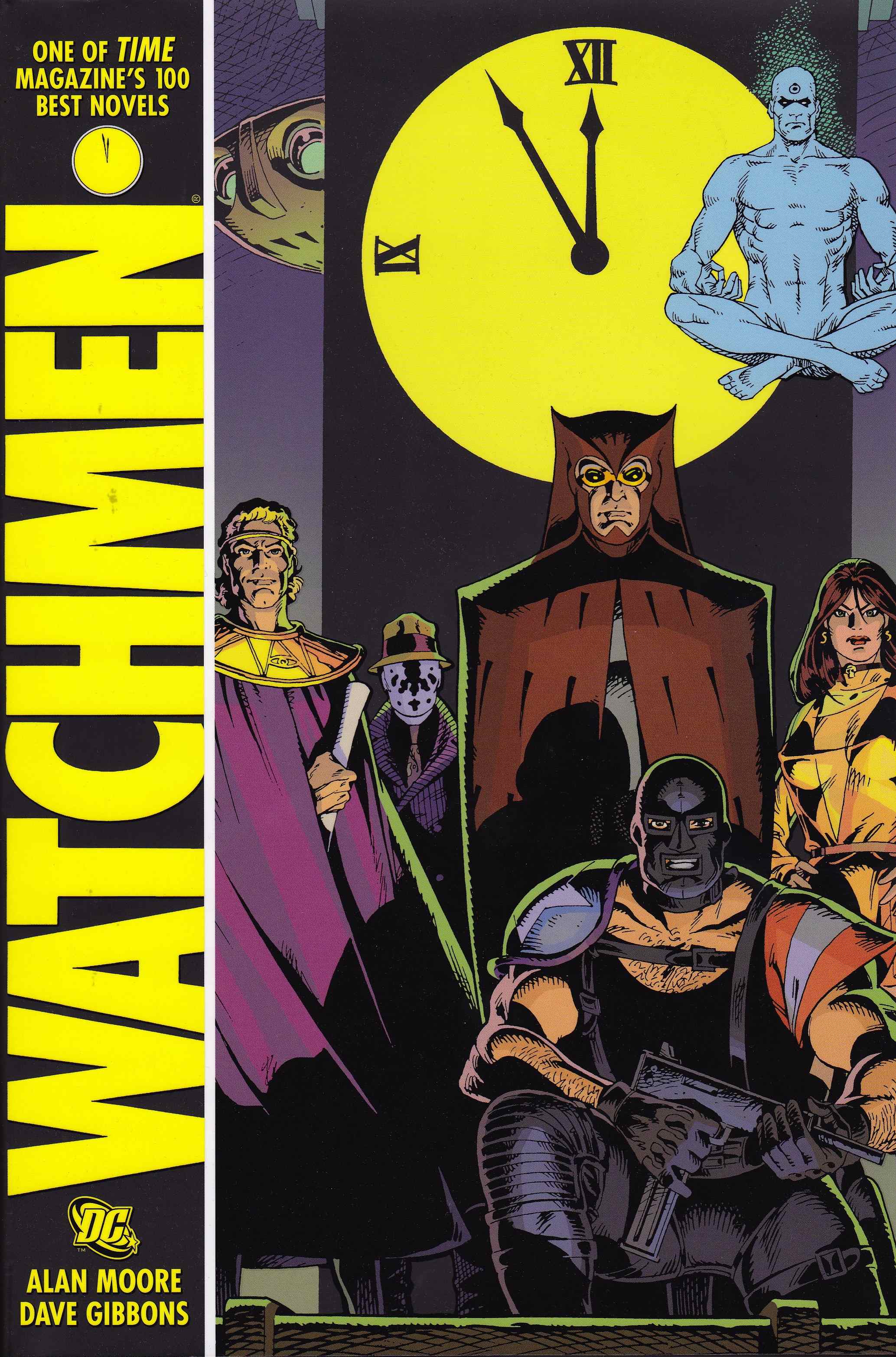
alan-moore-watchmenAll of these values serve the story and messages of this creation made up of words and pictures, which uses the narrator’s understanding and interpretation of the themes of the groundbreaking graphic novel Watchmen by writer Alan Moore and artist Dave Gibbons as they shift and mature over his lifetime to express powerfully the moral dilemmas he sees in the world around him.  It is not a ridiculous leap to see it as a discussion of the current conflict between Israelis and Palestinians, particularly when one considers the context of The Realist blog which has dealt with related issues in a number of its preceding entries – while through its lack of specifically referring to these events it also calls to mind similarly thorny dilemmas in history and the contemporary world.  This example features a topic that is challenging for any educator to address because of its highly emotional and incendiary subject matter, but it points to the value of precise use of visual communication and the demonstrative impact of image-based media, whether through the sequential art of graphic novels or sequences of shots that make up moving images.

Read Full Post »

A page from the Lost Notebook showing work on Fantasia

A page from the Lost Notebook showing work on Fantasia

Two newly released books qualify as treasures: The Lost Notebook: Herman Schultheis & the Secrets of Walt Disney’s Movie Magic by John Canemaker and Genius, Animated: The Cartoon Art of Alex Toth by Dean Mullaney and Bruce Canwell.  The arrival of Canemaker’s new book is the cinephile’s equivalent of a newly unearthed Tutankhamen’s tomb.  Many of the details of the techniques developed by the Disney studios in crafting their groundbreaking first animated features have remained shrouded in mystery until now, and the discovery of the meticulously compiled notebooks of cinematic craftsman Herman Schultheis is an major event in the history of animation.   Suddenly we are offered this looking glass view into the unparalleled work of the Disney teams of creators during a period in which they were forging breathtaking new visions in media communications.  It’s truly astonishing.  Another inspiring and instructive new work is the final installment of biographies devoted to the œuvre of Alex Toth: Genius, Animated.  In an earlier post, I wrote about this pioneer in animation and comics, and this ultimate volume in a trilogy devoted to his work reveals new aspects to his achievements.  In particular, his storyboards are a revelation.  I have to say that authors Canwell and Mullaney understate the case when they say, “While fine in and of themselves,” when introducing storyboards for the Saturday morning cartoon “Superfriends.”  In particular, the boards to the episode “Battle of the Earth’s Core” highlight the depth of thoughtfulness, visual storytelling skills, design acumen, and complete mastery of motion picture language that Toth brought to work that many others would have just phoned in.  I bring these books up as suggestions for some inspiring summer reading and for great examples of pre-production tales from which young filmmakers can learn many lessons.

Read Full Post »

« Newer Posts - Older Posts »