Feeds:
Posts
Comments

Fanciful flights across the globe, then back to Prague

Recently, I attended the 10th Annual Northeast Media Literacy Conference at the University of Connecticut.  There, I delivered a presentation on the development of higher order communications skills through non-fiction platforms using critical analyses and digital production of news media, documentary essays, and public service announcements (Recording, Synthesizing, and Evaluating Reality: Non-fiction Media in the Secondary Classroom).  It is typically an invigorating experience for teachers to be able to engage with colleagues from other schools, grade levels, and disciplines, and this conference offered ample opportunities for a rich diversity of interactions.

The two keynote speakers were Dr. Kathleen Clarke-Pearson, a pediatrician who discussed her perspective as a “mediatrician,” and Howard Schneider, former managing editor for Newsday and founding dean of the SUNY-Stony Brook School of Journalism, who spoke about his work establishing a news literacy course for all students at the university.  Dr. Clarke-Pearson stressed the need to balance continually the positives and negatives of new methods of communication and immersion in digital media, and she pointed out the importance of considering neurobiology and studies that have investigated the impacts of media usage on young children.  She highlighted the work of Michael Rich at the Center on Media and Child Health and that of Dimitri Christakis in early brain development, in which he has shed light on deficient language development and significant attention problems due to the negative effects of television exposure in young children.  After lunch, Howard Schneider recounted the development of a news literacy program at Stony Brook in which all undergraduates take a required journalism course to prepare them to be discerning news consumers and competent citizens.  His opening salvo was “The Truth is in Trouble,” and, while describing the essential questions and frameworks of their program, he focused on the importance of imparting three parameters to students for evaluating news to qualify it as reliable information: Verification, Independence, and Accountability.
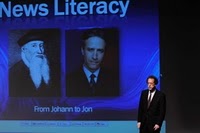
Howard Schneider with Gutenberg and Stewart

Moreover, the conference was attended by a large group of international educators and professionals from media communications fields across the globe, and the final event of the conference was a panel discussion with five members of this group.  We were able to hear from Rania Al Malky, the Chief Editor of Daily News Egypt, who discussed the well acknowledged role of social media in the revolution in Egypt, as well as the functions of moving image media in how the uprisings played out and were experienced nationally and throughout the globe.  During the panel discussion,  the Rev. Mike Nsisak Umoh, the Director of the Center for Media Development at the Catholic University of Lagos, Nigeria, spoke of worldwide cultural shifts taking place and their possibilities to impact deep social change.  He described the development of media literacy as offering the possibility of “a Panacea for World Peace Development” and commented that “Media is the new World Currency.”  In particular, he cited the need to revisit the controversial MacBride Report for UNESCO from 1980, and the degree to which its analyses and recommendations have continued to resound pertinently to those working in media literacy in the developing world.

Karel Zeman contemplating a sequence

Another member of the panel was Pavlina Kvapilova, the executive director of New Media Division for Czech Republic national television networks (with the intriguing channel order of 1, 2, 24, 4), and a dynamic speaker and debater.  In particular, she spoke about the use of social media by the Czech national television services to keep connected to their audience and keep their news division pertinent to viewers.  Check out the pages for children’s programming — they’re incredibly fun to look at and remind me of the great traditions in Czech animation.  A personal favorite movie that I was reminded of as I looked at these pages was “Ukradená vzducholod” — or, The Stolen Airship — from 1967 by the great Czech director (and animator and special effects wizardKarel Zeman.  I saw this movie (as Le Dirigible Volé) a few years ago with my eldest son in the Studio des Ursulines in Paris , one of the most magical cinemas in the world that has specialized in children’s movies for a number of years having started out nearly a century ago as a theater showing movies of the avant-garde.  How the media world turns…
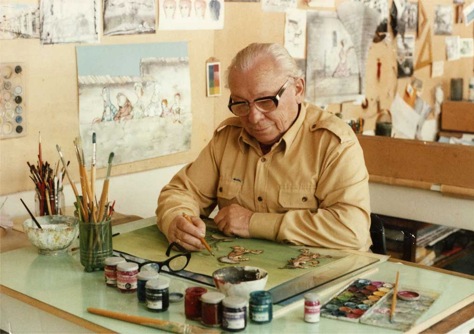
Karel Zeman with other tools of creation

Closer to home, I can report that some of the most resonant connections that I made during the conference were those closer to my own backyard.  During lunch, I met groups of colleagues from Ellington and Simsbury High Schools in Connecticut, and it was such a pleasure to share stories of the challenges we face in the classroom as well as new ideas and tales of our ever evolving roles as 21st century educators.

One of the logos for the group responsible for the Kony 2012 Viral Campaign and 11 short films over the past decade.

Earlier this week, while my media class was working in groups on an upcoming project, one student turned to me and said, “Kony 2012.  You’ve got to check this out.  A major event is happening right now in how media works.  I’m not saying it’s good, but you should check it out.” Later during that same period, other students started talking about it; some had shared it from Facebook, some were talking about celebrity posts on Twitter, some were thinking about doing something in response to this piece.  The next day, I even heard 7th graders talking about it in a Middle School class that I teach.

Indeed, this week, a phenomenon burst into the scenes of social media, non-fiction moviemaking, and how moving images are functioning in our world today.  I would recommend for teachers and students to look at the Kony 2012 movie using the questions for Chapter 6, “Recording and Presenting Reality,” on pages 237-238 of Moving Images.  Notable subjects for discussion of this media document are the presence of director Jason Russell in the voiceover and images; the use of his young son as one of the primary figures in the images; the digital techniques used in the movie; and marketing methods employed by the filmmakers and this group.  Here is an excellent article from the New York Times on the phenomenon of the Kony Video going viral.  In addition, here is a one of the rare news pieces appearing in major media – in this case from Democracy Now – about the deployment of troops to Uganda by the Obama administration in October 2011.

Inspired by the pioneers!

In February, I dedicated a post to a discussion of the amazing news that not only one but two movies in serious contention for many Academy Awards this year dealt with the worlds of silent movies: The Artist and Hugo.  As it turns out, these two films were the big winners of this year’s ceremony.  Strike up a win for visual storytelling and the legacy of the pioneers of cinema, both featured in Chapter 2 of Moving Images!  

For study of non-fiction film, this year’s feature winner is sure to be a favorite for use by many educators: Undefeated, directed by Daniel Lindsay and T.J. Martin.  (I should add that this win was a bit of a shocker, as many had picked Paradise Lost 3: Purgatory, by Joe Berlinger and Bruce Sinofsky, who also made another classic contemporary documentary, Brother’s Keeper, as well as a documentary about Metallica; others picked Pina or Hell and Back Againbut it was the feel-good sports movie that won in the end.)

The Swell Season, a documentary about Glen Hansard and Marketa Irglova

While we’re on the topic of documentaries and the Oscars, one of the most stirring moments of the Academy Awards in recent years occurred in 2008 for the Original Song Award for “Falling Slowly” by Glen Hansard and Marketa Irglova of The Swell Season.  Since then, directors Nick August-Perna, Chris Dapkins, and Carlo Mirabella-Davis made The Swell Seasona documentary about Hansard and Irglova’s professional and personal lives, which a number of critics consider to be one of the best movies ever about music-making and the life of a couple.

For great moments from this year’s Oscars, how about the winners for Best Animated Short, William Joyce and Brandon Oldenburg, who during their acceptance speech served as a better comedy team than even old pros Zach Galifianakis and Will Ferrell.  They won for The Fantastic Flying Books of Mr. Morris Lessmore, which you can watch here.

Also, to return to a celebration of award-winning documentary filmmakers, you can check out my Chapter 6 Close-Up interview of editor Deborah Hoffmann for many sharp, subtle insights and enlightening angles on the many challenges and particulars of the editing process and profession.

And one last note: as a follow-up to the earlier post about Super Bowl commercials, here is a page on the Adland.tv site that presents 40 Years of Super Bowl Commercials — very interesting material for analyses of trends in consumer behavior, cultural norms, and advertising styles, among other media topics!

Iconic image of Robert Redford in “The Candidate”

Here is an excellent discussion between Bill Moyers and Neal Gabler (with fine choices of clips from the undervalued classic The Candidate along with George Clooney’s The Ides of March).  Gabler and Moyers discuss many issues that will be featured themes of this blog and work especially well with issues raised in Chapters 5 and 6 of Moving Images: the influence of movies on politics; news literacy; advertising culture and democracy; the struggle between depth and superficiality in moving images, media narratives, acting, creative expression, and independent thought.  This interview is exceptionally informative, thought provoking, and useful for debate and further inquiry; it is simply a treasure trove for studies of media literacy and contemporary culture — political and otherwise.  Highly recommended!

I will be back soon with discussion of the Oscars and useful links regarding the movies that got the nods from the Academy voters.   And here’s another interesting link: Neal Gabler’s choices for Ten Great Political Films.

On this standard Toth Black Canary comic page one can see a distinctively cinematic story board

Alex Toth was certainly one of the most compelling and dedicated visual storytellers working in comics and television animation during the second half of the 20th century.  His stylistic and narrative prowess was formidable, and a study of his artistic development during the 1950’s and 1960’s provides some of the most inspiring and informative lessons that anyone working in visual communications can hope to encounter.  Genius, Isolated, the first volume of a comprehensive biographical trilogy on Toth by Dean Mullaney and Bruce Canwell, came out last year, and the next book – Genius, Illustratedis due out in a few months.

Space Ghost by Alex Toth

Having worked in a wide variety of comic genres in the 1950’s, during the 60’s Toth shifted to working mostly in the medium of television animation, and he created some of the most strongly designed cartoons ever to hit the airwaves, including Space Ghost, Birdman, The Galaxy Trio, and The Herculoids, and he contributed to Doug Wildey’s influential Jonny Quest.  Throughout his life, Toth loved movies, and he consistently talked about the impact of cinematic storytelling on his work and approach to layouts, pacing, and character design.

Toth model sheet for animated Three Musketeers

A few years ago, Hanna-Barbera released some of the Toth cartoon series on DVD, and a highlight of those discs was the inclusion of some excellent documentaries on Toth’s life and complicated personality, artistic impact, and working methods.  One moment that stuck out for me among those biographical pieces was a reference to a series of “How-To” comics that Toth produced during the 70’s when he was working on the popular Super Friends Saturday morning cartoon.  I was overjoyed recently to see on the Toth website, run by his family, that they had posted these pages among their archives.  They are stunning and engrossing to anyone interested in animation history, professional draftsmanship, and television production traditions and techniques.  I certainly hope they are going to appear among the pages of the second and third installments of the “Genius” books chronicling the dramatic life and vibrant artistry of Alex Toth.