Here are two shorts by Brendan Kirschbaum, a student in my media literacy and digital production classes from this past school year. The first, Boxes, was his final for the fall semester, and the second, Zom, was his final project for the advanced class. They won awards for Animation and Editing at our 12th Annual Film and Video Festival this past June. Both can be very interesting to use for Chapter 2, Inventions and Origins, for their use of non-dialogue visual communication (or a number of other lessons in Moving Images as well!).
Posted in Animation, Chapter 2 | Tagged Boxes, Brendan Kirschbaum, High School Animation, High School Film and Video Festival, High School Media Literacy, Moving Images, Zom | Leave a Comment »
From our 12th Annual Film and Video Festival, here are some award winning shorts directed and produced in my high school media literacy and production classes by Jake Peterson. The first, The Aftermath, or Why I Seem so Tired in the Morning, is the short Jake produced for the portrait assignment in Chapter 5: Personal Expression and Studio Production. Next is a documentary that presents a state championship season of a high school cross-country team: SHS X-Country 2012. Finally, there is The New Office, an entry in the rapidly-developing genre of the mockusitcommockumentary. Or something like that. It won a screenwriting award.
Posted in Chapter 5, Chapter 6 | Tagged High School Film and Video Festival, High School Media Literacy Courses, High School Media Self Portrait, Jake Peterson | Leave a Comment »
I was amused to see the picture accompanying one of the most recent in-depth interviews with Emmanuel Lubezki, a featured cinematographer in Chapter 4 of Moving Images (titled “Storytelling with Light”). This photo from the shoot of Terrence Malick’s Tree of Life shows Lubezki measuring light. When I was in the process of completing the work for Chapter 4 of Moving Images, which focuses on cinematography and compels students to understand and reflect on the capture and use of light and its impact on visual storytelling, I found an image that showed a famous cinematographer using a light meter. I thought it would serve as a good illustration of a director of photography at work and bring home the basic idea that light is something that can be measured and manipulated in order to create the images that one wishes to use to tell a story in moving image media. I contacted him to request permission to use the image. He responded with a thoughtful response, but he forthrightly declined, making a variety of comments that amounted to “these devices are stuck resolutely in the past” and offering phrases of the “manufacturing a buggy whip after the invention of the car” variety. I moved on and was graciously offered an image gratis from independent filmmaker William Farley.
Interestingly, since then, there has not been a single year yet in which the majority of Oscar nominees for cinematography have shot digitally. Although that year is sure to come, it is clear to me that it is in any student’s interest to have a fundamental comprehension of key concepts of light and photography, whether for digital sensors or through celluloid. To establish an understanding that one can measure light, that it makes a difference how and with what tools one captures light, and that the ways light is used by a creator to tell a story help to form the basis of what we view as moving images, whether in feature films, TV shows, commercials, local PSAs, music videos, YouTube streams, and everything in between and beyond — that is what educators must convey when introducing “Storytelling with Light.”
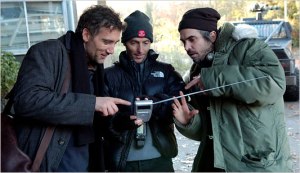
The cinematography of Emmanuel Lubezki offers some of the most powerful contemporary examples of the expressive possibilities of moving images, particularly his work with Alfonso Cuarón, such as the awe-inspiring Children of Men and A Little Princess (see Fig 4-14, Moving Images); with Terrence Malick (including the Oscar-nominated The Tree of Life); and in Tim Burton’s Sleepy Hollow. And here is a commercial directed by Lubezki for broadcast during the recent London Olympics.
For more thoughts on issues about working in digital or celluloid-based media, here is an interview with cinematographer Janusz Kaminski, Steven Spielberg’s long-time collaborator and DP on War Horse and many other features. In the accompanying article they announce that Kaminski would be shooting Harmony Korine’s Spring Breakers, but the cinematographer of Saving Private Ryan didn’t seem to have what it takes to make the cut since Benoît Debie ended up as DP. In 35. Go figure.

Posted in Chapter 4 | Tagged A Little Princess, Alfonso Cuaron, Children of Men, Emmanuel Lubezki, Film Intel, Janusz Kaminski, London Olympics Media Literacy, Sleepy Hollow, Terrence Malick, The Tree of Life, Tim Burton, William Farley | 3 Comments »
One of the most important – and complex – developments regarding media and the Olympics has undoubtedly been the integration of the Internet in the diffusion of information, images, and analyses. Of particular note this year has been the place of Twitter in this evolving landscape. Greek and Swiss athletes have been dismissed from the 2012 London Olympics because of Twitter posts, while a journalist has had his Twitter account blocked because of his repeated criticism of NBC, which has had its own negative impact on Twitter (among other stories). And here is an article by legal journalist Trevor Timm on free speech issues generated by all this Twitter activity.
Currently, educators are capitalizing on the communicative possibilities of social media for their uses in the classroom, while they also wrestle with the challenges posed by the use of these types of Internet platforms in schools. It is clear that the critical thinking skills that are at the core of media literacy education have become more vital than ever. An earlier event from this summer demonstrated this clearly to me. In France, a Twitter trending topic generated a rather humorous response from French comic Elie Semoun (who had already developed a rather thorny, and not funny, history with Twitter): “I confirm my death,” he responded from his Twitter account after the “story” of his death became a “news item” for a number of hours, having been stirred up by a flurry of Twitter posts. This has happened to other celebrities, such as Paul McCartney, but this response by the “dead man” was particularly original. All it required was a small dose of media literacy skills to figure out this was not news and certainly not reliable – and, as it turns, out, not true. The importance of our abilities in analyzing, evaluating, and properly using media resources has been one of the key lessons of this Twitter-filled summer.
Posted in Media Literacy | Tagged Critical Thinking, Elie Semoun, London Olympics 2012, Media Literacy Education, NBC, olympics and free speech, Paul McCartney, Teaching Internet Skills, Trevor Timm, Twitter, Voula Papachristou | Leave a Comment »