
Fanciful flights across the globe, then back to Prague
Recently, I attended the 10th Annual Northeast Media Literacy Conference at the University of Connecticut. There, I delivered a presentation on the development of higher order communications skills through non-fiction platforms using critical analyses and digital production of news media, documentary essays, and public service announcements (Recording, Synthesizing, and Evaluating Reality: Non-fiction Media in the Secondary Classroom). It is typically an invigorating experience for teachers to be able to engage with colleagues from other schools, grade levels, and disciplines, and this conference offered ample opportunities for a rich diversity of interactions.
The two keynote speakers were Dr. Kathleen Clarke-Pearson, a pediatrician who discussed her perspective as a “mediatrician,” and Howard Schneider, former managing editor for Newsday and founding dean of the SUNY-Stony Brook School of Journalism, who spoke about his work establishing a news literacy course for all students at the university. Dr. Clarke-Pearson stressed the need to balance continually the positives and negatives of new methods of communication and immersion in digital media, and she pointed out the importance of considering neurobiology and studies that have investigated the impacts of media usage on young children. She highlighted the work of Michael Rich at the Center on Media and Child Health and that of Dimitri Christakis in early brain development, in which he has shed light on deficient language development and significant attention problems due to the negative effects of television exposure in young children. After lunch, Howard Schneider recounted the development of a news literacy program at Stony Brook in which all undergraduates take a required journalism course to prepare them to be discerning news consumers and competent citizens. His opening salvo was “The Truth is in Trouble,” and, while describing the essential questions and frameworks of their program, he focused on the importance of imparting three parameters to students for evaluating news to qualify it as reliable information: Verification, Independence, and Accountability.
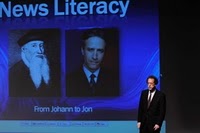
Howard Schneider with Gutenberg and Stewart
Moreover, the conference was attended by a large group of international educators and professionals from media communications fields across the globe, and the final event of the conference was a panel discussion with five members of this group. We were able to hear from Rania Al Malky, the Chief Editor of Daily News Egypt, who discussed the well acknowledged role of social media in the revolution in Egypt, as well as the functions of moving image media in how the uprisings played out and were experienced nationally and throughout the globe. During the panel discussion, the Rev. Mike Nsisak Umoh, the Director of the Center for Media Development at the Catholic University of Lagos, Nigeria, spoke of worldwide cultural shifts taking place and their possibilities to impact deep social change. He described the development of media literacy as offering the possibility of “a Panacea for World Peace Development” and commented that “Media is the new World Currency.” In particular, he cited the need to revisit the controversial MacBride Report for UNESCO from 1980, and the degree to which its analyses and recommendations have continued to resound pertinently to those working in media literacy in the developing world.

Karel Zeman contemplating a sequence
Another member of the panel was Pavlina Kvapilova, the executive director of New Media Division for Czech Republic national television networks (with the intriguing channel order of 1, 2, 24, 4), and a dynamic speaker and debater. In particular, she spoke about the use of social media by the Czech national television services to keep connected to their audience and keep their news division pertinent to viewers. Check out the pages for children’s programming — they’re incredibly fun to look at and remind me of the great traditions in Czech animation. A personal favorite movie that I was reminded of as I looked at these pages was “Ukradená vzducholod” — or, The Stolen Airship — from 1967 by the great Czech director (and animator and special effects wizard) Karel Zeman. I saw this movie (as Le Dirigible Volé) a few years ago with my eldest son in the Studio des Ursulines in Paris , one of the most magical cinemas in the world that has specialized in children’s movies for a number of years having started out nearly a century ago as a theater showing movies of the avant-garde. How the media world turns…
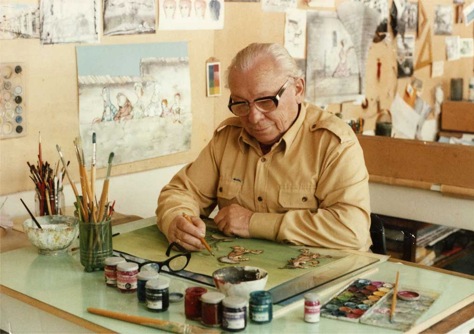
Karel Zeman with other tools of creation
Closer to home, I can report that some of the most resonant connections that I made during the conference were those closer to my own backyard. During lunch, I met groups of colleagues from Ellington and Simsbury High Schools in Connecticut, and it was such a pleasure to share stories of the challenges we face in the classroom as well as new ideas and tales of our ever evolving roles as 21st century educators.


 mediateacherdotnet