Feeds:
Posts
Comments

Archive for the ‘Media Literacy’ Category

Ticket window at Studio Cinémas in Tours, France

This past April, I led a student exchange trip to France in which students from my school stayed with correspondents and their families from Tours, France.  While there, I visited Studio Cinémas, a local cinema that houses an extensive cinematic archive and provides an example of a lively cultural presence in its small city.

This cinema is an example of one of the many independently-run theaters in France.  In France, there exists a system of support for independently-run local venues, such as through the Association of Arts Cinemas (Cinémas d’art et d’essai).  In terms of youth initiatives, throughout Europe there has been a great deal of enterprise with media literacy education (and particularly in Britain) and France is no exception.

Courtyard at the back of Studio Cinémas

In fact, there are many initiatives in France to encourage understanding of media and to expose young people to diverse media messages.  In some countries, funding of cultural initiatives and events is viewed as important to the health of society.  It is compelling to look at examples of this on a small scale, and in the case of this theater, there is a courtyard in the back and café at the front of the cinema, as well as a library and setting for cultural events.

Foyer with distinctive staircase and information desk.

This raises key questions of economics and of the viability of independent cinemas: what is their business model?  Conversely, how do chain theaters operate?  How have distribution networks evolved over the history of cinema and television?  To take the example of Paris, France, it is no random event that there are still dozens of individually-run cinemas in that city: they have been highly organized in developing support networks and they have been supported by societal attitudes in which culture is seen as a vital part of public life.

Think about how you experience movies and how they reach you: is there a diversity of choice in the movies you have access to?  Is going to the movies part of any other social interactions you have?  For many Americans, this would include the mall in which the chain theater is located.

Thanks for waiting: the last showing is not finished.

For most young people today, they do not experience the majority of the movies they see in a theater.  Often, they are seen streaming on the Internet or through sources such as Netflix.  One aspect of media communications that is rarely discussed in any extensive or profound way is how we are affected by viewing experiences: what are the different manners in which we see and hear media?  How do these differences affect us in contrasting ways?  How do these experiences affect behavior, everyday life, and personal development?

As mentioned in an earlier post, an excellent investigative project can be undertaken by students in which they look at local examples of media sources, including cinemas, and work to answer questions about how they function, how they are designed, and how they are experienced.  In the case of Studio Cinémas in Tours, here is an interesting article that appeared  in The Guardian about this independent cinema.

Around the corner from the cinema with library sign at right.

Read Full Post »

Here is an important article by Agence France-Presse (AFP) lifestyle editor Robert MacPherson about questions raised by Common Sense Media founder James P. Steyer concerning the effects of social media on kids.  Jim Steyer’s guide is called Talking Back to Facebook (there is a video to check out on this page).  These questions can be compared, contrasted, and evaluated alongside those of many longstanding debates about the effects of motion picture media, advertising, video and computer games, and other media on kids, grownups, and everybody else.  The topics of this book offer strong discussion points when considering the use of social media in schools and the role of visual media in social and cognitive development.

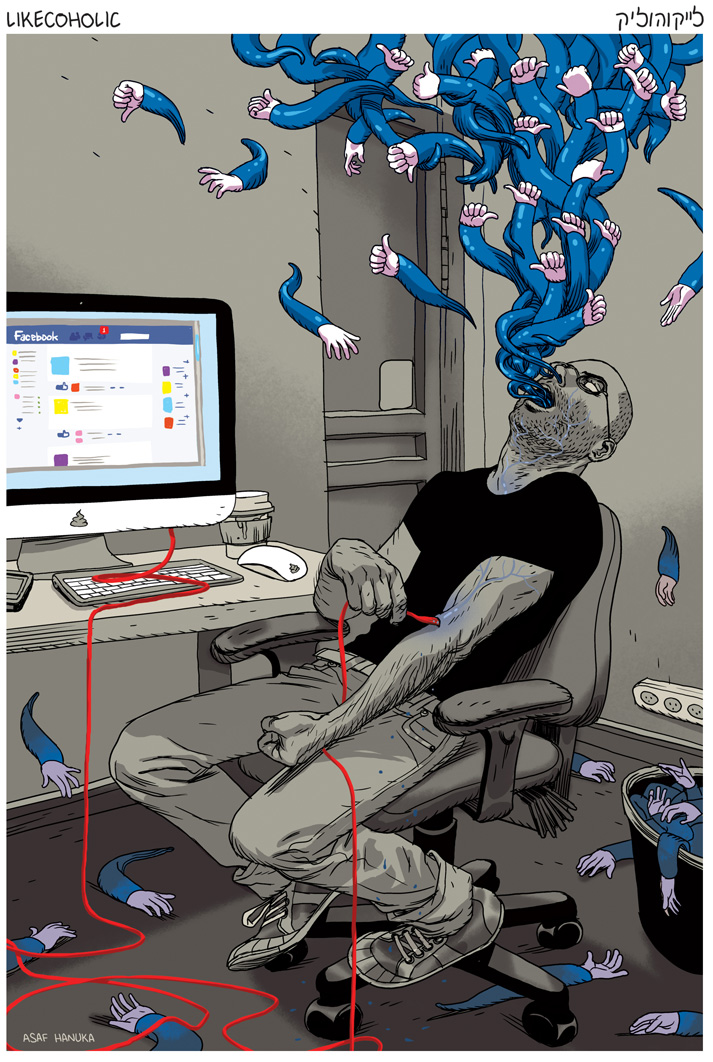
“Likecoholic” by Asaf Hanuka

For a rather striking illustration to accompany this post’s theme (I also recommend checking out Sponge Brain), check out the weekly online comics blog from Asaf Hanuka, the illustrator for the cover and splash pages of Moving Images.  Hanuka lives in Israel, and The Realisthis weekly comic that explores the emotional, societal, and artistic travails of a nearing-forty artist and father, is exceptional.   Earlier in these pages, when discussing Douglas Rushkoff’s A.D.D.I wrote “Graphic novels continue to be one of the most dynamic media around – one of the nice surprises that as the world goes digital, drawing continues to make a comeback in innovation and inspiration – and the relationship between comics and moving images offers boundless potential for visual storytellers and learning scenarios.”  I think it would be hard to find a more pertinent or striking short-form, online example of this than in Hanuka’s The Realist visual blog.

For those interested in the graphic arts and their myriad intersections with moving images, I encourage you to check out my earlier posts on Saul Bass and Alex Toth.

Read Full Post »

Fanciful flights across the globe, then back to Prague

Recently, I attended the 10th Annual Northeast Media Literacy Conference at the University of Connecticut.  There, I delivered a presentation on the development of higher order communications skills through non-fiction platforms using critical analyses and digital production of news media, documentary essays, and public service announcements (Recording, Synthesizing, and Evaluating Reality: Non-fiction Media in the Secondary Classroom).  It is typically an invigorating experience for teachers to be able to engage with colleagues from other schools, grade levels, and disciplines, and this conference offered ample opportunities for a rich diversity of interactions.

The two keynote speakers were Dr. Kathleen Clarke-Pearson, a pediatrician who discussed her perspective as a “mediatrician,” and Howard Schneider, former managing editor for Newsday and founding dean of the SUNY-Stony Brook School of Journalism, who spoke about his work establishing a news literacy course for all students at the university.  Dr. Clarke-Pearson stressed the need to balance continually the positives and negatives of new methods of communication and immersion in digital media, and she pointed out the importance of considering neurobiology and studies that have investigated the impacts of media usage on young children.  She highlighted the work of Michael Rich at the Center on Media and Child Health and that of Dimitri Christakis in early brain development, in which he has shed light on deficient language development and significant attention problems due to the negative effects of television exposure in young children.  After lunch, Howard Schneider recounted the development of a news literacy program at Stony Brook in which all undergraduates take a required journalism course to prepare them to be discerning news consumers and competent citizens.  His opening salvo was “The Truth is in Trouble,” and, while describing the essential questions and frameworks of their program, he focused on the importance of imparting three parameters to students for evaluating news to qualify it as reliable information: Verification, Independence, and Accountability.

Howard Schneider with Gutenberg and Stewart

Moreover, the conference was attended by a large group of international educators and professionals from media communications fields across the globe, and the final event of the conference was a panel discussion with five members of this group.  We were able to hear from Rania Al Malky, the Chief Editor of Daily News Egypt, who discussed the well acknowledged role of social media in the revolution in Egypt, as well as the functions of moving image media in how the uprisings played out and were experienced nationally and throughout the globe.  During the panel discussion,  the Rev. Mike Nsisak Umoh, the Director of the Center for Media Development at the Catholic University of Lagos, Nigeria, spoke of worldwide cultural shifts taking place and their possibilities to impact deep social change.  He described the development of media literacy as offering the possibility of “a Panacea for World Peace Development” and commented that “Media is the new World Currency.”  In particular, he cited the need to revisit the controversial MacBride Report for UNESCO from 1980, and the degree to which its analyses and recommendations have continued to resound pertinently to those working in media literacy in the developing world.

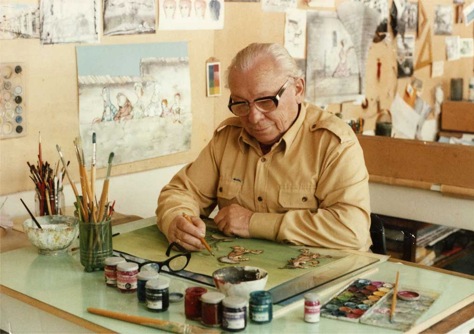
Karel Zeman contemplating a sequence

Another member of the panel was Pavlina Kvapilova, the executive director of New Media Division for Czech Republic national television networks (with the intriguing channel order of 1, 2, 24, 4), and a dynamic speaker and debater.  In particular, she spoke about the use of social media by the Czech national television services to keep connected to their audience and keep their news division pertinent to viewers.  Check out the pages for children’s programming — they’re incredibly fun to look at and remind me of the great traditions in Czech animation.  A personal favorite movie that I was reminded of as I looked at these pages was “Ukradená vzducholod” — or, The Stolen Airship — from 1967 by the great Czech director (and animator and special effects wizardKarel Zeman.  I saw this movie (as Le Dirigible Volé) a few years ago with my eldest son in the Studio des Ursulines in Paris , one of the most magical cinemas in the world that has specialized in children’s movies for a number of years having started out nearly a century ago as a theater showing movies of the avant-garde.  How the media world turns…

Karel Zeman with other tools of creation

Closer to home, I can report that some of the most resonant connections that I made during the conference were those closer to my own backyard.  During lunch, I met groups of colleagues from Ellington and Simsbury High Schools in Connecticut, and it was such a pleasure to share stories of the challenges we face in the classroom as well as new ideas and tales of our ever evolving roles as 21st century educators.

Read Full Post »

One of the logos for the group responsible for the Kony 2012 Viral Campaign and 11 short films over the past decade.

Earlier this week, while my media class was working in groups on an upcoming project, one student turned to me and said, “Kony 2012.  You’ve got to check this out.  A major event is happening right now in how media works.  I’m not saying it’s good, but you should check it out.” Later during that same period, other students started talking about it; some had shared it from Facebook, some were talking about celebrity posts on Twitter, some were thinking about doing something in response to this piece.  The next day, I even heard 7th graders talking about it in a Middle School class that I teach.

Indeed, this week, a phenomenon burst into the scenes of social media, non-fiction moviemaking, and how moving images are functioning in our world today.  I would recommend for teachers and students to look at the Kony 2012 movie using the questions for Chapter 6, “Recording and Presenting Reality,” on pages 237-238 of Moving Images.  Notable subjects for discussion of this media document are the presence of director Jason Russell in the voiceover and images; the use of his young son as one of the primary figures in the images; the digital techniques used in the movie; and marketing methods employed by the filmmakers and this group.  Here is an excellent article from the New York Times on the phenomenon of the Kony Video going viral.  In addition, here is a one of the rare news pieces appearing in major media – in this case from Democracy Now – about the deployment of troops to Uganda by the Obama administration in October 2011.

Read Full Post »

Iconic image of Robert Redford in “The Candidate”

Here is an excellent discussion between Bill Moyers and Neal Gabler (with fine choices of clips from the undervalued classic The Candidate along with George Clooney’s The Ides of March).  Gabler and Moyers discuss many issues that will be featured themes of this blog and work especially well with issues raised in Chapters 5 and 6 of Moving Images: the influence of movies on politics; news literacy; advertising culture and democracy; the struggle between depth and superficiality in moving images, media narratives, acting, creative expression, and independent thought.  This interview is exceptionally informative, thought provoking, and useful for debate and further inquiry; it is simply a treasure trove for studies of media literacy and contemporary culture — political and otherwise.  Highly recommended!

I will be back soon with discussion of the Oscars and useful links regarding the movies that got the nods from the Academy voters.   And here’s another interesting link: Neal Gabler’s choices for Ten Great Political Films.

Read Full Post »

« Newer Posts - Older Posts »