
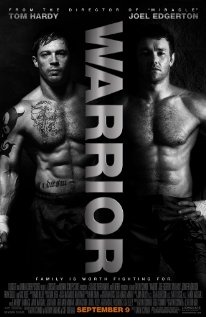
Marketing and visual communication discussion for the classroom: Is this poster effective in communicating the story of “Warrior?” Is this poster going to help to attract the full potential audience for this movie?
From my perspective, one of the most useful movies from 2011 to study in a media literacy class would have to be Warrior, directed by Gavin O’Connor. In the American press, much of the commentary that I have seen is about the film’s relationship to the traditions of Rocky and similar sports movies (smartly acknowledged by the filmmakers in an offhand dig at character Tommy Conlon/Riordan when he first goes into a gym). However, a very interesting contrast with that 1976 movie can be studied through the roles of various media in Warrior: the style and omnipresence of television’s high-octane, aggressively promotional nature in contemporary society; the use of social media as a go-to connection between people (in fact, that it is through the Internet that you will be tracked down!); and the importance of audience in the relationships between subjects, media, and events.
The central setting of the movie is one of the most important issues to consider: the mixed martial arts ring. Its violence is not for every viewer, and that should be the first consideration of the use of this movie, although in current television standards, there is a strong push to normalize mixed martial arts in popular culture. At its release in the summer of 2011, critics virtually across the board seemed quite surprised that this movie combines the rousing excitement of a sports showdown movie with complex thematic material, from abuse, alcoholism, and family dissolution to military service and the drive to live through violence. For many viewers, this is a deeply moving motion picture. I must add that the casting and direction of actors are particularly distinctive: the performances in this movie are simply pitch-perfect. Tom Hardy has received many justified accolades for his performance and Nick Nolte should be nominated for a Best Supporting Actor Oscar in one of the best performances of his career, but the rest of the ensemble I found to be just as good, including Joel Edgerton in a particularly challenging role, playing a high school physics teacher beset by financial troubles that bring him back into the brutal ring of MMA. I should add that Joel Edgerton’s brother Nash is the filmmaker who is featured in the interview for Chapter 8 of Moving Images, and their production company Blue-Tongue provides another fine angle for the study of the moviemaking process in conjunction with this chapter, The Production Process.

Tom Hardy and Joel Edgerton in Warrior: two performances that are more about subtlety and character depth than brawn.
In addition, the movie raises a number of other fruitful topics for classroom work. First, to investigate the moviemaking process, the bonus materials available on Warrior’s discs provide for an in-depth examination of pre-production and production, including one of the best “making of” docs I have seen (primarily because of excellent filmmaker interviews that avoid most of the fluff typically seen in these pieces). The development process is described in vivid detail and the perspective of the writers is well explored, including the story’s original setting of Long Beach, California! There are many other issues providing for fruitful discussion, including the contributions of cinematographer Masanobu Takayanagi (in an astonishing major feature production debut), the rehearsal process, and analysis of footage from the production. There is also the inclusion of a deleted scene, that, to me, is one of the most painful I have ever had to watch: this sequence belonged so powerfully in the movie! I can understand the desire of the filmmakers to keep up the pace of the movie early on, but this is a tour de force scene that helps to give more substance to the shared background in the military of Tommy and his father Paddy. Classroom debate: is the movie already too long? Do you need the scene? Can you put it in? Where?
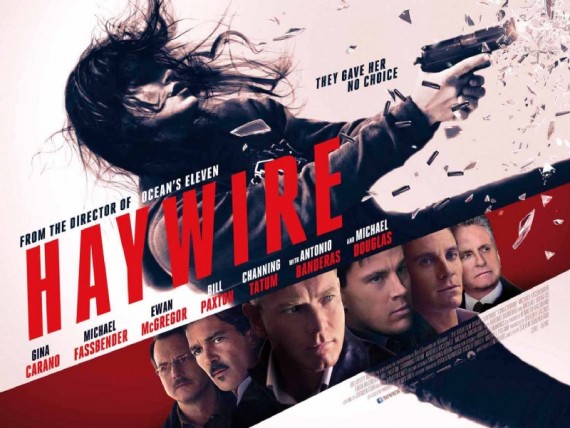
Second is the role of violence considered from a number of angles: in the mediamaking process, in the values held by contemporary cultures, and in the themes and meanings of this particular story. One important angle is this: what is the responsibility of media professionals regarding the safety of those working on its products? There is a great deal of footage in the extras of this movie that show the lengths to which the moviemakers worked to choreograph the convincingly realistic fight scenes. Recently, I have noticed a trend in celebrating “real violence” as necessary to the realism of media products. Just this week, I read two articles about movies opening this month in which filmmakers were using the pain inflicted on their performers as selling points to the movie. For Soderbergh’s movie Haywire, scripted by Lem Dobbs (the writer of Kafka and The Limey, which is one of my favorite Soderbergh films along with King of the Hill, The Underneath, and Out of Sight), when the director talks about his new movie he stresses the effects of actually inflicting the pain. Talking about actor Michael Fassbender, he says, “He took a beating.”
In an interview about the release of Contraband, directed by Baltasar Kormákur, actor Mark Wahlberg talks at length about the degree to which they wanted to “just go crazy… like when I get to smash Giovanni Ribisi’s head and pull him through the window of the truck, that was really fun…[and for a scene in the upcoming movie] Broken City… I honestly think it’s going to be one of the best fight scenes ever in a film, because it’s real.”
The first chapter of Moving Images is about motion picture language, which involves learning about the power of editing and basic techniques of moviemaking. In the classroom, students will sometimes write scenes in which there are physical altercations, punches, or fights. For some students, it takes a bit of learning to discover that the actors do not need to hit each other in order to create the scene. In fact, the students are required not to inflict harm or break any school rule when creating media, just as our drama students learn how to stage fights for theatrical productions. These recent trends in movie culture could provide for potent classroom discussion.
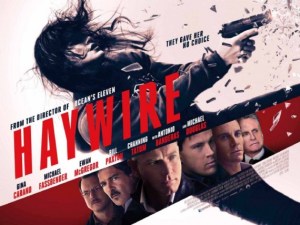
Steven Soderbergh’s “Haywire” with script by Lem Dobbs
Raising the point of editing is one of the major other topics addressed in this debate: in their interviews both Soderbergh and Wahlberg talk negatively about intentionally jarring editing and jittery hand-held shooting, and each one cites the more recent Bourne movies as an example. In fact, I use The Bourne Supremacy as an example of jump cuts in Chapter 1 of Moving Images. Now, the tables are turning and filmmakers are vaunting the fact that in their movies the viewer can actually understand the geography and sequence of action scenes. (Although in the interview with Soderbergh, the reporter uses Doug Liman’s Bourne Identity as the reference, but this is incorrect; it was in the later Bourne movies directed by Paul Greengrass that this highly jarring, non-continuity style was adopted full force.) Soderbergh says about Haywire, “I don’t think there’s a single hand-held shot in the movie. We were really consciously going against the grain there, because my feeling is that lately, there has been a way of disguising the fact that the people can’t really do what’s required, and knowing that I had Gina, and knowing that we had cast people around her who could actually do this stuff, we took the conscious position of letting you really see it, not cutting as fast, keeping the shots looser, and having you feel, ‘Wow, that’s really happening in front of us.'” And when Soderbergh cites a James Bond movie as an influence for this movie, it is Terence Young’s From Russia With Love – which sounds good to me, as it’s one of my favorites too!
How styles cycle back and forth!
And as a final note, thanks to my student Dylan Taravella for recommending Warrior and for not giving up reminding me until I saw it.
Read Full Post »
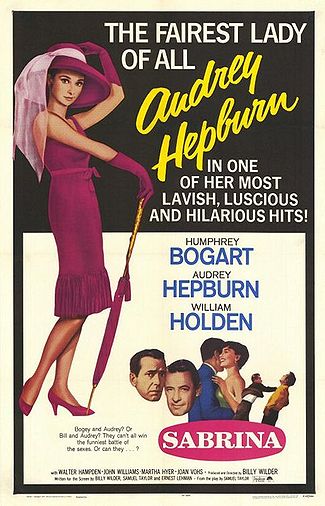 Today there was an elegantly designed Google Doodle about one of the most celebrated costume designers in moviemaking history: Edith Head. Here is an article from the Christian Science Monitor that features an excellent embedded video in which Edith Head discusses her work with Audrey Hepburn, one of the most stylish actresses of Hollywood history. Edith Head’s story provides intensely interesting insights into the workings of the studio system — in her case, it was primarily at Paramount Studios (including numerous Hitchcock pictures). In fact, to check out her work at Paramount, I would recommend to go right to one example of a black and white movie and another in color. For B&W, check out the delightful Sabrina, directed by Billy Wilder and starring Hepburn, Humprey Bogart, and William Holden, and in color, the s’wonderful Funny Face, directed by Stanley Donen and starring Hepburn and Fred Astaire.





 mediateacherdotnet