Feeds:
Posts
Comments

Archive for the ‘Chapter 5’ Category

image-homepage

Admongo: Deconstructing Commercial Messages

As mentioned earlier in this blog, at the 11th Annual Northeast Media Literacy Conference at UConn I am presenting a talk titled “CCSS and Media Literacy in the Classroom: Communications and Critical Thinking through Promotional and Public Service Messages.”  As a service to those attending the conference and to followers of this blog and the Moving Images textbook, here are notes and links included in my presentation.

First, it is important to review principles of media literacy: here are the essentials at the NAMLE website.

Then, on to what educators face as principal challenges in curriculum development today: the Common Core State Standards.  For media literacy professionals, the following descriptions are the essentials.  For Reading Literature:  Analyze the representation of a subject or key scene in two different artistic mediums (RL/9-10:7); Analyze multiple interpretations of a story, drama, or poem (RL/11-12:7).  For Reading Informational Texts:  Analyze various accounts of a subject told in different mediums (incl. multimedia).. (RI/9-10:7); also, integrate and evaluate multiple sources of information presented in different media or formats (e.g. visually, quantitatively) as well as in words in order to address a question or solve a problem (RI/11-12:7).  For Speaking and Listening, students must make strategic use of digital media (incl. audio, visual, and interactive elements) in presentations to enhance understanding of findings, reasoning, and evidence and to add interest.  (SL/9-12:5)  Finally, in History/Social Studies and Science/Technical Subjects, learners have to make strategic use of digital media (incl. audio, visual, and interactive elements) in presentations to enhance understanding of findings, reasoning, and evidence and to add interest.  (SL/9-12:5)
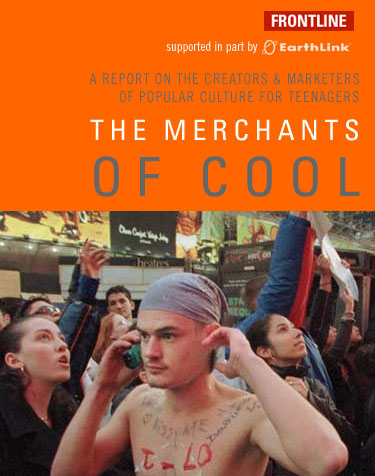
MerchantsCoverFor resources specific to the investigation of commercials, one of the best places to begin is at Frank Baker’s Media Literacy Clearinghouse, where there is a homepage for materials on critical thinking about advertising.  For educators of elementary and middle grades, there is the Federal Trade Commission resource Admongo, which features many exercises and lessons.  From my own materials related to Moving Images, there is an extended interview on this blog with advertising copywriter Kevin Goff, and links to commercials can be found.  These can be evaluated using such models as those of the Instructor’s Resources with Moving Images or this lesson from the MLC pages: Deconstructing a TV ad.  Recent ads have come under quite a bit of scrutiny, such as the commercials during this year’s Super Bowl.

Other examples used during the presentation are for investigative work done by students using such exposes as PBS’s Merchants of Cool and Digital Nation and Media Education Foundation’s Killing Us Softly and The Bro Code .   Using selected parts of these media reports as a basis, students must research topics offered by their teachers and create presentations based on the media questions that are most appropriate.  The attached Unit Activity GuideCritical Analysis 5b Lesson Plan – was drafted for work with Merchants of Cool and Digital Nation in conjunction with Chapter 5 of Moving Images.

As for examples from my classes that are shared during the presentation, those are for attendees – so I look forward to seeing some of you media literacy educators there!

Read Full Post »

mindtap_contestpage_335x360_FINALCengage, the publisher of Moving Images, is sponsoring a video challenge through their MindTap initiative that should greatly interest student moviemakers and media teachers.  Cengage is offering scholarships to the winning projects that express compelling and provocative answers to this question: “What makes you a unique learner?”  Check out the explanatory video and contest guidelines, and you will see that the contest is designed around an interesting premise that promotes a wide range of creative possibilities.

I should add that this could make for an excellent assignment for Chapter 5 of Moving Images.  And the top prize is $2500 (applied to university tuition)!

Read Full Post »

As media professionals work on figuring out new ways to reach audiences and create sustainable business models, here is a new example that can be very useful for media educators: the I Files.  This YouTube channel, developed by the Center for Investigative Reporting, is looking “to make investigative reporting more web-centric, vibrant and social, in a way we hope attracts more viewers and interest for the enterprise journalism communities depend on,” according to Michael Maness of the Knight Foundation, which funds The I Files.  The site will serve as a conduit to investigative news reporting and will feature work not only from major media outlets but also by independent, web-based journalists.  Research has shown that news events are among the top searches on YouTube, and The I Files hopes to capitalize on this.  The channel is also offering The I Files Future Award, a contest for journalism students.

In their most recent postings, The I Files are highlighting current news and documentary Emmy nominees for non-fiction work.   These include Better This World (directed by Katie Galloway & Kelly Duane de la Vega; about two Americans arrested as domestic terrorists during the 2008 Republican convention; see it here on PBS), Enemies of the People (directed by Thet Sambath and Rob Lemkin, this feature doc concerns the Khmer Rouge genocide in Cambodia), A National Disgrace (produced by Dan Rather reports, it is about challenges facing the Detroit School System), and a number of other highly rated contemporary documentaries worthy of investigation by educators.

Read Full Post »

The Aftermath, or Why I Seem so Tired in the Morning by Jake Peterson

From our 12th Annual Film and Video Festival, here are some award winning shorts  directed and produced in my high school media literacy and production classes by Jake Peterson.  The first, The Aftermath, or Why I Seem so Tired in the Morning, is the short Jake produced for the portrait assignment in Chapter 5: Personal Expression and Studio Production.  Next is a documentary that presents a state championship season of a high school cross-country team: SHS X-Country 2012.   Finally, there is The New Officean entry in the rapidly-developing genre of the mockusitcommockumentary.  Or something like that.  It won a screenwriting award.

Read Full Post »

Ticket window at Studio Cinémas in Tours, France

This past April, I led a student exchange trip to France in which students from my school stayed with correspondents and their families from Tours, France.  While there, I visited Studio Cinémas, a local cinema that houses an extensive cinematic archive and provides an example of a lively cultural presence in its small city.

This cinema is an example of one of the many independently-run theaters in France.  In France, there exists a system of support for independently-run local venues, such as through the Association of Arts Cinemas (Cinémas d’art et d’essai).  In terms of youth initiatives, throughout Europe there has been a great deal of enterprise with media literacy education (and particularly in Britain) and France is no exception.

Courtyard at the back of Studio Cinémas

In fact, there are many initiatives in France to encourage understanding of media and to expose young people to diverse media messages.  In some countries, funding of cultural initiatives and events is viewed as important to the health of society.  It is compelling to look at examples of this on a small scale, and in the case of this theater, there is a courtyard in the back and café at the front of the cinema, as well as a library and setting for cultural events.

Foyer with distinctive staircase and information desk.

This raises key questions of economics and of the viability of independent cinemas: what is their business model?  Conversely, how do chain theaters operate?  How have distribution networks evolved over the history of cinema and television?  To take the example of Paris, France, it is no random event that there are still dozens of individually-run cinemas in that city: they have been highly organized in developing support networks and they have been supported by societal attitudes in which culture is seen as a vital part of public life.

Think about how you experience movies and how they reach you: is there a diversity of choice in the movies you have access to?  Is going to the movies part of any other social interactions you have?  For many Americans, this would include the mall in which the chain theater is located.

Thanks for waiting: the last showing is not finished.

For most young people today, they do not experience the majority of the movies they see in a theater.  Often, they are seen streaming on the Internet or through sources such as Netflix.  One aspect of media communications that is rarely discussed in any extensive or profound way is how we are affected by viewing experiences: what are the different manners in which we see and hear media?  How do these differences affect us in contrasting ways?  How do these experiences affect behavior, everyday life, and personal development?

As mentioned in an earlier post, an excellent investigative project can be undertaken by students in which they look at local examples of media sources, including cinemas, and work to answer questions about how they function, how they are designed, and how they are experienced.  In the case of Studio Cinémas in Tours, here is an interesting article that appeared  in The Guardian about this independent cinema.

Around the corner from the cinema with library sign at right.

Read Full Post »

« Newer Posts - Older Posts »