Feeds:
Posts
Comments

Archive for the ‘Animation’ Category

kirstenleporemountain

Kirsten Lepore making Move Mountain

In earlier posts, unique animators like PES and Norman McLaren (and Tim Burton too) have been featured, and here is something new to check out: the work of Kirsten Lepore.  As with many independant stop-motion filmmakers, a great deal of her work is in commercials.  Great lessons in non-dialogue storytelling, editing, and sound design are to be found in her shorts Bottle (a distinctly poignant love story between sand and snow) and Move Mountain (which the director describes as “a story about illness, perseverance, and our connection to everything around us”).  Along with lessons in frame-by-frame moviemaking, of course.  Both also have respective making of pieces: Making of Move Mountain and Making of Bottle.

If you are interested in more information on the topic, check out Cengage Learning’s title The Advanced Art of Stop-Motion Animation (by Ken Priebe).  While we are on this topic, you might be interested in turning to two of the masters of the form: Jan Švankmajer and Brothers Quay.  And in a few months, the very promising-looking The Boxtrolls from Laika studios will be arriving…

Update: Here’s a great interview by Girls at Library with Kirsten Lepore (who by now has also written and directed an episode of Adventure Time: Bad Jubiesabout reading and books.

Read Full Post »

Saul Bass titles for Delmer Daves's "Cowboy"

Saul Bass titles for Delmer Daves’s “Cowboy”

Today’s Google Doodle is a clever visual pièce-de-résistance quite worthy of its subject, Saul Bass.  A year ago, I wrote a blog post about this brilliant American creator in Saul Bass, Visual Innovator.  As well as checking out my post you should also see this piece by the Doodle’s creator, Matthew Cruickshank, or this Washington Post blog that features many video links.  Have fun watching this little movie and guessing the big movies it celebrates!

Read Full Post »

curfew_movie_poster-650x0This year’s Oscar winning live action short film, Curfew, has all the earmarks of 21st century media artistry: it was edited on a Macbook Pro by its director and star who is also the frontman for an indie band.  Shawn Christensen also wrote its script; moreover, aspiring screenwriters are encouraged to check out this year’s highly lauded group of nominated shorts, which offer many lessons in screenwriting and directing, particularly Asad by Brian Buckley and Buzkashi Boys, directed by Sam French and written by Martin Roe.

In the documentary category, the winning movie, Inocente, directed by Sean Fine and Andrea Nix Fine, was partially funded by a Kickstarter campaign.  It is a non-fiction portrait about a young girl’s powerful determination to continue to create art and never surrender to the intense challenges she faces in her life.

Tough BirdIn the animated category, the winner was the Disney short Paperman, directed by John Kahrs and released along with Wreck-It Ralph.  In this case, the most surprising aspect of the victory for this non-dialogue short created through a new in-house technology called Meander is that this is the first win for a Disney short in this category since 1969!  That short was It’s Tough to be a Birddirected by legendary animator Ward Kimball.

Read Full Post »

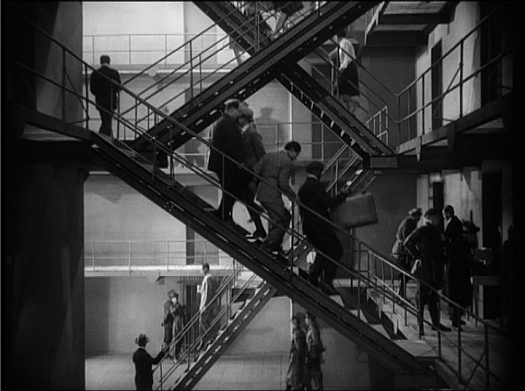
“Spies” directed by Fritz Lang, 1928

When we teach, we are constantly discovering (and hopefully those who are learning are constantly discovering too!).  Some lessons work, some fall flat.  We need to renew, to reinvent, to challenge ourselves and our students to dig deep into the themes and problems that we face in our studies and to invigorate our skills through these explorations.

In an earlier blog post, I discussed the particular challenges in developing students’ skills as visual communicators and the benefits of studying early motion picture history and non-dialogue moviemaking.  Recently, as my class was working on this unit, I decided to do something new.  One of the skill-building class activities I have done with this unit is a short project – produced in just a couple of class periods – in which students face the same challenge that filmmakers did for the Lumière and Company project.  This one-minute, one shot movie is offered as one of the extra projects that teachers can use with Moving Images (this one is Class Activity 2).  While I do find that this project can be instructive and offers a distinctive test to students, I thought it was about time to try something new.  I wanted to give them a task that could connect with other events going on in our school and could tie into learning in upcoming units.

“More” an animated short by Mark Osborne

So this is the intro to the exercise:  In this unit, you study the invention of moving images and the advances made in visual communication by early moviemakers. For this class exercise, you will explore possibilities of motion picture storytelling through the creation of a short movie designed to communicate a simple idea to an audience. For this project, you will determine a topic appropriate for a message at your school. This may be a public service announcement, a promotional piece for a school group, club, or team, or a commercial for a school enterprise. Along with studying examples from the early years of cinema, from Lumière and Méliès shorts and The Great Train Robbery to more advanced silents including selections from Fritz Lang’s The Spieswe also study contemporary examples of non-dialogue movies, such as Mark Osborne’s More (which is on the Moving Images DVD) and Mark Gustafson‘s Mr. Resistor.  Since this project had to meet the distinct needs of commercials or PSAs (in our case, to last between one and two minutes), we also watched previous standout student work in this vein in addition to commercials such as Volkswagen’s “The Force” (which premiered during the 2011 Super Bowl).

I decided that I would let students select their collaborators, and they dived right into the task.  As it turned out, the class ended up in four groups, and the projects they did turned out very well.  In fact, every completed PSA turned out to be quite worthy and appropriate to show on the school-wide morning announcements.  They were clearly the best set of rapidly produced shorts in this course that I have taught for over a decade.

This activity has already been added to the teacher materials for Chapter 2 – it is titled “Class Activity 2b” – and it has been uploaded to the Cengage textbook site for instructors and students.

Read Full Post »

A page from Winsor McCay’s comic “Little Nemo”

Today’s Google Doodle celebrates the work of groundbreaking artist Winsor McCay, whose creations are ripe for investigation when exploring the material of Inventions and Origins in Moving Images.  McCay’s explorations of motion picture language and the ways that one can play with frames and sequences in films such as Gertie the Dinosaur reflect the sense of discovery and invention that one sees in recent transitions during our own digital age, and they can initiate fruitful discussion and inspiration in the classroom.  Moreover, Little Nemo‘s visual storytelling and intricate artistry serves as one of the best and most beautiful examples of sequential art that one can find.  For further information on McCay, John Canemaker‘s biography is excellent (as usual; his writings on the Disney studios, such as Nine Old Men, are also highly recommended) and here is an interesting blog page on this innovative and very interesting creator.  (And definitely check out the full animation of the Little Nemo doodle — it’s superb and quite worthy of the artist and vaudevillian McCay; in further celebrations of moving images, last month’s Google Doodle for the 46th anniversary of Star Trek was a real winner too!)      

Read Full Post »

« Newer Posts - Older Posts »