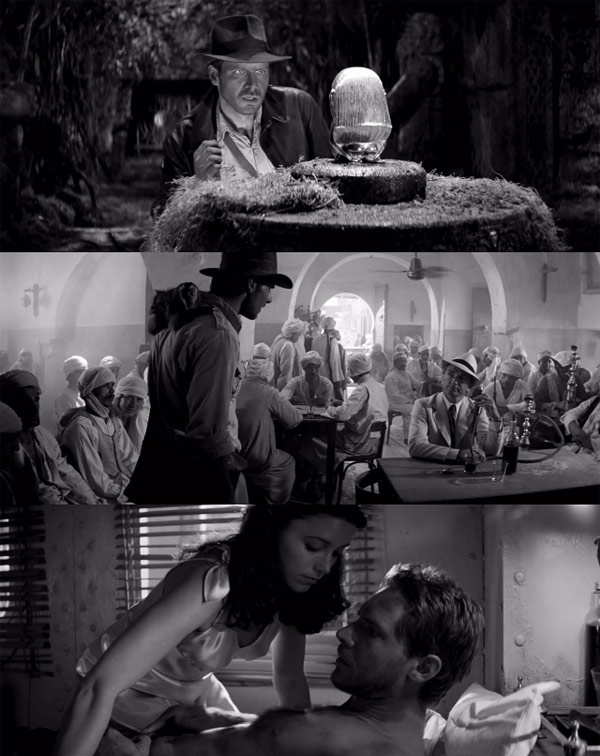
 For a lesson in the art of directing from American master Steven Spielberg, here is an educational exercise courtesy of another American master, Steven Soderbergh. On his site Extension 765, Soderbergh has taken the movie Raiders of the Lost Ark and posted a version of it in which he has removed the color and replaced the entire soundtrack with a contemporary — and very Soderberghian — score, in order to study the staging, pace, and other visual elements of Spielberg’s direction. And, yes, Raiders looks superb in black and white, thanks to its cinematographer Douglas Slocombe (still alive at 103 years old!), who also shot such classics as Rollerball, The Lion in Winter, The Lavender Hill Mob, The Man in the White Suit, and one of my all-time favorites, The Fearless Vampire Killers. If you ever wondered what Raiders of the Lost Ark would look like as a silent film, this is it! And if you are looking to see how others have learned lessons from the directing (and cinematography and editing) skills of Mr. Steven Soderbergh, look no further than that little TV show Breaking Bad. For my money, Vince Gilligan and his colleagues must have spent a fair amount of time watching various examples of Soderbergh’s work to find inspiration for Breaking Bad from the tone, pace, atmosphere, and other elements of style in a number of his best movies.
Archive for 2015
Soderbergh Raids the Ark
Posted in Chapter 1, tagged Breaking Bad, Douglas Slocombe, Extension 765, Raiders of the Lost Ark, Steven Soderbergh, Steven Spielberg, The Fearless Vampire Killers, Vince Gilligan, Visual Literacy on April 17, 2015| 1 Comment »
Lumières, Caméra et Action !
Posted in Chapter 2, tagged Grand Palais, Institut Lumière, Invention of Cinema, Louis Lumière, Lumière! Le Cinéma inventé, Rachel Donadio on April 6, 2015| Leave a Comment »
 That’s not really what they say in French to begin a take, but it will work on this occasion. In fact, the “cinématographe” was the groundbreaking device invented by Louis Lumière, working with his brother Auguste, over 120 years ago. To mark this 120th anniversary of the birth of projected movies and the inventions, innovations, and visions of the Lumière brothers, the Institut Lumière based in Lyon, France has partnered with the Grand Palais in Paris to create an exhibition “dedicated to the flagship inventions of the Lyon-based pioneers of cinema, Louis and Auguste Lumière.”
 Rachel Donadio, writing in the New York Times, states “Back before Instagram and selfies, before home movies and Kodachrome — and long before the obsessive documentation and online sharing of every moment of our waking lives — there were two brothers from Lyon whose innovations opened the door to the future.” It is appropriate that this exhibit is in Paris, where the brothers held the first paid public screening of their movies on December 28, 1895 at the Grand Café, and where they screened large-format 75mm films at the Universal Exhibition of 1900. Check out this thorough article from the New York Times for an introduction to these inspiring filmmakers, or of course consult the pages in Chapter 2 of Moving Images that describe their place in moving image history.
Looking for “Truth?”
Posted in Chapter 6, tagged Errol Morris, Standard Operating Procedure, The Fog of War, Truth in Documentary Film on March 31, 2015| 1 Comment »
 As a follow-up to concepts in the previous post — Getting all Black and Blue over Media Literacy — here is an excerpt from an interview with filmmaker Errol Morris (The Thin Blue Line, Fog of War, Standard Operating Procedure, among others) in which he discusses seeking authenticity and truth in documentaries. Morris also wrote an article about this topic in the Boston Globe.
Getting all Black and Blue over Media Literacy
Posted in Chapter 4, Chapter 6, Media Literacy, Social Studies, tagged American Sniper, Brain Games, Clint Eastwood, Jeffrey M. Zacks, media literacy, Noah Gittell, Seeing is Believing, Selma, The Imitation Game, White Gold Blue Black Dress, Why Movie 'Facts' Prevail on March 29, 2015| 2 Comments »
 Or is it white and gold? A few weeks ago, a new viral event entered the lexicon: So, is the dress in that picture white & gold or blue & black? And an intense debate ensued. I first was asked about it by a student in my Advanced Media Literacy & Production class, and I laughed because kids, being kids, were quickly getting furious about the different opinions being expressed and whether or not one was a “white/gold” or “blue/black” person. And they were also quite sure that what they were talking about was the color of a dress. I told them that what they were looking at, and debating, was a picture of a dress, and that what they were disputing was how they perceived the visual information in the picture. If they were well trained in media literacy, they might be able to address a few key issues at hand: first, the lighting in the picture is clearly problematic and we tend to interpret that visual information relative to many perceptions we have related to light and color. I guessed “white/gold” because the bluish tint to the white I instinctively dismissed to the overexposed highlights while the darker tone certainly did not look black to me. (Do it right now with the picture here: cover everything else except for a patch of the dark bands on the dress: is that black to you?) This also brings up another issue that is important to consider: by giving the choice of blue/black or white/gold, there is already a setup for the viewer, we are already given a bias or a set of parameters that will skew our reactions to what we see. We may even see things that aren’t necessarily there or it may limit our reactions by design. These issues are discussed in Chapter 4 of Moving Images: in order to master Storytelling with Light, one must understand light. And that includes the concept of white balance, which clearly was not in play with this photo. For anyone interested in further exploration of these issues related to light and color, I highly recommend the episode Seeing is Believing from the excellent series Brain Games. The lesson related to our perception of color is also in this BBC article – scroll down to the example Cube Illusion – within moments, you will probably be thinking “I can’t believe my eyes! No way!”

Another American marksman: director Clint Eastwood in Unforgiven
Another major media event from this year that makes me think of these issues is the enormous success of the movie American Sniper, directed by Clint Eastwood, which may become a media document used in our schools throughout the years to come. For many young people, both the movie and its source autobiography are already regarded as a core historical text in the “War on Terror” and a rather faithful document of recent American history, as I have witnessed on numerous occasions in conversation and text. This movie is a treasure trove of lessons in media literacy, through which one can delve into the messages being communicated visually and constructed for audiences, from the editorial links between the events of 9/11 and Iraq; to depictions of Iraqis as “savages” (to quote the author and subject of American Sniper, Chris Kyle) and black-clad villains of the American Western transplanted from the sandy vistas of cowboys to the desert lands of the Middle East; and to the use of actual documentary footage from Kyle’s funeral in Texas to conclude the film, cementing its message to audiences as a historical document. In discussing the topic of the understanding of history through movies, Jeffrey M. Zacks writes in Why Movie ‘Facts’ Prevail (New York Times,February 13, 2015): “You might think: Does it really matter? Can’t we keep the film world separate from the real world? Unfortunately, the answer is no. Studies show that if you watch a film — even one concerning historical events about which you are informed — your beliefs may be reshaped by ‘facts’ that are not factual.”

“Mustafa” – truth or fiction? Be media literate and do the research!
Issues of authenticity, distortion of historical truths or outright inaccuracy, acceptable or inappropriate license taken in the depiction of historical events or figures are all core issues faced by countless media creators working in both fiction and non-fiction. They are core topics of Chapters 5 and 6 of Moving Images. This past year, many valid points have been raised about controversial choices relative to the visual communication and dialogue in a number of historically-based movies, particularly American Sniper, The Imitation Game, and Selma. Educators must continue to encourage vigorous debate and to develop students’ abilities to interpret, question, and assess the media messages with which they regularly interact.
If you are looking for a good analytical piece on American Sniper, I think this article by Noah Gittell is one of the best; he provides a brief but excellent visual and thematic analysis of the movie and appropriately contextualizes the opposing poles observed in reactions to the film.
Let’s Be Careful Out There
Posted in Chapter 1, Chapter 8, Media Literacy, tagged Midnight Rider, Randall Miller, Sarah Jones, The Frame, Video Production Safety on March 15, 2015| Leave a Comment »
For any teacher of moviemaking, one of the most vital concerns should always be safety. I know that it always has been for me — and for anyone working with adolescents it must take on the utmost importance. In class guidelines, the significance of clear rules and principles for safety must be firmly articulated in any agreement to which students and parents must sign. When developing the textbook Moving Images, I knew that I would need to discuss safety in my notes to instructors and in project guidelines, and I pointed out to the publisher that there must be a clear statement about safety in the front matter of the book.
 In recent months, the importance of safety for all media creators has been at the forefront of discussions of industry standards and production practices and the legal implications of our work as moviemakers in the tragic death of assistant cameraperson Sarah Jones. Director Randall Miller was sentenced to a two-year prison term for involuntary manslaughter for the death of Ms. Jones during a night shoot on the feature film Midnight Rider. As reporter Richard Verrier explains, “The crew was filming a scene – a dream sequence for a movie about the life of Greg Allman of The Allman Brothers. And actor William Hurt was lying on a bed that had been placed on a railway track … the crew had been assured that no trains would be coming down the track, that they had permission to film there from the landowner. And what happened was a CSX freight train came barreling down the tracks and hit the bed and shards from the bed struck and killed the camera assistant Sarah Jones… and injured several other workers.” This piece for the podcast The Frame provides further information and discussion of this tragic incident and its current implications for the industry. However, it should be pointed out that these are not new concerns: Among the most famous cases of loss of life during film production are the deaths of Vic Morrow and two child actors during the making of John Landis’s segment of Twilight Zone, the death of actor Brandon Lee on The Crow, and the death of a stunt crew member for the creation of chase sequences in Christopher Nolan’s The Dark Knight.
 Related to all of this, I am reminded of the classic recurring line from Sgt. Esterhaus of Hill Street Blues: “Let’s be careful out there.” For ourselves, as well as for those with whom we are working and for whom we are responsible.
 mediateacherdotnet