Feeds:
Posts
Comments

Posts Tagged ‘media literacy’

realist227ENThe most recent installment in the Realist comic blog by Asaf Hanuka, the illustrator for the cover and splash pages of Moving Imagesoffers some great lessons in the range of competencies inherent in media literacy and the expressive potential of visual communication.  In a nine-panel, single page comic, Hanuka, an Israeli native, takes on one of the most challenging, complex, and controversial topics from the news of this past summer: the conflict between Israel and Gaza.  Without ever saying so directly.

From its title, “Spoiler Alert” – which uses the meaning of this phrase as a warning from a critic or other commentator regarding a reveal of the content of a media creation – to the references to a graphic novel (later made into a movie) to the precise use of visual information married to text, the reader must engage in media literate interpretation in order to process this work.  Since the artist puts the reclining figure of the narrator in the same position reading the same book in the first three panels, we instantly know that this is the same person seen over a sequence of years, much like in the examples described in Chapter 1 of Moving Images.  Then, the visually literate reader can also move to more subtle and detailed visual information conveyed to us by the artist: in movie terms, the art direction of the backgrounds (from a student’s room to an army scene to an adult’s comfortable bedroom with framed picture), the costume changes, and finally the cinematography of the lighting and lens changes in the second and third trios of images.  In fact, in the final three panels Hanuka creates the graphic novel equivalent of camera movement or a push in with the concluding images of this comic.  They underline and heighten the drama much like a comparative movement in filmmaking.
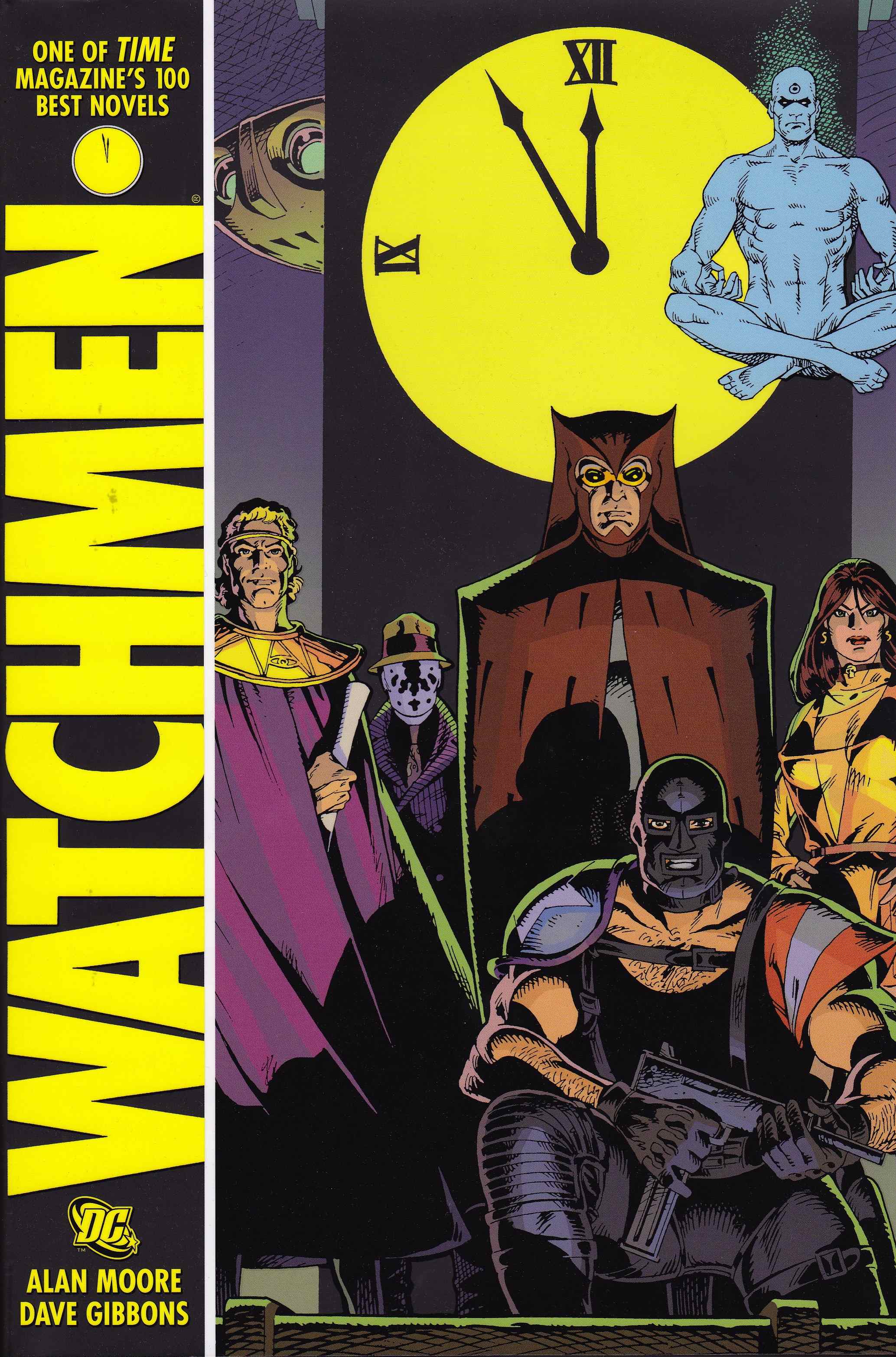
alan-moore-watchmenAll of these values serve the story and messages of this creation made up of words and pictures, which uses the narrator’s understanding and interpretation of the themes of the groundbreaking graphic novel Watchmen by writer Alan Moore and artist Dave Gibbons as they shift and mature over his lifetime to express powerfully the moral dilemmas he sees in the world around him.  It is not a ridiculous leap to see it as a discussion of the current conflict between Israelis and Palestinians, particularly when one considers the context of The Realist blog which has dealt with related issues in a number of its preceding entries – while through its lack of specifically referring to these events it also calls to mind similarly thorny dilemmas in history and the contemporary world.  This example features a topic that is challenging for any educator to address because of its highly emotional and incendiary subject matter, but it points to the value of precise use of visual communication and the demonstrative impact of image-based media, whether through the sequential art of graphic novels or sequences of shots that make up moving images.

Read Full Post »

Dead-poets-society-robin-williams-32089561-500-336This week’s incredible journey of virtual mourning for millions over the tragic death of Robin Williams (and personal, private mourning for his family and friends) has been quite powerful in its breadth and is anchored by this still recent ability to share media – like going down the cellar to take out the boxes of home movies and prepare them for family reminiscing – so quickly, so widely, and so interactively by both professionals and the general public.

One of the movies selected for study with Moving Images is Dead Poets Society, and a picture of Robin Williams as Charles Keating is featured on page 296 in a discussion of casting in the production process.  Interestingly, the first time I personally used the film in a media literacy course – because it is generally used in a sophomore English class at my school – was this past spring.  I had not seen it in a while, and I was struck in particular by Robin Williams’s performance, along with the entire cast.  If one is looking for lessons in directing of actors in a film from the past few decades, the work that Peter Weir did in this movie was extraordinary.  I have found that people tend to focus on the “antics” of Robin Williams’s performance in this role, but if that is the case, they aren’t looking very closely or with an open critical eye.  While general perception of this role has tended to focus on his behavior as a “teacher on stage,” Williams is able to convey the care that his character takes in trying to understand his students and pay attention to them as appropriate to the context of a private academy of the 1950’s.  His is a supporting role – and another great lesson for students learning from this film is to investigate and discuss the core dramatic issues of the screenplay: who is the main character?  when are the turning points of the story?  what are the objectives of all of the characters and where are the conflicts? –  and it is one that is quite subtle and honest; it is often best in the quiet moments, even ones without words.  This is not often enough said of Robin Williams performances, but I find it true here.  I highly recommend giving this movie a fresh viewing and doing it with an open critical mind; the poetry is in more than the book Williams is holding in this picture.

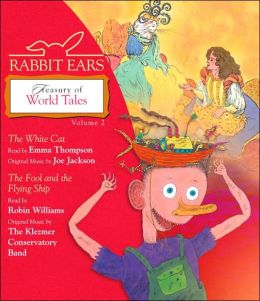
fool and flying shipOn the solely verbal side, I would like to recommend another Robin Williams performance that is not among his most famous: his narration of The Fool and the Flying Shipa children’s story for Rabbit Ears Records back in the 1980’s.  All of his voice gifts are there, along with the one-liners, the accents, the infectious energy, but as opposed to the ping-ponging, zipping here and there qualities of his stand-up work, here he is grounded by story.  And since he is narrating, the voices of individual characters have time to stay with us, come back into view, and form a distinct presence in the life of a narrative, which is a bit different than the quick blips of caricature that he would use in comedy performances, talk shows, and similar work.  He also narrated Pecos Bill, which is more well-known and is excellent as well in different ways, but I would encourage anyone interested to seek out the brilliant creation The Fool and the Flying Ship.  I must add a personal note that was rather unbelievable to my family and I: we listened to this story precisely four days ago.  This past Monday morning, the day of Robin Williams’s death, we had to drive to Boston for a medical appointment for two of our children.  On a whim, I grabbed a CD that we hadn’t listened to in many years, The Fool and the Flying Ship.  It was the first thing we listened to during our drive, and I remarked to my wife, “I think this is one of the best things Robin Williams has ever done.  It really brings together so many of his best qualities and he is just so on here.  It’s right up there with his most distinctive, natural performances.”  We just couldn’t believe it when we got the news that evening when we arrived home, which is clearly still the case across the globe.

As one final comment, in discussions of Williams’s work this week, I have not heard mention of Moscow on the Hudson, directed by Paul Mazursky.  It was his most acclaimed performance of his early feature film work and one that appeared to be very important to him.  It should certainly be listed among the defining titles of his filmography along with some of the later more famous, and perhaps not as distinctive, performances.

Read Full Post »

A few days ago, my daughter, who just finished 5th grade, called me over to the computer to show me “something neat.”  “Look at this animal, isn’t it amazing?  I hope they can save it,” she said.  I scratched my head at the pictures and descriptions of the tree octopus on this sharp, very official and scientific looking site, and responded to her, “Ummm, Lucie, who made this site?  It looks pretty cool and all, but I’m not so sure about this.  I think we should check on this.”

“Oh, yeah, I know,” she answered with a smile.  “Mrs. P showed us all about this stuff and how you need to really check on sources you find, like these other three…”  She was testing me.  Very deadpan, very funny.  Good job, elementary school teachers and kids!  I should add that I am looking forward to sharing this post with my daughter (and sons too) because she used my mediateacher.net site this year for a research project she did on stop-motion animation, which led to me sharing a number of books, other resources, and my input with her.

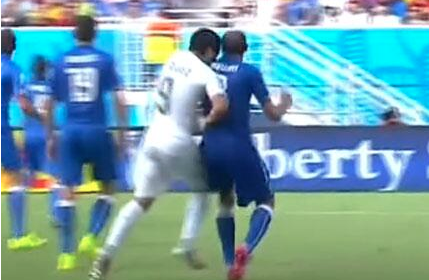
World Cup 1So as we review our previous school year’s work and look to the next cycle, it is imperative to look back at media literacy developments that might inform our ongoing work in the classroom and beyond.  Right now, the enormous media event known as the World Cup is going on, and what we quickly interpret as “reality” is often the one that is selected by the camera angles and lenses chosen for us.  Did we really see that?  Who was editing?  Did they cut out part of the whole story?  What might seem like a clear witnessing of an event could just be part of the story, and a distorted one at that.  Or not.

Twerk gone badFrom this past year, there was a media story that should enter right into any educator’s playbook: the viral event generated by the “twerking gone bad” clip with a woman in her room who falls over and catches fire.  As it turns out, this YouTube phenomenon was orchestrated by Jimmy Kimmel with a professional stunt woman (Daphne Avalon, using a pseudonym in the video) for his late-night show.  The piece from Jimmy Kimmel Live is really quite exceptional and can be used quite well in investigating authenticity and other issues associated with moving images and their role in society today.   In particular, the degree to which television shows reported the phenomenon as real, as shown in the clip from the show.

Read Full Post »

logoToday, the The National Coalition for Core Arts Standards, in partnership with Americans for the Arts, released a set of national standards for the arts, including Media Arts.  Here is a link to pages that provides documents and resources for these standards.  In reviewing these standards, it is clear that they are well aligned with national media literacy standards highlighted in the pages of this blog and that formulate the core principles of Moving Images and the coursework provided with this textbook.

Read Full Post »

Where Winter Olympics meet young filmmakers: snowboarding videos

Where Winter Olympics meet young filmmakers: snowboarding videos

Sochi 2014 is here!  There are so many topics to discuss, whether concerning cultural perspectives, world languages, geography, human rights and equality, world history and international relations, and, of course, sports, among many other angles.  For media literacy perspectives on the Games, I am posting right here a new lesson activity that works with Chapter 5 of Moving Images: Critical Notebook 5b.  This exercise encourages students to apply principles of media literacy to the images that they see as they watch the Olympics – from the personal interest pieces to direct sports coverage to commercials to power outages.

Image: 2014 Winter Olympic Games - Opening CeremonyAs we discuss or write about how we “experience” these Winter Olympics (or any similar event) from afar, it is particularly useful to raise questions about concepts that are at the core of the Olympics themselves: how does one interpret these events differently in another country or through contrasting media sources and visual traditions?  Students should be encouraged to seek out media from across the globe in relation to coverage of specific sporting events or ceremonies, sports figures, and commercial interests.  It can be highly enlightening to discover new perspectives on familiar institutions, events, or phenomena.  Including commercials.

I also recommend the continuously evolving video resources of the New York Times, which include a piece on snowboarder Mark McMorris that might be a big hit with high schoolers.

HedgehogOwlP.S.: I have to add that, on a personal note, whenever I watch an Olympics opening ceremony in the USA (and I have seen them from the vantage point of other countries, where the coverage is so very different), I am reminded of the lines from the Grim Reaper in Monty Python’s The Meaning of Life: “Shut up… You always talk, you Americans. You talk and you talk and say ‘let me tell you something’ and ‘I just wanna say this’.”  Couldn’t we ever just watch the actual ceremony in America with its actual soundtrack?  Do the commentators really need to be blabbing on about whatever comes into their heads while these amazing images from out of Tarkovsky and Hedgehog in the Fog are gorgeously floating by on the screen?  It’s really maddening at times.

Read Full Post »

« Newer Posts - Older Posts »