This fall, I was overjoyed to see the news that Frank Borzage’s 1932 film A Farewell to Arms would be released by Kino in a full, restored version on DVD and BluRay. For me, this release holds special significance because it was during an amazing run of movies shown at the Wadsworth Atheneum in the 1980’s that I discovered the films of Borzage — relatively forgotten to the moviegoing public at that time, even cinephiles — along with so many other classics in programs curated by University of Connecticut lecturer Robert Smith. Below is a excerpt of the program — Smith’s preface is a perfect introduction to the story of this version of A Farewell to Arms in the context of film preservation. 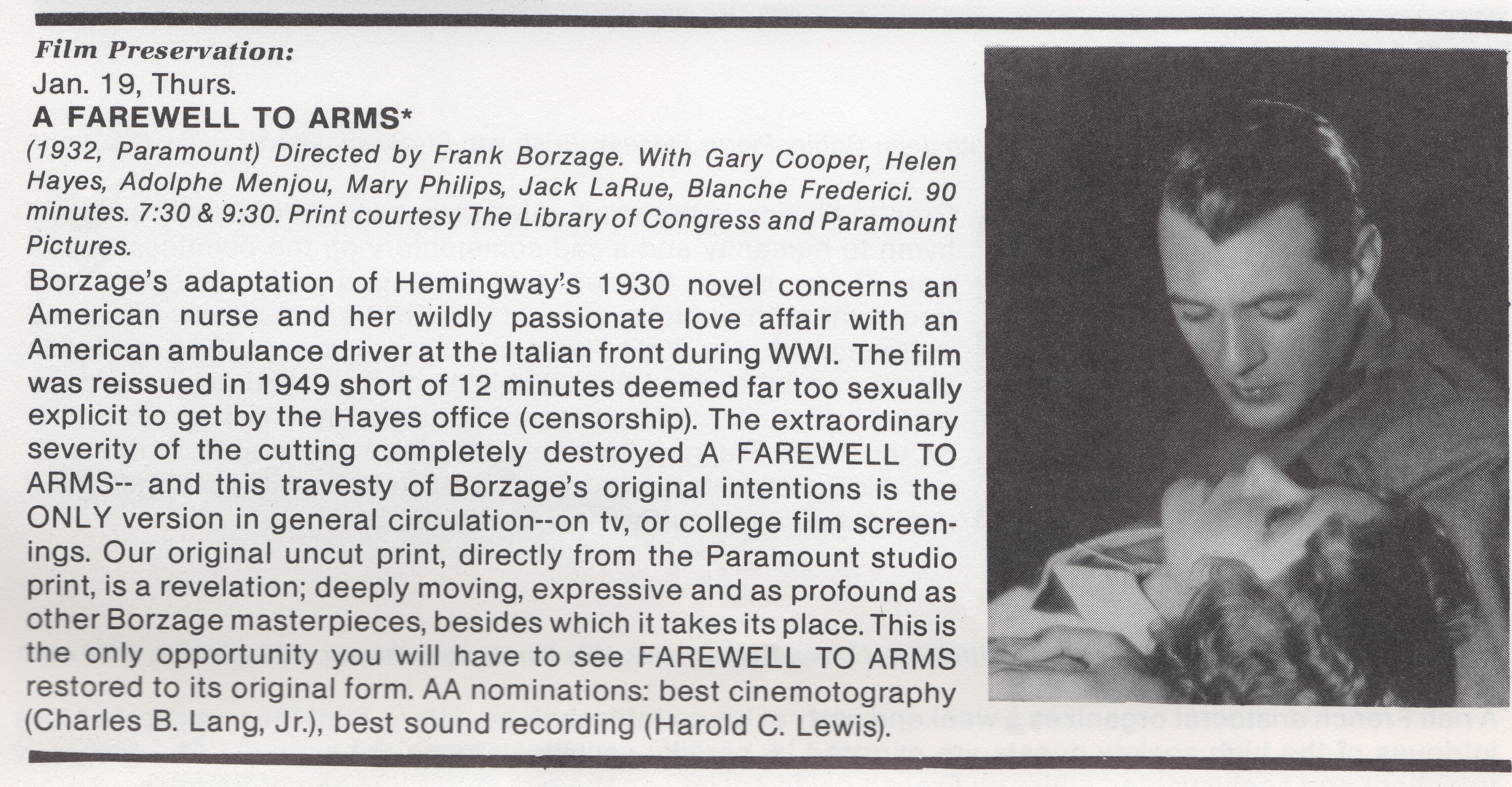 Borzage films are highlighted in figures 4-21 and 4-22 of Moving Images (“Storytelling with Light”) and I use A Farewell to Arms as an example in Chapter 5: Personal Expression and Studio Production. Frank Borzage was a member of a large, close-knit Italian immigrant family and his films show consistent dedication to the ties that bind couples together and to roots in family and place. He began working in Hollywood as an actor and throughout his directorial career actors lauded his passionate support of their craft and his attention to their interaction. Borzage was one of the most highly regarded directors of early Hollywood, and his works offer some of the richest examples of visual storytelling in the period of transition from late silent films to early sound. While Borzage is certainly known for the deep romanticism of his films, I have found that the weaving of his tales of passionate love through finely detailed places and amidst contexts of everyday life and economic or familial struggles gives his stories more depth and grounding than they are generally given credit for. In the 1990’s, the discovery and subsequent release of the silent film Lucky Star was a particular revelation (currently available in the beautiful box set Murnau, Borzage, and Fox); I was fortunate enough to see it at the Film Forum with live music and an enthusiastic audience. Among Borzage’s sound films, I would highly recommend his movies Three Comrades, The Mortal Storm, and Moonrise, and Joe McElheney’s article on Borzage is the finest recent scholarship on the director I have read. Or perhaps some time before or after going to see the new 3-D release of Titanic, it would be a revelation to see Borzage’s History is Made at Night from 1937 — now that’s a movie about the Titanic that really gets the heart stirred!
  Here are the program notes from 1984, written by Robert Smith, for a double bill with Little Man, What Now? : “History is Made at Night is the Borzage film for everyone, with enough material for three ordinary movies. Jean Arthur is absolutely radiant, transfigured by Borzage’s genius and his commitment to a redemptive vision of the world. Mad love, insane jealousy, murder, and a giant ocean liner racing through the ice-bound darkness provide the mortal trial through which Jean and Charles (like all great Borzagian protagonists) demonstrate their spiritual and moral greatness. Soon after their first meeting, Jean Arthur and Charles Boyer dance the Tango of the Roses in a deserted Parisian nightclub. Arthur is dressed in a lace nightgown, and the image of Arthur’s exquisite naked feet peeking out from that swirling lace nighty as they tango in the darkness will haunt you the rest of your days – now that’s romance!” … okay, does this sound familiar to anyone? James Cameron, eat your heart out!
Posted in Chapter 4, Chapter 5, Directors | Tagged A Farewell to Arms, Charles Boyer, Film Forum, Film Foundation, Frank Borzage, James Cameron, Jean Arthur, Joe McElhaney, Titanic 3D, University of Connecticut, Wadsworth Atheneum | 2 Comments »

Nash Edgerton with camera operator Sebastian Dickens shooting “Lucky”
The interview for Chapter 8, The Production Process, is with a filmmaker who has been involved in an amazing range of capacities of media processes: as a writer, actor, director, editor, and in the role that originally started his career, stunt artist. Nash Edgerton has also played a key role in one of the most interesting stories in movie production of the past decade or so, which has been the emergence of the group of filmmakers who work through the partnership Blue-Tongue Films. This collective of young Australian filmmakers has sustained a very interesting working relationship to produce work that clearly revolves around the stories, styles, and objectives that interest and inspire them personally and as a group. Among the highlights of Nash Edgerton’s prolific career are the shorts Spider and Fuel, and his feature The Square; he has worked on the stunts of dozens of movies and served as stunt coordinator on the upcoming Wish You Were Here. In addition, his shorts Lucky and The Pitch are featured on the DVD with Moving Images. His next short, Bear – which is a follow-up to Spider – premiered in competition at the 64th Cannes International Film Festival. As a couple of final notes, one neat aspect of connecting with Nash as a contributor to this textbook is that I have used one of the original Blue-Tongue collaborations, Bloodlock, in my media studies and production classes for many years, and this short provides many enlightening lessons on the roots of Blue-Tongue films, their stylistic approaches, and the dynamics of their collaborative. Finally, it was such a pleasure to be able to work with Nash: he was very generous with his time, materials, and attention, and so keen on sharing his respect for his collaborators and his love for his craft.
Did you have any early inspirations to use moving images to communicate?
I watched a lot of films when I was a kid. Seeing something that totally affects you, like horror films – I think what surprises me now, working on films, knowing what goes into it, the make-believe, is that I still get affected by films when I see them and that’s what’s really powerful about them.
From the beginning of your career, you have worked as a stunt specialist. How did you develop expertise in that type of work?
I kind of got into it and learned it in an old-fashioned approach, learning from people that had done it before. I would get the concept by helping out, and then get training by working with different people. I think one of the most important aspects of it is being adaptable because there are things that are always changing and things don’t always go to plan or you’re working against time or weather or various other things. As you work, you can get better at finding solutions. Having learned to be adaptable, as director you can get better ideas on that day when you’re in actual situations. I think that’s what helped me most in preparing to be a director.

Nash Edgerton performing a stunt for “Lucky” featured as the short for Chapter 4 of Moving Images
Your background as a filmmaker is rather unique, having moved to the director’s chair from starting as a stunt specialist and actor. How did your work as a director unfold as your career evolved? Describe your initial experiences overseeing an entire production.
By the time I started directing I had been on a lot of film sets, so just by being on film sets I feel natural and comfortable being around a crew. It’s quite daunting running the show, so the fact that I was comfortable really helped. I think it’s always kind of scary trying to get your head around how to tell the story. You have to make sure you can do as much homework as you can so you have an idea of how you’re going to approach the day of filming with fresh ideas. Filmmaking is such a collaborative process. You try to hire the right people to be around you because they’re going to bring something to it. The combination of you all is going to help you get the best of your day. What I like about filmmaking in general is that it does take more than just one person to do it. It’s working as a team made of different people who all have different skills. It’s a combination of these contributions that creates what it becomes.
What were some useful lessons you learned through your first moviemaking experiences?
The best thing I learned is to be open to accidents, to things going wrong or not your way. Instead of resisting it, maybe it’s meant to be that way. If you’re open to things that change or don’t go your way, maybe you’ll find a better idea. Rather than just being disappointed because it’s raining or because you can’t have this tool or something is broken, there is always a solution. It’s good to have a plan, but ideas are always evolving and part of it is always out of your control. Embrace the chaos!
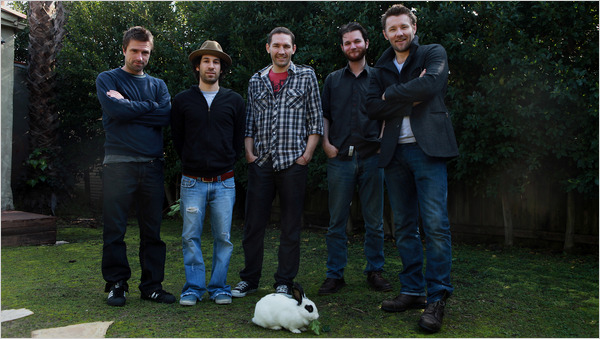
David Michôd, Spencer Susser, Nash Edgerton, Luke Doolan and Joel Edgerton of Blue-Tongue Films
You have worked with a team of filmmakers throughout your career, and you have helped to run Blue-Tongue Films, an independent production unit. How have your collaborative relationships been fruitful to you throughout your career?
Yes, there’s a bunch of guys that I work with, what’s great is that we all work on each other’s films, in different aspects. I’m not always directing, like at the moment I’m editing, or I do stunts on them. Luke (Doolan), who edits a lot with me, he sometimes shoots on my stuff, he’s also been directing. What’s great is you learn from each other, and we have a good shorthand with each other that makes it easier. They have a good way of challenging you and asking why you want to do something a certain way. It’s kind of like a healthy competition. It helps you to be the best that you can be and next time you want to do something even better than that. Then they make something better, and it makes you want to do something better. I like working with my friends.
On some of your films, you have served as writer as well as director. How have you experienced the process of seeing a project move from inception to release? What lessons have you learned from that process?
I find writing hard, to put it quite bluntly. Ultimately, making something you’ve written tends to be more satisfying. Going from what’s inside your head, sharing it with other people, going through the whole process, I like that a lot. For example, Spider was my idea. I’ll explain my ideas to one of my friends or my brother, because I know I will like their writing of it better. So Spider was my idea and it took David (Michôd) to actually write it out and flesh it out a bit. I like to see someone else’s take on the idea.
When you have directed from screenplays by writers other than yourself, what input or developmental contributions have you made to them? Have you found that scripts evolve significantly during production or post-production?
For example, for films I have made with my brother what will usually happen when I read it during the process and the different drafts is that I will be thinking about it as a director. If I can see it when I’m reading it, then I know how to make it. If I can’t see it, for a particular scene, if I can’t visualize it then I fear there’s something that’s not working for me in it so that’s how I talk about it with the writers. Rather than telling them how to do the scene I’ll say there’s something about the scene that doesn’t work. I know it’s not right because I can’t visualize it. By the same token, I’ll say what scenes I like – it’s as simple as that. If I can’t see it, there must be another way of doing it or it doesn’t need to be there. I’d rather say it at that point than try to shoot it without any idea on how to.
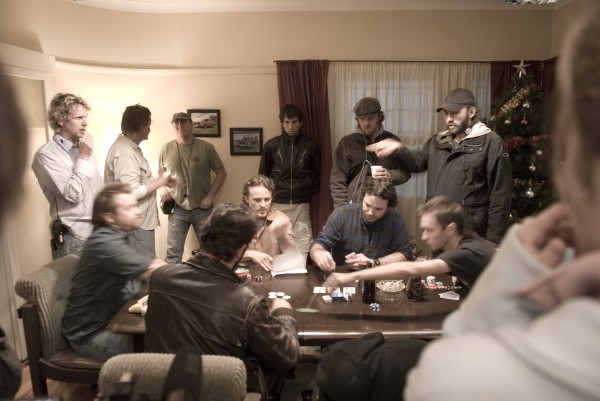
Nash Edgerton at right directing The Square
What have been some of the greatest challenges you have faced in filmmaking?
Usually on any kind of shoot day you get challenges, where you’re trying to get everything you need to shoot in that one day. A lot of the time, I find that the start of the day is rather slow and the second half of the day you’re chasing your tail to get things done. The challenge all the time is, if you have a plan like “the way I want to cover this scene is in five shots,” you have to be ready for complications. There was a day we were shooting The Square in a small apartment, and we had gotten really far behind. We were trying to get this scene, and my plan was to get five or six shots, and with the amount of time I had left, I was forced to try and cover the scene in one shot. I think sometimes the pressure can help, and the way we ended up shooting it was way better than anything I had come up with before. Because I was forced to do it in that shorter space of time, I got something better than I would have if I had all the time I wanted. It’s funny because the pressure or the challenges you may face make you step up to it, or I’ve shot stuff where you try and figure out the best way to do it, and then you get home after the shoot day and then you figure it out. Naturally, it can be pretty depressing because it’s too late, and you figured out how to solve it when what you should be doing is planning the next day. Filmmaking is always ups and downs, but I find that there’s always at least one good thing that happens in a day, and it’s enough to keep you going. Something good happened or something worked out how you planned it. You try to savor that when other things don’t work out.
What have been among your most fulfilling experiences in moviemaking?
The most fulfilling part for me is when you screen the film for the first time in front of an audience and it works. The actual process of shooting is always challenging and exhausting – and rewarding. When you’ve written something, you’re thinking about it, you’re planning it, you’re shooting it, you start to forget the freshness and enjoyment of when you first write or read something. When you’re making it, you start to lose sight of what it was, and it’s not until you see it with an audience for the first time that you’re reminded of how you felt when you first read something. You get to see it through other people’s eyes and through their reactions. A lot of times, the hardest thing is to complete something you start, and if you do go full circle that’s when you get the reward. If it doesn’t happen, you get to learn what works and what doesn’t.
With storytelling and filmmaking, I always try and make stuff that I want to make. I try not to make something just because I think other people are going to like it. I try to trust in the fact that if I like it, there are enough people in the world that someone else might like it too. Rather than trying to second-guess what you think, you try to create movies for yourself and put yourself in the audience. Hopefully you’re not that weird and someone else will like it too.
Posted in Chapter 8, Close-Ups, Directors | Tagged Animal Kingdom, Bear, Blue-Tongue Films, David MIchôd, Joel Edgerton, Kieran Darcy-Smith, Luke Doolan, Nash Edgerton, Spencer Susser, The Square, Wish You Were Here | Leave a Comment »

Deborah Hoffmann, center, receiving a Silver Baton award at Columbia University (Charlie Rose at right)
For Chapter 6 of Moving Images — titled Recording and Presenting Reality — the Close-Up interview features insights from Deborah Hoffmann into the work involved in documentary filmmaking and the editing process. Hoffmann has been working for the past few decades as a documentary editor and director, and her work includes the award-winning movies The Times of Harvey Milk, Complaints of a Dutiful Daughter, and A Long Night’s Journey into Day.
Did you have any early inspirations to use moving images to communicate?
When I was in college, I got very involved in still photography, and the one connecting thing – other than liking working with images – was that I got very involved with putting on exhibits, and I really liked thinking through the order of the images, so that viewers can have a specific type of experience going to the event. That was the beginning for me. It took a while for me to get from there to being involved in making documentaries, but I think that was where it began.
Describe the path you took to become an editor. Did you initially plan on working as an editor? Did you specifically choose to work in the documentary field?
Things were not that well thought out for me. A lot of my career was a bit of fumbling around in a series of accidents for me to end up where I ended up. I did sort of fall in with a crowd of documentary filmmakers and because of my background as a still photographer, I initially was going towards being a cinematographer. It just so happened that I developed a back problem, and I couldn’t deal with the equipment, so I shifted over to looking into editing, not realizing that sitting all day isn’t really that much better for your back. Nonetheless, I found myself moving towards editing, and it was a really fortuitous change, because I love editing and am very well attuned to it. So, slightly accidental, but I think it was meant to be.
During this shift to editing, what were your initial steps professionally?
Because this was the 1970s, there’s a way in which my personal story doesn’t really translate to today. These days, I teach documentary editing at the graduate school level at UC Berkeley’s school of journalism. I never went to [film] school, I never studied documentary filmmaking, and I was able to find my way to make a career out of it. I think that’s a lot harder today. So, my path, I really don’t think, is what kids coming along today can do. I began by volunteering as an assistant editor on a documentary in the mid-70s, and I got very lucky because very shortly thereafter I began volunteering on Dark Circle, a documentary about the anti-nuclear movement directed by Judy Irving. They got funding very quickly after I began, and there I was, I had a job. I worked as an assistant editor – and, again, this is dated stuff, because I was editing on film and I was doing a job that virtually no longer even exists. I went from assistant editor to sound editor, and I was very determined and very devoted, and I was able to start making deals, “I’ll be assistant editor if you let me edit a scene.” That happened on one project, then on the next project I edited enough scenes to be associate editor, and then I was off and running and editing film.
When you first started editing films for other directors, was there anything that surprised you about the process? Any lessons that you learned from your early efforts?
It’s a very delicate relationship. I remember very early on, when I was an assistant working with an editor, he said to me, “You know, the relationship between the editor and the director is more difficult than a marriage.” And I’ve always remembered that, and there’s a lot of truth, not that it needs to be difficult, but it is a very complicated relationship, and of course when I became a director, now I’ve seen it from both sides. Directors are handing over their baby, and that’s their point of view. And the editor feels like, “I can really see what’s working and what’s not, and the director is too close to the material.” So there’s that tension, and I think that this tension can be really helpful in film. And when I teach the students that I teach, and they’re editing their own films, and I always tell them, “You are doing the most difficult thing possible.” You go out, you round up the subjects, stand in the snow and rain to film them and go through all that, you become convinced you’ve got a masterpiece and every frame is wonderful. And the person who didn’t do any of that and they’re just seeing what ended up in the footage – and not what the entire surrounding experience was – which can allow them to see more clearly. So when you’re editing your own material, you have a unique challenge compared to when you’re editing someone else’s material.
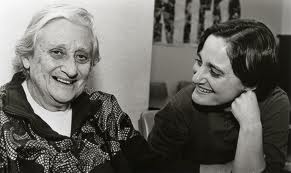
Filmmaker Deborah Hoffmann with her mother, Doris
You have also directed documentaries. What inspired you to do this? Was your previous work as an editor helpful to your role as a director?
Well, if I ruled the world, or at least the world of documentary film, I would make every director be an editor first, because I do think that you learn so much about what makes a scene and what tells a story by actually having to do it in the editing room. So I felt it was really, really helpful that I had been editing before I was directing. The first thing I directed was a personal film I made about my mother and Alzheimer’s, and that was almost not a decision, it was just an overriding need that I had to make that film. So I did. And then I thought, this is kind of fun, you get to make all the final decisions. There was something very appealing about that, and so I thought of dividing my time between editing other people’s projects and directing.
As a documentary editor, what distinctive challenges do you face in contrast to editors of fiction motion pictures?
Let me just say that I’ve never edited fiction features, so what I’m saying you can take with a grain of salt, but I think that a documentary editor has a much more thrilling job than a fiction editor because you really find a make the story in the editing room. You do wonderful things as a fiction editor too, but you’re not sort of writing the story, and I feel that you really are doing that as a documentary editor. It’s a wonderful thing, and you really can discover unexpected things in the editing room.
Could you comment on the process of editing documentary films and some of the ways in which you have experienced a particular project?
Unless I was doing something historic that was mostly archival – and even then there would be current interviews – it was not a long time after the shooting process, and in fact, it was usually while the shooting process was still happening that I would be brought on. So, I could start editing, we could see where the weaknesses were, and we could see what filming still had to happen. I think that absolutely works the best. I think this is also smart financially, for directors not just to film everything and see if they’ve got it later, assuming it’s not something where they’re halfway around the world and it’s a one-time thing. But if the project is one in which you can go back and fill in the holes.

Long Night’s Journey Into Day, Produced for HBO Documentaries
Documentary filmmakers seek funding from a variety of sources, including institutional grants and foundations. Taking one movie as an example, how have you sought support for your projects?
The biggest project we had to fundraise for was the film we did about South Africa’s Truth and Reconciliation Commission called Long Night’s Journey into Day. I made that with my partner Frances Reid, we started that in 1997 and it was 90 percent funded by foundations and the remainder funded by individual donations. We sold it to HBO and that’s how we got our finishing funds. But 1997 was a very different time economically than now, it was sort of a peak. Here we were making a film about reconciliation, which was a hot topic then. Fundraising is never easy, but that was one of the easier experiences I know about. In fact, there was one foundation that responded to our request and said, “Actually, we want to give you more.” We were very fortunate, and I think right now it’s very tough for documentary films. But right now, documentarians can be a one-man-band. A lot of my students, they go all over the world, they take one crew person with them, and they do everything incredibly cheaply, and then they edit it at home with Final Cut Pro. The expenses have come down in a lot of ways, but it’s still tough in a lot of ways.
What has been your experience of the collaborative nature of the filmmaking process? Are there particular relationships that have been fruitful to you in your career?
It is extraordinarily collaborative. I’ve been very, very lucky in that all of my collaborative experiences have been quite wonderful, in fact they are some of the most wonderful experiences in my life. For instance, from the first major film that I was the editor of, The Times of Harvey Milk, the people I worked with on that have been best friends ever since then. I’ve formed many long-lasting relationships, and I love that give-and-take collaborative.
What have been some of the greatest challenges you have faced during your filmmaking endeavors?
Most of them are economics. If you’re doing your own projects, the constant search for money can really beat you down. If you’re working for other people and you want to be working independently as I always did – that you don’t want to be working for a TV station or the news – then you are constantly looking for work. You can feel very insecure a lot of the time. It’s grueling work, but it’s thrilling work, so until you get burned out, your problem will not be that you’re unhappy at your work.
What have been among your most fulfilling experiences in moviemaking?
One thing I feel that I haven’t said is that sometimes I feel that there’s a selfish, cheating thing being a documentary filmmaker, because it was a way to go places and meet people that you would otherwise have no way of experiencing. You have the excuse of making this film, and you meet the most fantastic people in the world.
Posted in Chapter 6, Close-Ups, Women Mediamakers | Tagged Alzheimer's Documentary, Deborah Hoffmann, Documentary Editor, Frances Reid, Harvey Milk, HBO Documentaries, Judy Irving, Long Night's Journey Into Day, Women Make Movies | 1 Comment »

Henry Mancini conducting a studio orchestra
During the production of Moving Images, one of the many pleasant experiences I had was through my dealings with the Henry Mancini Estate. They were extremely helpful and generous with their support of our educational mission, and two images from their archives ended up in the book (figs. 3-14 & 3-15 in Chapter 3: Sound and Image). This is quite apt because Henry Mancini’s legacy is one of the most inspiring examples of boundless creativity, exceptional attention to one’s craft and medium, and deep generosity towards one’s collaborators and peers. Looking for insights and inspiration? I highly recommend a visit to the Henry Mancini website established by the Mancini Estate (which has experienced an interesting evolution over the years; they have clearly worked hard to make the site exceptional).
The video archive of material represented here is particularly rich (click on “Video Clips” from its main page). The discussions of the creative process by Jack Lemmon and Mancini himself are quite interesting and inspiring; the explanations by Mancini, sitting at the piano, of the origins of his most well-known melodies should be treasured by anyone who appreciates the creative process and composing. Any of them can be very useful for classroom use; for a film class, the video on the far right, “Thoughts on the Creative Process,” also features clips from a Blake Edwards film in production and the most in-depth insights on the particulars of composing for the screen.
For educators, there is one clip that is of great value. At the top of the left hand column is “On Music Education,” which is a jaw-droppingly appropriate discussion of the priorities of education in the United States and the profound values of arts education. I’m guessing that this video is from the 80’s, but its message could have been recorded yesterday. Check it out.
These materials center on Mancini’s gifts as a melodicist, but I would like to add that his talents as an arranger and sound innovator are too often neglected. He explored the possibilities of the studio orchestra like few other movie composers in history, and his use of the range of tones, colors, and quirks of the widest possible scope of instruments gives such richness to his scores. Whether writing for French Horns, mallet percussion, the full families of clarinets or flutes, or Plas Johnson’s sax, he explored their capacities and articulated a boundless range of emotions and expressions of life’s rhythms, movements, and mysteries. While he is most famous as a composer of “light” music, he could write in any vein. He could compose dark, eerie material right alongside specialists in that genre, and there has never been a better scorer of comedies.
When pianist and composer Roy Budd had a sudden opportunity to make a break into the movie scoring business at the age of 23 in 1970, the already successful jazz musician knew that the only way he could fake it was to buy Henry Mancini’s book, “Sounds and Scores,” and learn from the master. Budd got the job and went on to compose some of the greatest scores of the 70’s. He was right in looking to Mancini for guidance. As I indicate in Chapter 3 of Moving Images, the partnership of Henry Mancini and Blake Edwards is one of the most successful collaborative partnerships in motion picture arts history, and a study of how their talents merged so dynamically is very enlightening. (Here is a particularly moving story about Henry Mancini’s last days by Blake Edwards.)
Posted in Chapter 3, Music & Sound Design | Tagged Blake Edwards, Henry Mancini, Jack Lemmon, Julie Andrews, Moon River, Music Education, Wait Until Dark | 3 Comments »

Cliff Martinez playing the Baschet crystal
It was very exciting news to hear that Cliff Martinez would be collaborating again with Steven Soderbergh for the score of Contagion. Martinez is having a very busy season with the additional release of Nicholas Winding Refn‘s Drive. Here is one recent interview with Martinez, whose biography and approach are quite unique; two of his finest scores are both for Soderbergh films: the haunting score for Solaris and the Oscar winning Traffic.
I have to add that one of my dream projects for a film restoration would be for Steven Soderbergh to recut and remaster his film King of the Hill. This movie from 1993 features superb performances by Jesse Bradford and the rest of the cast, striking cinematography by Elliot Davis (whose trio of films with Soderbergh are all visually stunning, the other two being The Underneath and Out of Sight), and pitch-perfect direction by Soderbergh; it is a sorely under-appreciated movie. Along with the recut, Cliff Martinez can rerecord some of this score with acoustic ensembles — like the woodwind parts, which are particularly rich — and the resulting version of King of the Hill could be a true revelation. Ah, dreams…
Update 2014: Here is another interview with Cliff Martinez. And King of the Hill did get released on Criterion after all, along with The Underneath!
Update 2015: Thankfully, the Martinez-Soderbergh collaboration has continued with the HBO TV series The Knick, starring Clive Owen. Here is an excellent June 2015 interview with Cliff Martinez in which he discusses his ongoing collaborations with Soderbergh and Refn as well as the challenges facing contemporary composers— summed up in a particularly amusing description of submitting scores to advertising clients.
Update 2016: On his website, you can access a Cliff Martinez Composing Masterclass with BAFTA. Listen to it through Soundcloud!
Update 2019: Really neat video with Cliff Martinez in Rotterdam!
Posted in Chapter 3, Music & Sound Design | Tagged Cliff Martinez, Contagion, Elliot Davis, Jesse Bradford, King of the Hill, Nicholas Winding Refn, Solaris, Steven Soderbergh, The Knick | 3 Comments »
 mediateacherdotnet