Feeds:
Posts
Comments
President Obama being sworn in for second term with wife Michelle Obama holding bibles of Lincoln and King

President Obama being sworn in for second term with wife Michelle Obama holding Bibles of Lincoln and King

Today President Barack Obama was inaugurated for a second term, and many people around the world experienced this event through a wide range of images.  As always, there are many angles to consider.  Have you ever switched between different channels covering the same occasion to see how different each can look, even when they are showing almost the same exact image?  Even without changing the source, note how colors, skin tones, and effects of light can change when cutting from a wide shot to a close-up.  It certainly helps to understand cinematography to comprehend how the choices made during production affect what we see and how we interpret it.  Now, the images that record this ceremony are available to be seen immediately on the Internet, and the different aspects of the event are instantly being further scrutinized, dissected, and evaluated, from President Obama’s speech to Richard Blanco’s poem to Beyoncé’s rousing rendition of the national anthem to Michelle Obama’s new hairstyle.

Here are some links that are interesting to check out: first, an ABC interview with poet Richard Blanco.  The interview should also be looked at by scrutinizing the total content of the image: that in addition to the interview with Blanco we are looking at a screen made up of many things going on at once.  Why?  How does that affect our understanding of the information, our processing of the visuals, and its aesthetic impact?  Of course, there is also Beyoncé singing the national anthem.  Finally, considering one of the key moments of President Obama’s speech when he made reference to the legacy of Dr. Martin Luther King, Jr. on his holiday, here is a link to Dr. Martin Luther King. Jr.’s August 28, 1963 “I Have a Dream” speech in Washington.
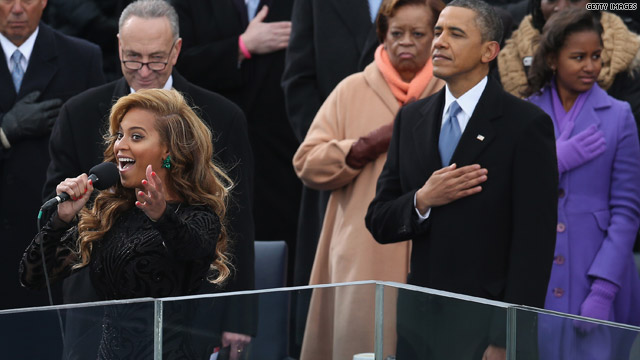
beyonce.inaugurationPostscript: Okay, so the Marines spilt the beans: Beyoncé was lip-syncing.  Good old pitch adjusters.  So does anyone else want any more “Wizard of Oz” moments here or lessons in “what you think you see is not necessarily what you get?”

Sinking into Sound

The Conversation: Sound Design Walter Murch

The Conversation: Sound Design Walter Murch

Do you want to know more about the basics of sound in contemporary moviemaking?  Here is an excellent talk titled 40 Years of Sound for Film given by Chris Newman (production sound mixer on such movies as The Godfather and The Silence of the Lambs) and Tom Fleischman (re-recording mixer who received the Academy Award for his work on Martin Scorsese’s Hugo).  In the piece, they discuss classics such as The Godfather and McCabe and Mrs. Miller and explain their perspectives on what digital technology has brought to the world of sound.  It is an excellent introduction to the current state of sound and can serve as video accompaniment to Moving Images Chapter 3: Sound and Image.  

Among the movies suggested for analytical work in the Moving Images Instructor’s Resourcesa trio by the Coen Brothers is worth highlighting for investigation in the context of sound: Raising Arizona, O Brother Where Art Thou?, and True Grit.  

Sound Designer Skip Lievsay working with Avid MC Mix for True Grit

Sound Designer Skip Lievsay working with Avid MC Mix for True Grit

All three feature the work of renowned sound designer Skip Lievsay and are also rich examples of the distinctive brand of “American Tales” that are at the core of much of the Coen brothers work, in which they have continued to explore and develop deep traditions of regional storytelling featuring distinctive narrative voices and exploring complex themes at the heart of the frontier experience and American culture.  They also offer strong links with cross-curricular connections: the short stories of Mark Twain, Bret Harte, Ring Lardner and other darkly comic narrative masters compared and contrasted with Raising Arizona; Homer’s The Odyssey for O Brother, Where Art Thou? (or Preston Sturges’s Sullivan’s Travelsthe cinematic source of its title); and the original Portis novel for True Grit; meanwhile, social studies connections also abound in these movies, particularly for O Brother.  Depending on classroom context and objectives, other movies from the Coen Brothers’ filmography can be quite worthy of investigation, such as No Country for Old Men and Fargo, but these first three are more appropriate for use in a high school classroom (all are PG-13).  Here is an extra for teachers – a worksheet for use with Raising Arizona: Critical Notebook 3c Raising Arizona.    

Director Christopher Nolan with Leonardo DiCaprio and Ellen Page on Inception

Director Christopher Nolan with Leonardo DiCaprio and Ellen Page on Inception

Another recent award-winner with rich classroom applications is Christopher Nolan’s Inceptionwhose sound teams won the 2010 Oscars for Sound Mixing and Sound Editing.  For the first award, three people were there to receive Oscars: Lora Hirschberg, Gary Rizzo and Ed Novick.  Why three?  Lora Hirschberg is re-recording sound mixer for effects and music, Gary Rizzo is mixer for dialogue and foley effects, and Ed Novick is the production sound mixer.  For Inception’s second sound statuette, sound designer Richard King won for editing.   Here are interviews with Lora Hirschberg and Ed Novick, and this is a page with many articles for Gary Rizzo on the site Designing Sound; in addition, here are a print interview and a short video about sound design with Richard King.

Ben Burtt and director Andrew Stanton at the French premiere of Wall-E

Ben Burtt and director Andrew Stanton at the French premiere of Wall-E

Excellent resources for interviews, technical information (such as SFX libraries), and more are available at filmsound.org and designing sound.org.  Among pages about such respected sound designers like Gary Rydstrom and Randy Thom, there are useful articles for a movie that was featured in an earlier blog post on this site: Wall-E.

The sound design on that Pixar movie was overseen by one of the legends of Hollywood sound artistry, Ben Burtt.   Speaking of groundbreaking sound designers, there are also excellent posts by or about pioneer Walter Murch, including these on the Orson Welles classic Touch of Evil  and the importance of sound design for the overall tasks of movie editing.  Of course, sound design is vital to the widest possible range of media platforms, and here is an article on one of the specialists for video game sound design, Jeff Seamster.
President Obama addressing the nation about the Newtown shooting (AP/Carolyn Kaster)

President Obama addressing the nation about the Newtown shooting (AP/Carolyn Kaster)

As educators wrestle to deal in their classrooms with the issues presented by the profoundly tragic attack on Sandy Hook Elementary School in Newtown, Connecticut, it is important to focus on methods to evaluate emotionally potent media sources effectively.  At this point, it is clear that the media lessons to be gleaned from rapid, weakly substantiated early-developing news reports can provide solid lessons for teachers across the disciplines.  In this case, the quick dissemination of information led to a disturbing level of misinformation regarding this assault, and as educators decide on strategies to process and understand this tragedy, one possible area of learning and higher order thinking skills that can be addressed is the examination of news media in the hours and days that followed the attack.  One online source that can initiate classroom dialogue is CNN’s Students News, where they feature questions as part of their Daily Discussion page.

In the sensitive days, weeks, and months following any tragedy that affects school life, the most important resources for any educator are those that provide guidance for reasonable and compassionate dialogue with and between one’s students.  Among those that have been provided recently, I would suggest the following links: Talking to Children about ViolenceEmotional Reactions to Traumatic Events; and educational resources and lesson plans provided by the NCTE.

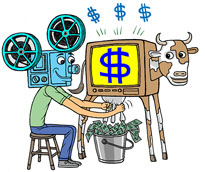
Hollywood EconomicsGetting down about financial prospects these days?  Times are tough all over, aren’t they?  Or at least for some.  Of course, if you believe Hollywood, they’re always struggling just to break even (yeah, sure).  Well, in the development of Media Literacy coursework, one of the richest veins of cross-collaborative planning is definitely with business courses, whether related to various fields of economics, finance, or career planning.

This recent article from the New York Times from a series on the use of tax breaks and financial incentives in the United States to spur business activity – titled “United States of Subsidies” – provides excellent examples for areas of inquiry in business and media literacy classrooms.  This particular story takes place in Pontiac, Michigan, where, as they way in the article, “happy endings do not usually come Hollywood-style.”

Real Art Ways, one of the primary independent venues for movies in Connecticut

Real Art Ways, one of the primary independent venues for movies in Connecticut

To provide another example, in Connecticut – the state in which I teach (and home of ESPN) – the business sectors of government have worked diligently to draw movie production to the state, as one can see in this site from the Department of Economic and Community Development and another page offering specific links for information and documents on tax breaks and incentives.  Wherever one is located, there are sure to be rich avenues of investigation for economics studies related to motion picture media.

Earlier, I put up a post on current prospects for movie production students, and things certainly have not changed much since then.  In addition, I also commented on topics for media and business classes related to independent cinemas (and also traditions of drive-in theaters).

These “Don’t Buy It!” pages from the PBS Kids site are designed for younger folks, but they’re pretty fun for anybody — and there are potential applications and ideas for high school teachers, some jumping off points here, including for cross-curricular work with health classes.  There are interactive questions and games for critical thinking about advertising, entertainment-related issues, and lots more, as well as excellent media literacy resources for teachers offered by PBS.   And in putting up this post, I just had to include this image from PBS’s media savvy creation “WordGirl,” featuring narration by Chris Parnell (of the classic “Lazy Sunday” digital shorts with Andy Samberg) and many other great voice talents.